
Bangladesh’s proposed national budget for the 2026-27 fiscal year introduces a record-breaking allocation of Tk 51,746 crore for climate change interventions, marking an increase of nearly 26 percent from the previous year (Hossain, 2026). This historic financial provision, which represents 11.03 percent of the combined budget across 25 relevant government ministries, signals a strong policy commitment from the new administration to address the nation’s intensifying environmental vulnerabilities (Khan, 2026a). Bangladesh currently endures an estimated annual economic loss of around $3 billion due to climate-induced disasters, equating to one to two percent of its gross domestic product (Khan, 2026b). However, while the fiscal strategy outlines highly ambitious targets for afforestation, renewable energy expansion, and coastal resilience, economists and climate experts warn that glaring implementation bottlenecks, structural misalignments, and a heavy reliance on domestic financing could severely undermine the country’s long-term adaptation goals (Shahrukh, 2026).
Despite the unprecedented domestic allocation, the proposed funds remain vastly inadequate when measured against Bangladesh’s mounting climate vulnerabilities. To successfully implement its current climate action plans, the nation requires an estimated $30 billion annually, yet actual climate-related finance flows currently stagnate at roughly $2 to $3 billion (Irfanullah, 2026; Khan, 2026b). Within the newly proposed budget, approximately 75.2 percent is earmarked for adaptation measures—such as flood control, coastal embankment protection, and climate-resilient agriculture—while 19.2 percent is dedicated to mitigation efforts (Hossain, 2026). Civil society leaders have criticized the total climate expenditure for constituting a mere 0.76 percent of the national GDP, arguing it must be elevated to at least 3 percent to properly safeguard vulnerable coastal and riverine communities (The Daily Star, 2026). The structural dependence on domestic public resources is a persistent concern, as international climate finance currently accounts for less than 20 percent of total flows, leaving Bangladesh to bear the severe financial brunt of a global crisis it scarcely contributed to (Khan, 2026b).
A closer examination of the budget allocations reveals concerning sectoral imbalances, particularly the systemic marginalization of public health and institutional research within the broader climate finance architecture. Although climate change is actively reshaping disease patterns across the country—driving spikes in heatstrokes, dengue fever, and waterborne infections—the share of climate-related allocations within the health services budget has steadily declined from 2.74 percent in 2021-22 to just 1.97 percent in 2025-26 (TCW Report, 2026). In vulnerable coastal regions, severe salinity intrusion and a lack of safe drinking water are causing alarming rates of reproductive health complications among women and adolescents, yet less than 1 percent of funded projects under the Bangladesh Climate Change Trust Fund are implemented by the Health Services Division (TCW Report, 2026). Similarly, proportionate investment in research, innovation, and knowledge management has dropped from 5.98 percent in 2015-16 to 2.47 percent, depriving the nation of the critical data-driven insights required for effective long-term adaptation planning (Khan, 2026b).
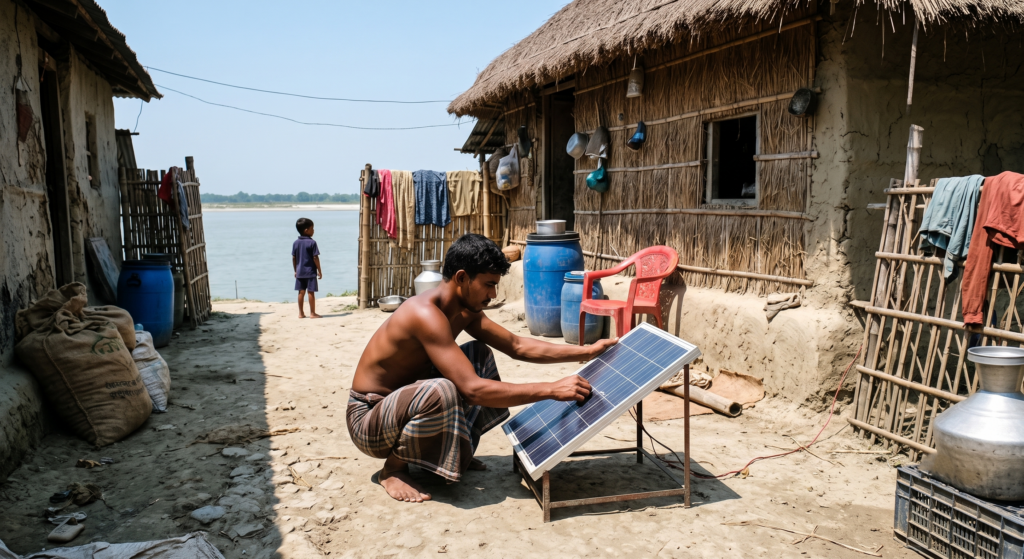
The government’s mitigation and green energy strategies have also drawn scrutiny from industry analysts for their lack of inclusivity and absent monitoring mechanisms. A flagship initiative within the budget is the commitment to plant 250 million trees over five years, aimed at generating over 350,000 green jobs and tapping into international carbon markets for potential revenues of up to $7.15 billion (Nurunnabi, 2026). However, financial experts caution that without highly sophisticated, GPS-tagged measurement, reporting, and verification (MRV) systems, these new forests will fail to produce independently auditable and tradeable carbon credits, risking accusations of greenwashing rather than generating genuine climate finance (Nurunnabi, 2026). Concurrently, while the budget offers zero-percent import duties on essential solar power components, these financial benefits are structured to exclusively favor large-scale corporate producers, entirely excluding off-grid rural consumers, solar irrigation farmers, and thousands of local distributors (Razib, 2026). This exclusionary tax policy, combined with a distinct lack of incentives for battery energy storage systems, severely bottlenecks a just and comprehensive renewable energy transition across the country (Razib, 2026).
Ultimately, the overarching success of Bangladesh’s FY2026-27 climate agenda hinges not on the sheer size of its financial allocations, but on the state’s institutional capacity to deliver tangible results. The nation’s Annual Development Programme (ADP) implementation rate has suffered a precipitous decline in recent years, dropping to a 49-year low of 68 percent in FY2024-25, which exposes profound bureaucratic inefficiencies and structural execution barriers (Khan, 2026a). Furthermore, analysts argue that the arbitrary thematic grouping of ministries in the budget document obscures institutional accountability, while the complete disregard for newly developed local-level climate vulnerability indices prevents critical funds from reaching the most at-risk communities (Irfanullah, 2026). To bridge the widening gap between policy ambition and on-the-ground reality, the government must undertake immediate structural reforms, prioritize locally led adaptation strategies, and ensure transparent, people-centered climate governance that fiercely protects the nation’s most marginalized populations (Irfanullah, 2026; TCW Report, 2026).
References
Hossain, S. (2026). Climate budget rises 26% – where will the money be spent?. The Business Standard. Retrieved from https://www.tbsnews.net/economy/budget/climate-budget-rises-26-where-will-money-be-spent-1461546
Irfanullah, H. M. (2026). What’s missing from the FY2026-27 climate budget. The Daily Star. Retrieved from https://www.thedailystar.net/opinion/views/news/whats-missing-the-fy2026-27-climate-budget-4208611
Khan, M. M. I. (2026a). What the FY2026-27 budget reveals about Bangladesh’s climate priorities. The Daily Star. Retrieved from https://www.thedailystar.net/opinion/views/news/what-the-fy2026-27-budget-reveals-about-bangladeshs-climate-priorities-4202326
Khan, M. M. I. (2026b). How the FY2026-27 budget can bridge Bangladesh’s climate finance gap. The Daily Star. Retrieved from https://www.thedailystar.net/opinion/views/news/how-the-fy2026-27-budget-can-bridge-bangladeshs-climate-finance-gap-4194056
Nurunnabi, M. (2026). Bangladesh’s green budget 2026-27: Unlocking a $3.75bn carbon market opportunity. The Business Standard. Retrieved fromhttps://www.tbsnews.net/features/panorama/bangladeshs-green-budget-2026-27-unlocking-375bn-carbon-market-opportunity-1461571
Razib, M. (2026). Budget 2026-27 exposes gaps in renewable energy rollout. The Daily Star. Retrieved from https://www.thedailystar.net/opinion/views/news/budget-2026-27-exposes-gaps-renewable-energy-rollout-4201506
Shahrukh, S. (2026). Green push expands in FY27 budget, but experts flag implementation gap. Dhaka Tribune. Retrieved from https://www.dhakatribune.com/amp/business/412530/green-push-expands-in-fy27-budget-but-experts-flag-implementation-gap
TCW Report. (2026). Bangladesh plans record climate budget amid concerns over health funding. The Climate Watch. Retrieved from https://theclimatewatch.com/bangladesh-plans-record-climate-budget-amid-concerns-over-health-funding/
The Daily Star. (2026). Climate adaptation budget falls short. The Daily Star. Retrieved from https://www.thedailystar.net/business/bangladesh-budget-2026-27/news/climate-adaptation-budget-falls-short-4198931