
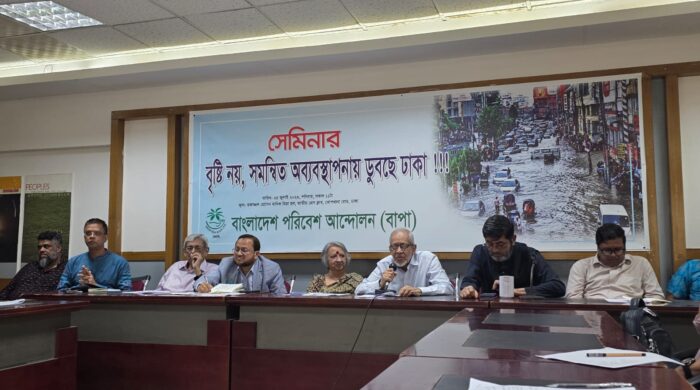
Dhaka’s severe monsoon waterlogging is largely the result of institutional mismanagement, unplanned urbanization, and the destruction of natural water bodies and drainage channels, experts said at a seminar organized by the Bangladesh Poribesh Andolon (BAPA) at the Jatiya Press Club.
Titled “Dhaka Is Drowning Not Because of Rain, but Due to Coordinated Mismanagement,” the seminar brought together urban planners, environmentalists, and policymakers to discuss the city’s worsening drainage crisis. Architect Iqbal Habib, a BAPA executive member and convener of its Urbanization Committee, presented the keynote paper. He blamed the crisis on poor coordination among Rajuk, the city corporations, the Bangladesh Water Development Board, and WASA, and called for participatory urban governance to restore Dhaka’s natural water pathways.
According to data presented at the seminar, Dhaka has lost around 120 kilometers of natural canals during decades of rapid urban expansion. Built-up infrastructure has increased by 75 percent, while the soil’s water absorption capacity has fallen from 40 percent to 20 percent. Surface runoff has consequently risen to 80 percent. Waste and sewerage problems have compounded the crisis, with 80 percent of solid waste reportedly remaining uncollected and sewerage coverage reaching only 20 percent of the city.
DSCC Chief Engineer Nur Azizur Rahman acknowledged that garbage-clogged drains are worsening waterlogging. He said the city corporation plans to redesign its drainage system using historical Cadastral Survey (CS) records and 50-year maximum rainfall data.
BAPA Vice-President Prof. M. Firoz Ahmed called for a comprehensive master plan to redesign Dhaka’s drainage and sewerage systems in response to climate change. Rights activist Khushi Kabir urged authorities to replace short-term projects with long-term planning involving civil society, environmentalists, and affected communities.
BAPA General Secretary Alamgir Kabir presented a seven-point charter calling for reduced dependence on water pumps, restoration of natural connections between canals and rivers, improved waste management, and drainage systems based on natural topography. The organization also recommended creating an interconnected network of rivers, wetlands, and lakes through hydrological modeling.
BAPA further demanded action against the illegal occupation and pollution of water bodies, long-term monitoring and rehabilitation, and stronger accountability among government agencies. BAPA President Prof. Dr. Nur Mohammad Talukdar said the problem extends beyond Dhaka and requires coordinated action between government and citizens across Bangladesh.