
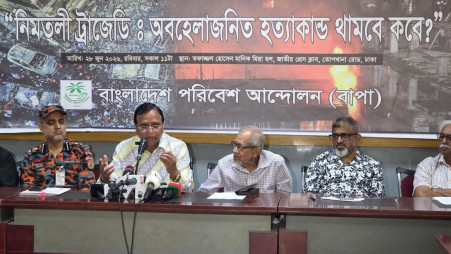
Sixteen years after the devastating Nimtoli fire, Dhaka remains highly vulnerable to similar disasters due to poor urban management, illegal chemical warehouses, and a widespread lack of public awareness. Experts, environmentalists, and government officials highlighted these ongoing risks during a seminar titled “Nimtoli Tragedy: When Will Deaths Caused by Negligence End?” organized by the Bangladesh Poribesh Andolon (Bapa) at the National Press Club in Dhaka on Sunday.
Speaking as the chief guest, Dhaka South City Corporation (DSCC) Administrator Md. Abdus Salam emphasized that preventing such fatal explosions requires much more than just government intervention; it demands active civic responsibility. He heavily criticized building owners who allow hazardous chemical businesses to operate in residential areas purely for higher rental income, stating that citizens must bear part of the blame when tragedies occur.
Drawing a parallel to the city’s ongoing dengue crisis, Salam noted that a recent survey found Aedes mosquito larvae in nearly 60 percent of homes in Dhaka. He pointed out that while many residents actively create mosquito breeding grounds in their own homes, they are quick to solely blame the city corporation. He argued that the same sense of personal accountability is urgently needed to eradicate illegal chemical businesses from densely populated neighborhoods.
The rampant violation of building codes and safety regulations was further exposed by Fire Service officials. Saleh Uddin, Deputy Director of the Fire Service and Civil Defence, revealed the grim reality of daily operations in Old Dhaka, noting that highly flammable chemicals are sometimes found hoarded even under beds. He highlighted that rogue developers frequently construct ten-story buildings after securing structural approvals for only five. Uddin stressed that without strong political will, strict enforcement of the law, and heightened public awareness, eliminating these death traps is impossible.
Presenting the keynote paper at the seminar, Bapa Joint Secretary Dr. Ahmed Kamruzzaman Majumder outlined an 11-point policy recommendation to address the crisis holistically. Key demands included the immediate relocation of all chemical warehouses and hazardous factories from residential zones, the establishment of a national chemical safety management framework, and the modernization of the fire service. Furthermore, he proposed creating a national database for vulnerable buildings, mandating fitness certificates, and introducing a digital licensing system.
The environmental fallout of poorly managed industrial relocation was also brought to the forefront. Bapa President Prof. Dr. Nur Mohammad Talukder, who chaired the event, warned that the unchecked expansion of chemical businesses along riverbanks is severely polluting the Buriganga and Dhaleshwari rivers. He lamented that existing environmental laws remain largely unenforced due to a lack of coordinated policy.
To ensure sustainable and people-friendly urban development, prominent architect and Bapa Executive Member Iqbal Habib advocated for the introduction of a unified “City Government” system. He argued that Dhaka’s unplanned, chaotic expansion must be forcefully halted in favor of coordinated, environmentally conscious planning.
Addressing the broader urban challenges of falling groundwater levels and worsening waterlogging, DSCC Administrator Salam urged the revival of community-based social organizations and traditional Panchayat systems in Old Dhaka. He concluded that robust disaster preparedness for climate change and earthquakes, combined with a strong community-led social movement, is the only effective way to safeguard the capital’s future.