
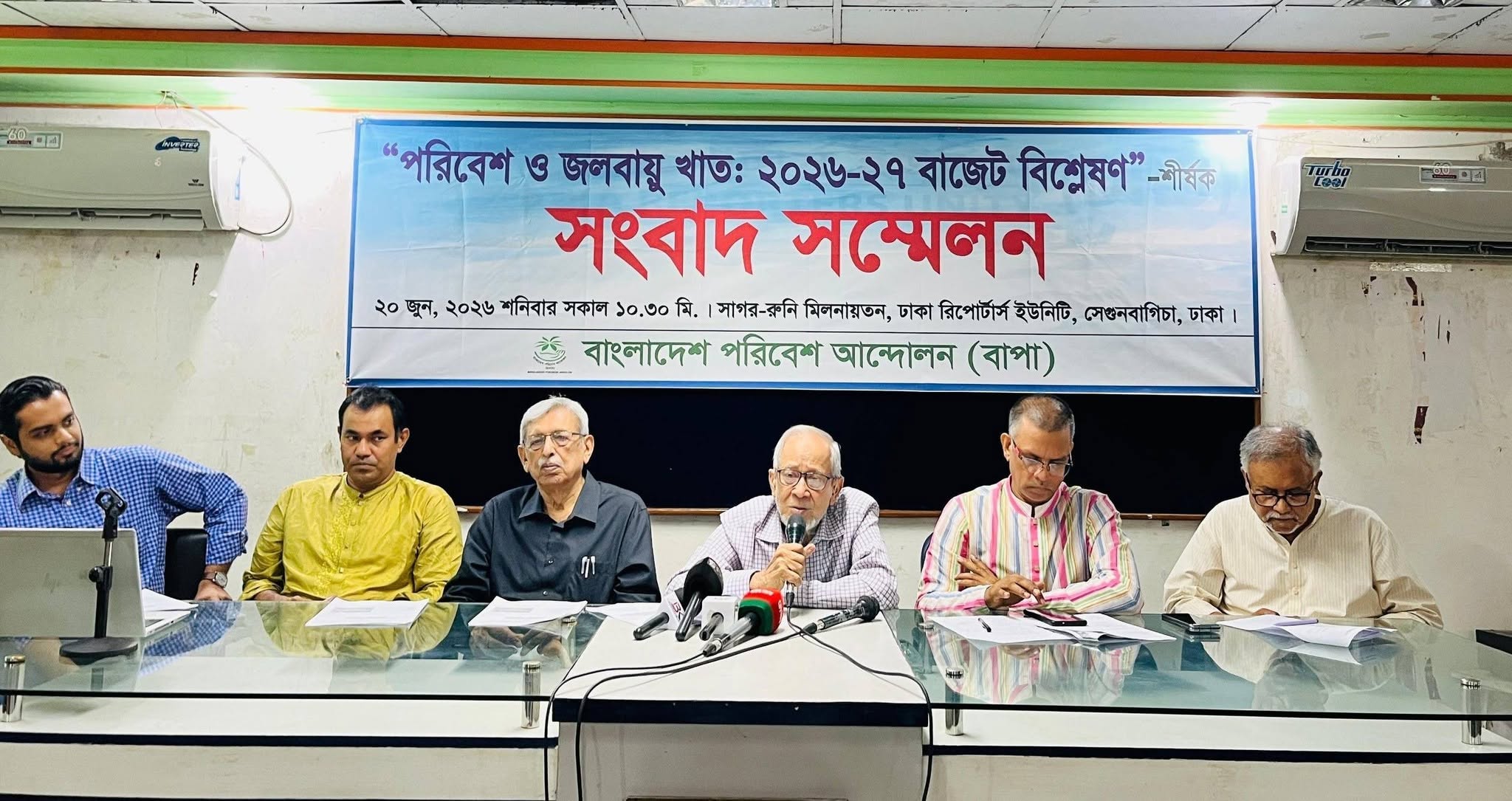
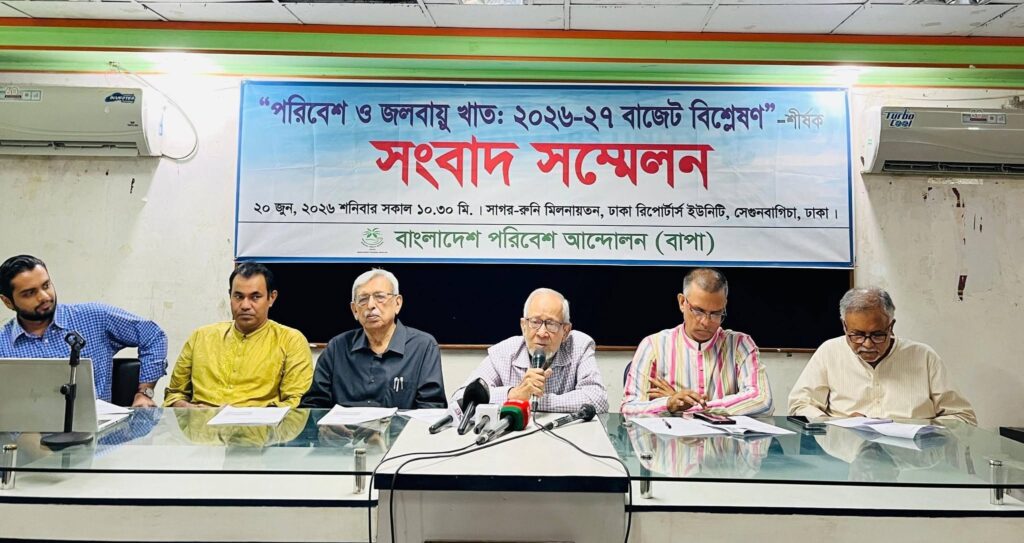
Although the proposed national budget for the 2026-27 fiscal year features a commendable increase in allocations for the environment and climate sectors, it will remain a “mere illusion” without strict accountability and transparent implementation. Leaders of the Bangladesh Paribesh Andolon (BAPA) made this remark during a press conference titled “Environment and Climate Sector: 2026-27 Budget Analysis,” held at the Sagar-Runi Auditorium of the Dhaka Reporters Unity (DRU) on Saturday. The environmental rights group termed the current allocation for climate change mitigation highly inadequate and demanded raising it to at least 3 percent of the GDP by 2030.
Presenting the keynote address, BAPA member Farhan Hossain Joy stated that while the proposed budget for the Ministry of Environment has increased by approximately 22 percent compared to the revised budget of the 2025-26 fiscal year, the state’s own climate change fund has been inexplicably stalled at 100 crore taka for years. Criticizing the contradictory nature of government policies, he pointed out the irony of a government allocating thousands of crores for river dredging while simultaneously encouraging sand extraction under political patronage. Reminding the audience of the government’s past successful initiatives, such as banning polythene and replacing highly polluting two-stroke baby taxis with CNG vehicles, he expressed hope for similar eco-friendly solutions this time around.
Addressing the event, BAPA President Professor Nur Mohammad Talukder urged the government to move away from conventional, bureaucracy-dependent budget planning. He alleged that the rushed expenditure of budget funds typically seen at the end of the fiscal year primarily leads to corruption and looting. Therefore, he demanded mandatory consultations with environmental experts prior to budget formulation and ensuring the corruption-free, transparent use of allocated funds. BAPA General Secretary Md. Alamgir Kabir echoed these sentiments, noting that while budgets often sound appealing on paper, the funds are frequently wasted and misappropriated. The speakers emphasized the need to stop environmental destruction in the name of mega-projects and focus on building a genuinely green economy.
During the conference, BAPA leaders also highlighted several missed opportunities and infrastructural flaws. Vice President Professor M. Firoz Ahmed noted that the construction of numerous flyovers has exacerbated urban air pollution, arguing that an underground transit system would have been significantly more effective in curbing emissions. He also expressed frustration that Bangladesh is completely failing to tap into the massive global carbon trading market, a sector currently dominated by China. Another Vice President, Zakir Hossain, called on the government to clearly define what it means by the “Green Jobs” mentioned in the budget documents.
To ensure better environmental and climate protection, BAPA put forward a set of specific recommendations for the government. These include establishing a green fund by introducing government-guaranteed bonds for private sector eco-friendly financing, imposing carbon taxes on high-emission industries and luxury car imports, and levying heavy fines on factories operating without Effluent Treatment Plants (ETPs) to fund the construction of central treatment facilities. Furthermore, the organization suggested adopting waste-to-energy projects at metropolitan landfills, completely banning single-use plastics, and establishing incubation centers and seed funds for climate technology startups. Finally, BAPA strongly recommended empowering SPARRSO with real-time monitoring capabilities to prevent river and forest grabbing, alongside reducing reliance on artificial dams in the Sundarbans region by creating natural defense barriers through extensive new mangrove afforestation.