
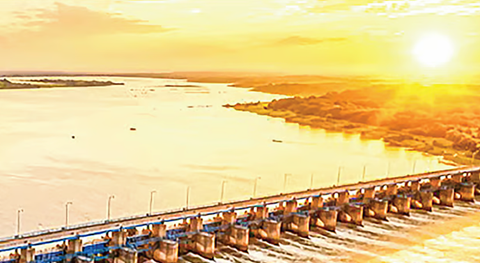
The proponents of the Padma Barrage project claim that it will bring massive development to the Ganges-dependent areas. Since the 1950s, we have been hearing such claims of massive success for all water development projects.
1.
On May 13, the Executive Committee of the National Economic Council (ECNEC) meeting, chaired by Prime Minister Tarique Rahman, approved the Ganges Barrage (First Phase) project. The Water Development Board (WDB) has been pushing for this project for a long time. Officially, it was named the Ganges Barrage because, from the very beginning, it was linked to the issue of sharing Ganges water with India.
In the eyes of many in India, the Ganges flows only towards Kolkata through the Bhagirathi river. Establishing this is advantageous for them because it then becomes easier to reject Bangladesh’s share of the Ganges flow. For this reason, they often do not want to acknowledge that the main stream of the Ganges enters Bangladesh near Rajshahi and takes the name Padma only after merging with the Jamuna at Goalanda.
Therefore, from the perspective of securing Bangladesh’s share in the Ganges, it is better to call it the Ganges Barrage. On the other hand, the common people of Bangladesh consider the Padma to start from Rajshahi. That is why it has recently been referred to as the Padma Barrage.
2.
Whatever name it is called by, the core idea remains the same: to construct a barrage (a dam with gates) somewhere between Rajshahi and Goalanda so that water can be retained by closing the gates during the dry season and directed towards the Gorai-Madhumati and other distributaries of the Ganges in the southwestern part of the country.
The idea originated in the 1960s. However, when India constructed the Farakka Barrage in 1974 and started diverting Ganges water towards the Bhagirathi, the water level of the Ganges in Bangladesh dropped during the dry season, leading to a crisis in the rivers of the country’s southwest. Consequently, efforts to build a Ganges Barrage within Bangladesh intensified.
The WDB conducted multiple studies. However, their main objective was to determine the best location for the barrage, rather than objectively examining whether building it was the right thing to do. Regardless, the WDB conducted its latest study in 2016 and is now moving forward with the project described within it.
Notably, the ‘Ganges Barrage Project’ was also included in the ‘Delta Plan 2100’ formulated during the previous Awami League government’s tenure. Its budget was estimated at $5.15 billion, which is about 62,000 crore BDT in current value.
The current BNP government is moving forward with the exact same project. However, perhaps to make the budget ‘acceptable’, it has divided the project into two phases. There is another similarity with the previous government: secrecy.
Like the previous government, the current government has also approved this mega project worth 33,474 crore BDT without giving the public any opportunity to understand or express their opinions. The ‘feasibility study’ on the basis of which this project was approved was not made available for anyone to see. The issue was not even discussed in parliament.
Were transparency, accountability, and public participation in decision-making—things the nation has been hearing about for almost two years—just empty words?
From the perspective of securing Bangladesh’s share in the Ganges, it is better to call it the Ganges Barrage. On the other hand, the common people of Bangladesh consider the Padma to start from Rajshahi.
Like the previous government, the current government has also approved a mega project worth 33,474 crore BDT without giving the public any opportunity to understand or express their opinions.
3.
The proponents of the Ganges Barrage project claim that it will bring immense development to the Ganges-dependent areas (the southwestern region of the country and the southern part of the Rajshahi division adjacent to the Ganges). Irrigation water can be supplied to approximately 2.9 million hectares of agricultural land in the greater Kushtia, Faridpur, Jessore, Khulna, Barisal, Pabna, and Rajshahi regions, which will increase rice production by about 2.4 million tons. Fish production will also increase by approximately 2.5 lakh tons.
Additionally, by installing turbines in the main dam and the Gorai intake structure, 76.4 and 36.6 (totaling 113) megawatts of electricity will be generated, respectively. In total, an ‘economic benefit’ of 7,127 crore BDT will be achieved annually. Consequently, the internal economic rate of return of this project will be 17.05%. That means the proposed Ganges Barrage project will be highly profitable.
Since the 1950s, we have been hearing such claims of massive success for all water development projects. I have written two books on their actual outcomes: an 822-page book titled “Water Development in Bangladesh: Past, Present and Future (2022)” and a 481-page book titled “Water Development in Bangladesh: Crisis of the Current Trend and Proposal for an Alternative Path (2023)”. Therefore, without repeating that here, I will focus on the pros and cons of the proposed Ganges Barrage.
However, one question must be raised at the outset. According to the WDB, the concerned engineering consultants, and other supporters of the proposed barrage, the main problem in the southwest of the country is water scarcity, and they are building the barrage to eliminate this scarcity.
But in reality, we see that the main problem in the southwest is waterlogging. People there are trapped in water for years. They cannot walk on dry land. Their lives are unbearable. When people die, it is even difficult to find a place to bury them.
If water scarcity is the main problem, then why are they trapped in water today? Doesn’t this prove that the engineers at ‘Pani Bhaban’ (WDB headquarters) fail to grasp the fundamental nature of the problems in the country’s southwest?
Clearly, water drainage has become a bigger problem than water scarcity in the southwest. This problem has been created by the WDB. The WDB built polders. Now the water inside the polders cannot flow into the rivers. The WDB built numerous structures like sluice gates, flap gates, regulators, etc., resulting in almost all rivers being choked with obstacles and barriers. Due to siltation in these obstructed rivers, their riverbeds have filled up, in many cases becoming level with adjacent roads. The entire river system of the area is in ruins today.
The WDB’s 2016 study shows that from 1997 to 2010, after the signing of the Ganges Treaty in 1996, the average flow of the Ganges below the Hardinge Bridge from June to December was 93.6% to 121.6% of the average flow during the same months from 1934 to 1974 (the pre-Farakka period). This means that despite the diversion at Farakka, there was no significant decrease in the Ganges flow during these months. So the question is, why didn’t this flow of the Ganges reach the various distributary rivers properly?
4.
The WDB is not particularly interested in facing these questions or solving the problems. Because, firstly, to remove sluice gates, flap gates, regulators, etc., one has to admit their own mistakes. They are unwilling to do that. Instead, they have set up police outposts next to their failed and broken-down sluice gates to protect them from local public anger.
The Baral River is a major proof of how distributaries have been deprived of Ganges water due to the WDB. In 1984, the WDB installed a sluice gate with a total width of 24 feet at the origin of this river in Charghat, Rajshahi, where the natural width of this origin was naturally over 500 feet.
Due to siltation, this sluice gate became inoperative, and the flow of water from the Ganges to the Baral stopped even during the monsoon. The living, strong, vibrant Baral river turned into the ‘dead Baral’. In 1996, further inland at Atghori, the WDB installed another sluice gate with only a 5-foot-wide single gate over the Baral, ensuring the death of this river.
Even in the face of intense agitation by local people, the WDB showed no interest in removing these sluice gates and rejuvenating the Baral. Rather, after 20 years of movement, when a decision was made at a ministerial-level meeting to remove these sluice gates, the WDB did not allow this decision to be implemented under the pretext of conducting a study.
Under pressure from the Water Resources Advisor of the interim government, the WDB was forced to lift the sluice gates at Charghat a few feet from the bottom, and immediately water from the Ganges began to gush into the Baral. Thousands of people from far and wide gathered on both sides of the Charghat sluice gate to witness the ‘miraculous’ incident of the dead river suddenly coming back to life. This miraculous change in the Baral directly proves that the WDB’s sluice gates are the sole reason why Ganges water doesn’t reach the Baral during the monsoon.
But despite this evidence, the WDB has not yet agreed to remove these sluice gates. Instead, in 2015, the WDB proposed building another sluice gate at Charghat, and to that end, in 2018, they had a study prepared by their preferred consulting firm, which recommended supporting the WDB’s 2015 proposal.
It should be noted that it is primarily on the basis of this consulting firm’s study that the WDB is now seeking to implement the Ganges Barrage project.
5.
Baral is just one example. The history of almost every distributary of the Ganges in Bangladesh shows how flow from the Ganges into them was effectively choked, primarily due to the WDB’s activities. If they were sincere about rejuvenating the Ganges distributaries, the WDB would have removed the obstacles built over these rivers and facilitated the Ganges’ flow into them.
But the WDB is not willing to walk that path. Apparently, there are three reasons for this.
Firstly, the WDB is almost entirely an engineer-dependent organization. Their profession is building various structures. Allowing rivers to flow freely diminishes the utility of their profession. As a result, their job becomes building structures even where they are not needed.
Secondly, they are unwilling to remove the structures they previously built that have proven harmful; because doing so would prove and establish their mistakes, making it difficult to propose building more such structures in the future.
Thirdly, building structures means getting a budget, and the bigger the structure, the bigger the budget. Conversely, removing faulty structures requires a smaller budget.
From this perspective, what could be more attractive than the 64,000 crore BDT Ganges Barrage project? This is the background of the proposed Ganges Barrage project. In the next part, we will discuss the pros and cons of this project.
Dr. Nazrul Islam
Professor, Asian Growth Research Institute
Former Chief of Development Research, United Nations
Founder, Bangladesh Environment Network (BEN)
The information presented here is an English adaptation based on the report published on The Daily Prothom Alo.