
Northeastern Bangladesh experienced severe flash flooding in April 2026 due to extreme pre-monsoon precipitation. Meteorological data indicated above-normal rainfall patterns driven by low-pressure systems over the Bay of Bengal (Bangladesh Pratidin, 2026). These systems transported moisture-laden marine air toward the Himalayan foothills. The interaction with cooler northern air masses generated excessive rainfall in the upstream catchments of the Surma and Kushiyara rivers. The Water Development Board issued early warnings in mid-April regarding potential waterlogging in the low-lying haor regions. Subsequent rainfall events between late April and early May elevated river water levels above critical danger marks. Flood Forecasting and Warning Center data confirmed continuous heavy precipitation from April 28 to May 3 (BSS, 2026). This rapid hydrological shift inundated vast topographical depressions across multiple districts.
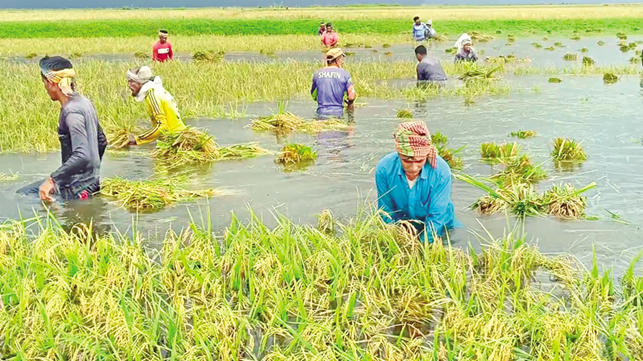
The primary economic impact of this hydrological event manifested in the destruction of the Boro rice crop. Boro paddy constitutes a critical component of national food security. Early meteorological disturbances between March 31 and April 5 initially impacted 1724 hectares of farmland across six districts (Halder & Chowdhury, 2026). The situation deteriorated significantly by early May following relentless upstream runoff. Government estimates revealed that 30605 hectares of cropland became submerged in the Sylhet region alone (Shamim & Chowdhury, 2026). Sunamganj and Kishoreganj districts sustained the most severe agricultural damage. Floodwaters inundated approximately 16000 hectares in Sunamganj and 9049 hectares in Kishoreganj resulting in combined estimated economic losses of 5 billion Taka (Rahman, 2026). Farmers were advised to harvest paddy at 80 percent maturity to mitigate losses (The Daily Star, 2026). However labor shortages and continuous atmospheric cloud cover hindered both harvest operations and grain drying processes.
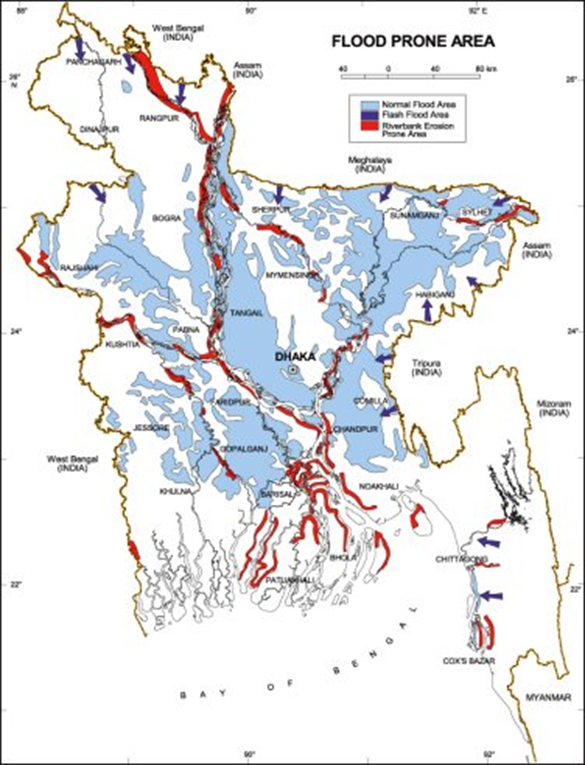
Environmental degradation and shifting land-use patterns have fundamentally altered the hydrological resilience of the haor basin. Historically natural swamp forests containing species such as Hijal tress provided structural resistance against incoming flash floods. Population pressures and agricultural expansion have systematically replaced these indigenous vegetation barriers with vulnerable settlements and crop fields. The removal of reed lands and forest cover eliminates natural water retention capacity and increases surface runoff velocity. Eroded sediment from deforested upstream areas further diminishes river channel capacity and creates destructive mudflows. Climate models predict progressive increases in pre-monsoon rainfall volumes over the Meghna River catchment which will exacerbate future drainage congestion (Haque, 2026).
Anthropogenic infrastructure failures also contributed significantly to the 2026 flood vulnerability. Submersible embankments are designed to delay floodwaters long enough to permit the Boro harvest. Reports indicated widespread structural failure of these defensive mechanisms across the haor region. Insufficient planning and substandard construction materials compromised the integrity of these embankments under hydrostatic pressure. Independent audits and rigorous monitoring of infrastructure projects remain necessary to ensure functional flood defense systems. Current agricultural strategies require adaptation to changing climatic parameters including the adoption of flood-resistant crop varieties with shorter maturation cycles. Comprehensive environmental management must integrate the conservation of native wetland vegetation alongside engineered flood protection systems to establish long-term ecological stability.
References
Bangladesh Pratidin. (2026). Flash flood warning issued for Sunamganj as heavy rain forecast in Haor region. Bangladesh Pratidin. Retrieved from https://en.bd-pratidin.com/city/2026/04/25/61396
BSS. (2026). Haor farmers asked to accelerate Boro harvesting as flash floods forecasted. Bangladesh Sangbad Sangstha. Retrieved from https://www.bssnews.net/others/382140
Halder, S. & Chowdhury, D. (2026). Heavy rain upstream water damage crops in six districts. The Daily Star. Retrieved from https://www.thedailystar.net/business/economy/news/heavy-rain-upstream-water-damage-crops-six-districts-4154661
Haque, A. (2026). Migration and climate pressures deepen flood risks in Bangladesh’s haors. Mongabay. Retrieved from https://news.mongabay.com/2026/04/migration-and-climate-pressures-deepen-flood-risks-in-bangladeshs-haors/
Ahmed, N., Azad, A. K., Khan, M. R., Habib, A., Ghosh, S., & Shahid, S. (2016, January). ShonaBondhu: a cloud based system to handle flash flood. In 2016 international conference on networking systems and security (NSysS) (pp. 1-6). IEEE.
Rahman, M. M. (2026). Saving the haor farmers. The Financial Express. Retrieved from https://thefinancialexpress.com.bd/views/columns/saving-the-haor-farmers
Shamim, S. & Chowdhury, L. P. (2026). Farmers’ dreams sink as flash floods turn Haor harvest into a sea of loss. bdnews24.com. Retrieved from https://bdnews24.com/bangladesh/8b54b1663e58
The Daily Star. (2026). WDB warns of possible early flood advises immediate harvest in Sunamganj. The Daily Star. Retrieved from https://www.thedailystar.net/news/environment/climate-crisis/natural-disaster/news/wdb-warns-possible-early-flood-advises-immediate-harvest-sunamganj-4157136