
the 30-year treaty between Bangladesh and India regarding the sharing of Ganges water is set to expire this year. Reaching an understanding on such an important and contentious issue like the Ganges treaty requires a lot of preparation. Nazrul Islam writes in two parts about how Bangladesh can prepare for the treaty’s renewal. This the final part:
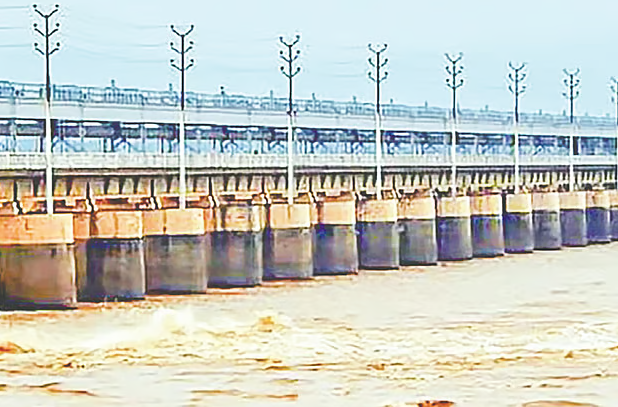
1. From a nature-centric perspective, Bangladesh’s most logical demand regarding the Ganges treaty would be the removal of the Farakka Barrage. This might seem like an impossible demand to many in Bangladesh, but not to many within India itself.
Public frustration regarding the Farakka Barrage is growing day by day in India. Firstly, this barrage has not helped Kolkata maintain its status as a seaport. Secondly, this barrage has become a cause of upstream siltation, floods due to the rising riverbed of the Ganges, and riverbank erosion.
For these reasons, a strong movement demanding the removal of the Farakka Barrage was built up in India under the leadership of the former Chief Minister of Bihar, Nitish Kumar. In the 11th meeting of India’s Inter-State Council held in 2016, chaired by Prime Minister Narendra Modi and attended by all central government ministers and state chief ministers, Nitish Kumar declared that the Farakka Barrage had caused more harm than good. Because of this, he demanded the removal of this barrage to ensure the uninterrupted flow of the Ganges River.
To draw attention to the adverse effects of the Farakka Barrage on India, Nitish Kumar organized a two-day conference titled ‘Aviral Ganga’ (Uninterrupted Ganges) on 25-26 February 2017. Many renowned Indian river researchers and activists attended this conference and identified the obstruction of the river’s flow and subsequent siltation caused by Farakka and other dams as the primary problem of the Ganges River.
Rajendra Singh, known as the ‘Waterman of India’, termed the Farakka Barrage an ‘evil’ and a ‘curse’ for Bihar at this conference and demanded its removal. Prominent Indian river researcher Himanshu Thakkar noted at this conference that the Farakka Barrage was approaching its 50th year. According to international norms, such dams require evaluation upon reaching 20 years. In that context, he demanded an evaluation of the Farakka Barrage experience.
Based on this conference held in Patna, an 11-point Patna Declaration was adopted, the main demand of which was the restoration of the natural flow of the Ganges by removing Farakka and other dams. Following the Patna conference, another similar conference was held in the capital, Delhi, in May 2017, where another declaration subsequent to the ‘Patna Declaration’ was adopted.
2. The removal of the Farakka Barrage is not a pipe dream. This demand originated within India itself, and Bangladesh needs to fully support it. In fact, Bangladesh’s opening statement in the Ganges treaty renewal discussions should start with this demand.
However, as long as the Farakka Barrage is not removed, efforts must be made to secure Bangladesh’s fair share of the dry season flow of the Ganges under this barrage. In this context, it is noteworthy that under the 1974 ‘Mujib-Indira treaty’, India was permitted to withdraw 11,000 to 16,000 cusecs of water during the dry season (January-May), so that Bangladesh could receive 40,500 to 44,500 cusecs during these months.
According to the 5-year treaty signed during the Zia government in 1977, India agreed to restrict its dry season water withdrawal to 20,000 cusecs, ensuring Bangladesh received 35,000 cusecs. A ‘minimum guarantee clause’ ensuring a minimum flow was incorporated into this treaty.
Under this clause, India guaranteed that the flow of the Ganges into Bangladesh during the dry season would not fall below 27,600 cusecs. After the expiration of the 1977 treaty, there was no treaty for a long time. Consequently, the volume of Ganges flow into Bangladesh during this period was largely dependent on India’s will.
According to the 1996 treaty signed during the Awami League government, it was agreed that if the flow at Farakka exceeded 75,000 cusecs, India would withdraw 40,000 cusecs and the rest would flow to Bangladesh. If the flow at Farakka was between 70,000 and 75,000 cusecs, Bangladesh would receive 35,000 cusecs, and India would get the remainder (i.e., 35,000 to 40,000 cusecs). Finally, if the flow at Farakka was below 70,000 cusecs, it would be divided equally between India and Bangladesh.
Notably, this treaty has no minimum guarantee clause for the Ganges flow into Bangladesh. This was alarming because, as mentioned earlier, due to the construction of numerous dams and barrages by India upstream on the Ganges and its tributaries, the flow of the Ganges at Farakka is decreasing day by day.
Statistics show that during the 1997-2010 period, the average flow of the Ganges at Farakka decreased by 2,132 cusecs every year. This reduction will be even greater for the dry season flow. Therefore, if there is no guarantee of a minimum flow for Bangladesh in the treaty, the flow of the Ganges into Bangladesh during the dry season will drop dangerously low. In fact, this has often been the case during the 1997-2025 period. Research shows that 52 percent of the time (calculated in 10-day cycles) during 1997-2016, Bangladesh did not receive its share of water as per the treaty, and this ratio was 65 percent during the ‘crisis period’ from March to May.
In light of this reality, there is no doubt that the ‘minimum guarantee clause’ must be re-established in the upcoming renewal of the Ganges treaty, and it must be set at a minimum of 35,000 cusecs. In this context, it is noteworthy that since Kolkata is no longer a seaport (the nearby Haldia port has taken over that role), the diversion of water towards the Bhagirathi is no longer as important for India. Furthermore, downstream tributaries like Mayurakshi, Ajay, Damodar, Silai, Rupnarayan, and Kangsabati (Kasai) join and increase the flow of the Bhagirathi-Hooghly.
On the other hand, the Ganges flowing into Bangladesh has no other tributaries that can increase its flow. Instead, there are numerous distributaries that rely entirely on the flow of the Ganges. Consequently, barring politics, there is little reason for a 50-50 division of the Ganges’ dry season flow at Farakka.
3. Conversely, there are both natural and economic arguments in favor of allocating 35,000 cusecs to Bangladesh. By nature’s rule, the main flow of the Ganges has shifted away from the Bhagirathi towards Bangladesh. Attempting to reverse this through Farakka is an act against nature.
Economically, the entire southwestern region of Bangladesh is dependent on the Ganges. It is further noteworthy that if a minimum flow is guaranteed for Bangladesh, the Indian government itself might be prompted to put some reins on the current relentless efforts to withdraw water from the Ganges and its tributaries upstream in West Bengal, and that would work in West Bengal’s favor.
Needless to say, for Bangladesh’s position to be accepted in the renewal of the Ganges treaty, it must gain support and sympathy within India. To achieve this, efforts are needed on both official and unofficial tracks. On the unofficial track, a network has been established between river experts and activists of Bangladesh and India, which will help in disseminating information about Bangladesh’s position and the arguments in its favor for the Ganges treaty renewal, but this is not enough at all. The government should expand and deepen this network manifold.
Massive efforts are also required in the international arena. As we have noted earlier, signing the 1997 UN convention on rivers will create the possibility of gaining the support and sympathy of the international community for Bangladesh’s stance. But massive efforts will be needed to realize this potential. To assess the impact of India’s river-linking project, UNESCO-dispatched delegations observed the degradation of the Sundarbans due to the Farakka Barrage on multiple occasions and noted the possibility of it becoming more severe due to India’s river-linking project, expressing concern over it.
This observation by UNESCO creates an opportunity to launch a campaign in the international arena in favor of removing the Farakka Barrage or increasing the flow of the Ganges into Bangladesh during the dry season. But no government has taken any initiative on this matter. In reality, people in the outside world know very little about India’s unfair treatment of Bangladesh regarding international rivers. In view of the impending need to renew the Ganges treaty, the Bangladesh government needs to pay attention to this matter.
It is noticeable that the geographical location that allows India to withdraw water from Bangladesh’s rivers also provides Bangladesh with some advantages relative to India. That is granting permission for transit and transshipment and access to Bangladesh’s seaports to accelerate the development of India’s seven northeastern states.
Back in 2013, I proposed “transit in exchange for rivers.” The previous Awami League government, however, did not accept this proposal and granted India transit, transshipment, and port access unconditionally. However, after the political changeover in 2024, the move to revoke the access of Bangladeshi exporters to Indian airports shows that previously granted privileges can also be withdrawn later.
We want to hope that India will realize the necessity of the Ganges’ dry season flow for Bangladesh with more sensitivity and will generously accept the demand for a guaranteed minimum flow of 35,000 cusecs, ensuring that cooperation between India and Bangladesh continues in other areas as well.
A competent and experienced team (group of negotiators) is required on Bangladesh’s part to successfully negotiate this complex and sensitive issue with India. Currently, the Bangladesh section of the Joint Rivers Commission is largely bureaucracy-dependent. It is difficult to say how successful Bangladesh will be in negotiations with India using this commission. Just including engineers in it is also not a solution because they generally lack adequate conception and understanding of river-related philosophy. Therefore, the proper restructuring of the Joint Rivers Commission is another important task and challenge for the renewal of the Ganges treaty.
Finally, it must be said that in the context of the impending need to renew the Ganges treaty, the approval of the Ganges (Padma) Barrage project by the Bangladesh government is a suicidal move. As a result, let alone demanding the removal of the Farakka Barrage, it will be difficult for the Bangladesh delegation to raise any demand such as increasing the share of the Ganges’ dry season flow or a ‘guarantee of minimum flow’, etc. India’s seasoned negotiators will quickly be able to expose the contradiction in the Bangladeshi representatives’ position and dismiss these demands of theirs. In light of the possibility of this tragic consequence, it is our expectation that the government will reconsider the Ganges (Padma) Barrage project.
Dr. Nazrul Islam
Professor, Asian Growth Research Institute
Former Chief of Development Research, United Nations
Founder, Bangladesh Environment Network (BEN)
The information presented here is an English adaptation based on the report published on The Daily Prothom Alo.