
The recent approval of the first phase of the proposed Padma Barrage project on the Ganges River by the Executive Committee of the National Economic Council (ECNEC), at an estimated cost of BDT 34,000 crore, has generated widespread public interest and concern among experts. The government argues that the mega-project will transform agriculture, expand irrigation, and help address salinity in Bangladesh’s south-western region. Environmentalists and river experts have expressed concern that the project may have been approved without sufficiently transparent feasibility studies or meaningful public consultation. Some have warned that, if poorly planned, it could have consequences for Bangladesh’s river systems reminiscent of the Farakka experience.
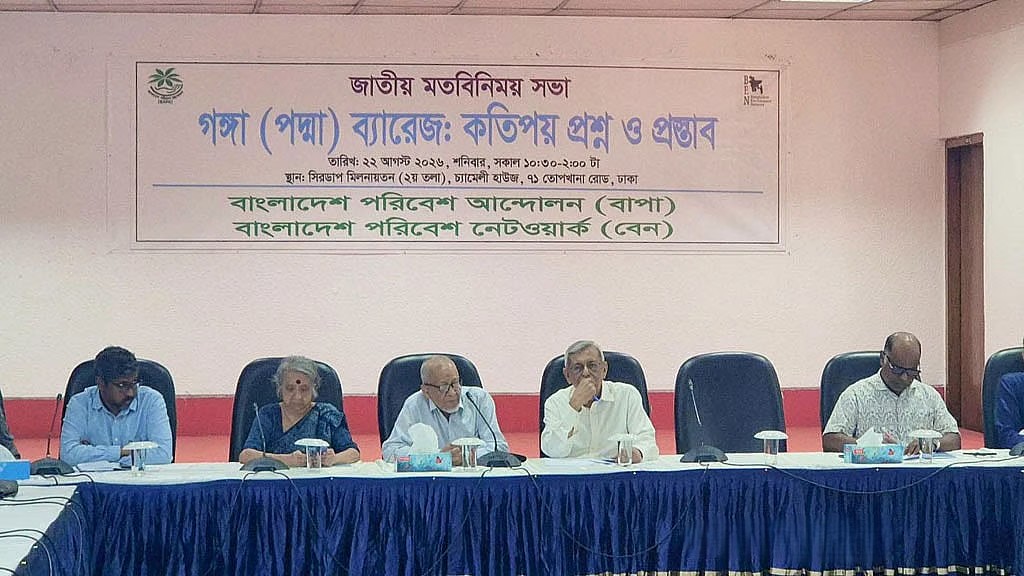
Bangladesh Poribesh Andolon (BAPA) and the Bangladesh Environment Network (BEN) organized an exchange of views meeting on August 22, titled “Ganga (Padma) Barrage: Questions and Proposals.” The meeting brought together engineers, environmental professionals, concerned citizens, and journalists. Discussions examined the project from multiple perspectives, including its technical feasibility, potential environmental impacts, and broader geopolitical implications.
Experts first raised questions about the sudden renaming of the long-discussed “Ganges Barrage” as the “Padma Barrage.” Dr. Nazrul Islam, Vice President of BAPA and founder of BEN, noted that the initiative has been known as the Ganges Barrage since 1963. Changing the name at this stage, he argued, is historically and geographically misleading. The timing is also significant, with the renewal of the Ganges Water Sharing Treaty approaching. Dr. Nazrul warned that the new name could weaken Bangladesh’s position in negotiations over its rightful share of the river’s water. India could potentially use the terminology to argue that the Ganges does not actually enter Bangladesh, further complicating the country’s position in international water diplomacy.
The project’s most appealing promise is straightforward: store excess monsoon water and use it during the dry season. But Dr. Nazrul Islam and Dr. Khalequzzaman challenged that premise using mathematical analysis. Their calculations indicate that the proposed barrage could store only about 1.53 percent of the monsoon flow. Even that limited storage, they argued, would meet only around 30 percent of the water promised to the distributary rivers during the dry season. The remaining 70 percent would have to come from diversion. That amount is equivalent to roughly 40 percent of the current flow of the main river. The consequences could extend far downstream. Rivers such as the Padma and Arial Khan, the Meghna estuary, and waterways across the greater Barishal region could face severe shortages, increasing the risk of widespread salinity intrusion.
Dr. Ahad Chowdhury, a geologist at Jefferson Community and Technical College in the United States, drew a comparison with the Louisiana Delta. His point was simple: a delta cannot survive indefinitely if the sediment that continually rebuilds it is cut off. He described the proposed barrage as a “Second Farakka,” arguing that while the Farakka Barrage reduced water flow into Bangladesh, the proposed Padma Barrage could trap sediment. Dr. Khalequzzaman pointed to what he described as a precedent at Farakka, where sediment accumulation reportedly raised the riverbed by about four meters and contributed to serious riverbank erosion in Malda and Murshidabad. He warned that similar processes could occur upstream of the proposed Pangsha barrage. Heavy sediment accumulation could increase flooding and waterlogging upstream while intensifying riverbank erosion downstream.
Not all participants shared these concerns. Several engineers and water experts presented arguments in support of the project. SM Mahbubur Rahman, former Executive Director of the Institute of Water Modelling (IWM), and Malik Fida Khan, former Executive Director of CEGIS, said that renowned national and international institutions have carried out extensive technical and mathematical studies on the project over several decades. Rahman argued that storage infrastructure is necessary to make maximum use of whatever water Bangladesh receives from Farakka during the dry season. He and Khan maintained that downstream impacts and sediment management have also been studied in detail. In their view, there is no practical alternative to protecting the greater Khulna and Jashore regions from worsening climate impacts and salinity. Professor Dr. Sirajul Islam of North South University similarly argued that structural interventions are necessary to expand irrigation and maintain food security for a growing population, provided that they are implemented with appropriate environmental safeguards.
Dr. Shahjahan Kabir, former Director-General of the Bangladesh Rice Research Institute (BRRI), offered a different perspective based on the country’s agricultural needs. He agreed that irrigation is essential to food security. But he questioned the project’s water calculations. The proposed scheme is expected to irrigate between 19 and 29 lakh hectares, requiring around 20 billion cubic meters of water. The barrage, however, has a maximum storage capacity of only three billion cubic meters. Where would the remaining water come from?
He also drew attention to the experience of the 139 polders constructed in the south-western region during the 1960s. Poor management of those systems, he said, has contributed to persistent drainage problems and long-term waterlogging, with Bhabodah serving as a particularly serious example. His argument was that repairing and properly managing existing infrastructure should take priority over constructing another mega-project.
River researchers and activists raised another fundamental point as they argued that the failure of water to reach the Ganges distributaries is not necessarily caused by a shortage of water itself. In many cases, they said, poorly planned infrastructure has obstructed natural river flows. The Boral River was cited as an example. According to participants, the Water Development Board effectively choked the river by constructing a 24-foot sluice gate at its mouth. Following prolonged protests by local communities, the opening of the sluice gates has reportedly begun restoring the river’s natural flow.
Their proposed alternatives are less about building something new and more about restoring what already exists. Dredging could improve river conveyance. Removing obstructions at river mouths could reconnect distributaries. Proper implementation of Tidal River Management (TRM) could also address drainage and sedimentation problems in vulnerable areas. Together, these measures, the participants argued, could reduce the need for a new mega-barrage.
One issue, however, cut across the debate: transparency. Participants expressed serious concern about the level of secrecy surrounding a project of such enormous financial and environmental significance. They questioned why the government and relevant agencies have not made the project’s feasibility studies and detailed environmental impact assessments publicly available.
They demand to release the studies so that independent experts can examine the assumptions, calculations, environmental risks, and downstream consequences. Technical experts, environmentalists, river activists, and the communities that could be directly affected should have an opportunity to participate in the discussion.
The debate over the Padma Barrage was therefore not simply about whether a structure should be built. It was about the evidence behind the project, the assumptions on which its benefits depend, and the risks that may emerge far beyond the barrage itself. Without greater transparency and rigorous scrutiny, a project intended as a solution to water scarcity, salinity, and climate vulnerability could create new and potentially irreversible pressures on the Bengal Delta. The full event can be rewatched here: https://youtu.be/p2I8IVBIYXs