
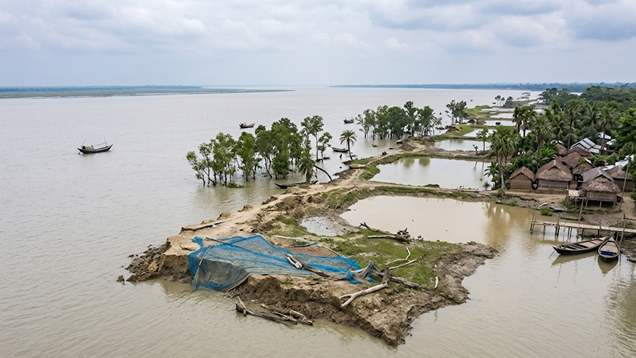
Southern part of Bangladesh stands at the precipice of a severe environmental crisis with an accelerated rise in sea levels paired with alarming rates of land subsidence. While climate change remains a global phenomenon the localized impacts in Bangladesh are unfolding at a pace far exceeding global averages threatening to dismantle the region’s ecology economy and human settlements.
Recent satellite altimetry studies indicate that the waters of the Bay of Bengal are rising at an unprecedented rate. While the global average sea level rise is recorded at roughly 3.42 to 3.8 millimeters per year Bangladesh’s coastal zones are experiencing an average rise of 5.8 millimeters annually (Molla 2024, Yousuf 2025). Regional disparities further exacerbate this issue for instance the southeastern Chattogram and Cox’s Bazar coast is witnessing a staggering sea level increase of 6.23 millimeters per year (Yousuf 2025). By 2100 sea level rise induced flooding could encompass nearly 18 percent of the nation’s coastal zone displacing over a million people and permanently altering the geography of the delta (Molla 2024). According to the International Labour Organisation 17 percent of Bangladesh’s territory could be entirely submerged by 2050 (Ahmed 2024).
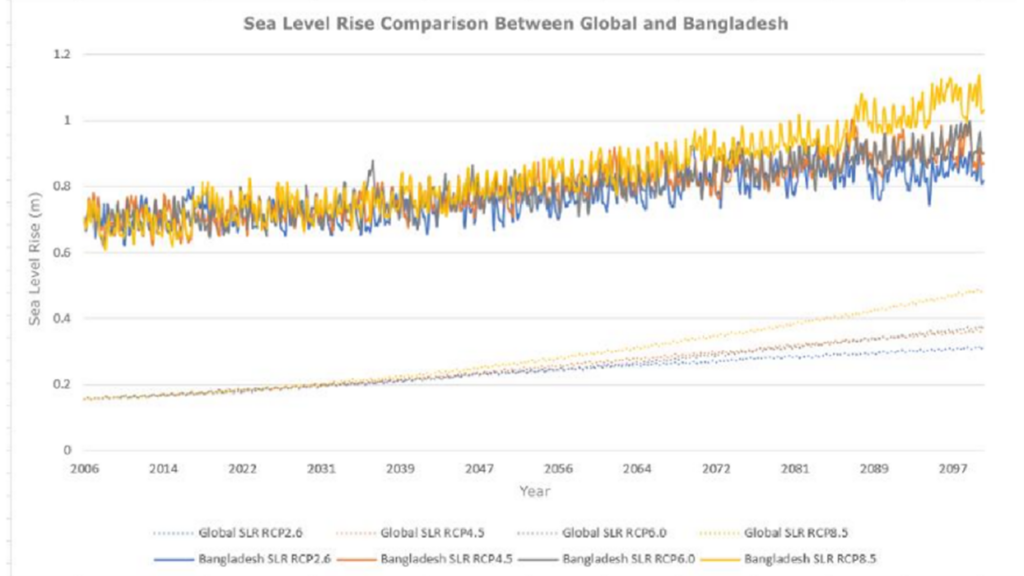
The escalating threat of rising seas is critically compounded by vertical land motion specifically land subsidence. A study published in the Proceedings of the National Academy of Sciences revealed that land in the delta is subsiding at rates between 1 to 7 millimeters per year (Siddiqui 2020). This phenomenon is heavily driven by a disruption in natural sedimentation. Over the past decades the construction of coastal embankments and polders has prevented river sediments from naturally replenishing the floodplains causing the land to gradually sink. Urban areas are facing severe localized subsidence crises as well. In Barishal the city is sinking at an average rate of 1.66 millimeters annually with extreme localized drops of up to 24.17 millimeters in a single year (Shahin 2026). This severe urban subsidence is largely attributed to unplanned urbanization and the relentless extraction of groundwater which compromises the subterranean soil structure and leads to tilting buildings and compromised infrastructure. If these subsidence trends continue unchecked estimates suggest that the combined effect of sinking land and rising water could result in an effective relative sea level rise of 85 to 140 centimeters by the end of the century drastically multiplying the devastation across the delta (Siddiqui 2020).
The ecological and economic ramifications of these converging crises are catastrophic. Salinity intrusion propelled further inland by the advancing sea is degrading soil fertility and jeopardizing food security. Projections suggest a staggering 30 percent loss of agricultural land by 2050 (Ahmed 2024). Furthermore an estimated 40 percent of productive land in the southern regions could be lost to a mere 65 centimeter rise in sea level drastically reducing the yields of staple crops like Aman rice (Islam 2025). The nation’s vital ecosystems are similarly imperiled. The Sundarbans the world’s largest mangrove forest faces an existential threat. A one meter rise in sea level would completely submerge this ecosystem decimating its rich biodiversity and obliterating a crucial natural barrier against cyclonic storm surges.
The human cost of these environmental shifts is immeasurable often exacerbated by the very development projects intended to foster economic growth. In the coastal region of Matarbari massive infrastructural endeavors like coal fired power plants have disrupted the lives of tens of thousands of residents. To accommodate these projects thousands of acres of traditional salt fields were acquired and natural river flows were obstructed resulting in the regular inundation of dozens of surrounding villages. Local communities find themselves trapped between the encroaching sea which has swallowed hundreds of homes and industrial developments that have systematically dismantled their ancestral livelihoods in agriculture and fisheries (Yousuf 2025). Consequently a wave of climate migration is forcing coastal populations into overcrowded urban centers where they face poor living conditions food insecurity and unemployment (Ahmed 2024).
The trajectory of Bangladesh’s coastal zones underscores a dire need for immediate multifaceted interventions. Combating the dual threat of sea level rise and land subsidence requires a paradigm shift in environmental management. Strategies must include the implementation of sustainable groundwater extraction regulations the promotion of surface water usage and the rethinking of coastal engineering to restore natural sediment flows (Shahin 2026, Siddiqui 2020). Moreover protecting the livelihoods of coastal populations necessitates robust social protection systems and adaptive agricultural practices such as cultivating salinity tolerant crops (Ahmed 2024, Islam 2025). While global adherence to carbon mitigation remains imperative Bangladesh must urgently deploy localized sustainable adaptations to ensure that its shores and the millions who call them home are not lost to the rising tides.
References
Ahmed W. (2024). Encountering sea level rise for survival. The Financial Express. Retrieved from https://thefinancialexpress.com.bd/views/columns/encountering-sea-level-rise-for-survival
Samiul Islam, F. A. (2025). Impact of Climate Change and Sea Level Rise on Coastal Zone of Bangladesh. American Journal of Innovation in Science and Engineering , 4(1), 112-122. https://doi.org/10.54536/ajise.v4i1.4556
Ashrafuzzaman, M., Santos, F. D., Dias, J. M., & Cerdà, A. (2022). Dynamics and Causes of Sea Level Rise in the Coastal Region of Southwest Bangladesh at Global, Regional, and Local Levels. Journal of Marine Science and Engineering, 10(6), 779. https://doi.org/10.3390/jmse10060779
Molla M. A. M. (2024). Sea level rise in Bangladesh Faster than global average. The Daily Star. Retrieved from https://www.thedailystar.net/environment/climate-change/news/sea-level-rise-bangladesh-faster-global-average-3613116
Shahin A. F. (2026). Debe jacche Barishal nogori Barishal city is sinking. Jugantor. Retrieved from https://www.jugantor.com/tp-lastpage/1082880
Siddiqui K. (2020). An exclusive interview of Dr AKM Saiful Islam. The Business Standard. Retrieved from https://www.tbsnews.net/interviews/land-subsidence-key-bangladeshs-rising-water-levels-dr-akm-saiful-islam
Yousuf M. (2025). Rising sea levels Livelihoods lost to development homes lost to the sea. Prothom Alo. Retrieved from https://en.prothomalo.com/environment/climate-change/7fhvbye723
