
There is no district or upazila in Bangladesh where the Bangladesh Water Development Board (BWDB) hasn’t constructed polders or embankments, and no significant river without a sluice gate or flap gate built over it. But how much has Bangladesh truly benefited from this? Nazrul Islam writes about various BWDB projects in a two-part series. This is the second and final part, published in the Daily Prothom Alo on 31-03-2026.
1.
After the mass uprising of 2024, when the interim government was formed and Syeda Rizwana Hasan, head of BELA (Bangladesh Environmental Lawyers Association), took charge of the water resources and environment ministries, a favorable environment for freeing the Baral river was created.
She (Syeda Rizwana Hasan) visited the Baral area and, in the presence of BWDB officials, sought the public’s opinion on freeing the river. The local people overwhelmingly demanded the removal of the sluice gates at Charghat and Atghori. Subsequently, the adviser directed the BWDB to remove these sluice gates.
2.
Following this order, BWDB temporarily removed the gates (flaps) of the sluice gates but did not agree to their complete removal. BWDB then argued that taking actions contrary to the recommendations of a 2018 survey required forming another ‘technical committee’ to review those recommendations.
On June 23, 2025, an eight-member committee was initially formed, which was expanded to 13 members on October 29, 2025. It was observed that while several Upazila Nirbahi Officers (UNOs) were included, S.M. Mizanur Rahman—who had led the movement to save the Baral as member secretary since 2006, establishing himself as the undisputed leader of the local people on the Baral issue, and who had also been appointed as a BWDB board member—was left out of the committee.
On November 14, 2025, the committee members visited the Baral area, including the sluice gates at Charghat and Atghori, and returned to provide 16 recommendations. Nine of these recommendations (2, 3, 4, 5, 6, 8, 9, 12, 16) were related to river dredging.
Superficially, the proposal for river dredging might seem harmless. But sustainable benefits cannot be achieved simply by dredging without unblocking the river flow. Therefore, the dredging proposal is not harmless either. Because such proposals often obscure the primary task of freeing the rivers.
Several other recommendations of the technical committee (like 10 and 14) were largely repetitions of self-evident facts. This left 5 recommendations (1, 7, 11, 13, 15) relating to the goal of removing the sluice gates.
Recommendation number 1 stated that the 2018 survey was 7 years old. Therefore, the model used in it needed ‘updating and re-verification’, and ‘a final decision should be made after reviewing the rationale of the newly proposed alternatives’. In other words, more surveys are needed.
Recommendation number 7 stated that to restore the Baral, ‘project implementation can be done according to the proposals of the 2018 survey or, if necessary, supplementary survey proposals’.
This recommendation is even more problematic. Because, firstly, determining whether to implement the 2018 survey proposals was the primary responsibility of this committee. Through this recommendation, instead of fulfilling that duty, they left the matter open.
Secondly, this recommendation contradicts recommendation 1; because that one stated the 2018 survey was outdated and a new one was needed. How the same committee could make contradictory recommendations on the core issue is incomprehensible.
Thirdly, it also contains a proposal for further surveys, but attempts to shift the responsibility for that proposal onto others.
Recommendation number 11 stated that decisions regarding the removal of sluice gates could be made after ‘conducting a risk assessment through a detailed survey’ on the impacts on related irrigation projects, fisheries, communication systems, and the Dayarampur Cantonment and public life. Meaning, here too is a proposal for more surveys.
Recommendation number 13 stated that reviving the ‘Mora Baral’ (Dead Baral) section requires ‘a decision based on a detailed survey regarding the one-door regulator constructed at its mouth’. Meaning, more surveys are needed, even though BWDB saw no need for surveys when they killed the Baral.
Recommendation number 15 stated that it ‘needs to be examined’ whether the process of removing the sluice gates would conflict with the proposed Ganges Barrage project. Again, a proposal for a new survey.
3.
Meanwhile, a major ‘survey’ happened in reality. The upper, larger portion of the sluice gates at Charghat and Atghori is part of the larger concrete structure. Thus, it is irremovable. Only the bottom few feet of the gates, made of iron plates, are removable.
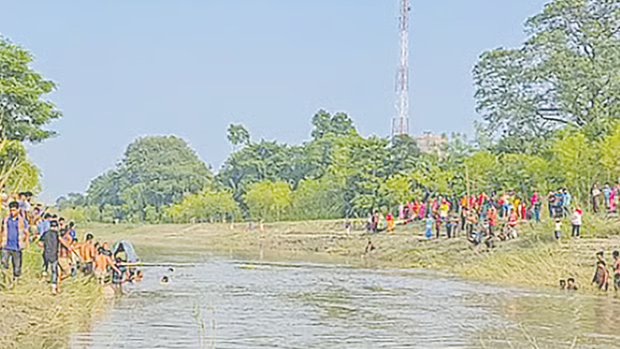
In June 2025, these iron plates were removed. It was the monsoon season. Getting just this little opportunity, the water of the Ganges rushed into the Baral river. After almost 40 years, the flow of Ganges water into the Baral appeared as a ‘miracle’ and created a sensation in the entire area.
Thousands of people gathered on both sides of the Charghat sluice gate day after day to witness this marvel. It became like a festival! The truth that the endless surveys of BWDB and its partner consulting firms tried to hide, real-world experience proved beyond doubt.
That truth is: to revive the Baral, the foremost task is to remove this sluice gate and construct a bridge spanning the river’s original width according to the CS record. Being enthusiastic about river dredging instead is much like putting the cart before the horse. That cart cannot move.
Now that real-world experience has irrefutably proven the necessity of removing the sluice gate, BWDB has brought up a new bogeyman. That is, the influx of water from the Ganges could cause floods in the Baral basin! Therefore, according to BWDB, it would be appropriate to wait a few years to see if flooding occurs before making a final decision on removing the sluice gates.
For nearly 40 years, the water of the Ganges could not enter the Baral. The once fast-flowing, wide Baral, which carried large merchant sailboats, turned into the ‘Dead Baral’. Not the slightest regret was observed from BWDB and its consulting partners. But now, when public movements have finally created an opportunity for Ganges water to enter the Baral, they seem to be losing sleep worrying about potential floods!
Above all, they seem to have a ‘trump card’ in their hands. That is the Dayarampur Cantonment, located in Qadirabad, near the Baral. The residents of this cantonment are people of this country. The current Bangladesh Army are the successors of those who fought the liberation war in the mud and water in 1971.
It shouldn’t be unknown to them that river water can enter floodplains, and they should welcome the river water. If for any reason river water is highly undesirable, they can build embankments as needed next to the cantonment or raise the land level of the flood-prone parts of the cantonment by filling it with earth.
Freeing the Baral and saving the ecosystem of the entire Chalan Beel area is a national duty. Portraying the army as an obstacle to this duty is akin to pitting the army against the people. BWDB should refrain from such activities.
4.
This fear of flooding proves a fundamental lack of thought about the role of rivers in deltas like Bangladesh by BWDB and partner consultants. Active floodplains will be flooded every year or frequently; this is expected and desirable. It is due to such flooding that siltation occurs on the floodplain; land elevation increases; water bodies and groundwater aquifers are replenished; less siltation occurs in the riverbed; the riverbed remains deep; and the ecosystem of the entire basin remains healthy.
Conversely, if floodplains are isolated from riverbeds through embankments, both the floodplain and the riverbed suffer. The foreign creators of the Master Plan failed to realize this fundamental truth of the delta. Regrettably, most officials in Bangladesh engaged in water management also fail to comprehend this basic truth.
There are two main reasons for this. One is cognitive. BWDB and partner consulting firms consist primarily of engineers. They learn engineering, but many of them do not gain a comprehensive understanding of rivers.
The second reason is material. They have an interest in large-budget projects, which can benefit them more financially. The best way to increase the budget is to include the construction of structures in the project. That is why it is seen that where the entire population of the Baral region is in favor of removing the sluice gates built on this river, BWDB is preparing surveys containing recommendations for constructing more sluice gates.
As a result, a conflict between the interests of BWDB and the interests of the people is arising. Just like in Bhabadah, in the Baral basin too, BWDB is appearing to the public as an anti-people organization. If BWDB wants to keep the sluice gates on the Baral against the will of the people and attempts to reinstall the removed gates for that purpose, there is no doubt that a conflictual situation will arise with the local people, and BWDB will have to bear the responsibility for it.
Looking at the situation, it is clear that instead of being a helper in protecting Bangladesh’s rivers, BWDB has largely become an obstacle. The question now is, how can this obstacle be removed?
Dr. Nazrul Islam
Professor, Asian Growth Research Institute
Former Chief of Development Research, United Nations
Founder, Bangladesh Environment Network (BEN)
The information presented here is an English adaptation based on the report published on The Daily Prothom Alo.
