
Bangladesh is staring at a severe environmental crisis due to inadequate waste management infrastructure, with urban waste generation projected to reach a staggering 1.18 lakh tons per day by 2040. To combat this looming threat, leading environmental experts, policymakers, and city officials have called for an immediate shift from traditional landfilling to a circular economy, emphasizing the strict enforcement of the Solid Waste Management Rules 2021.
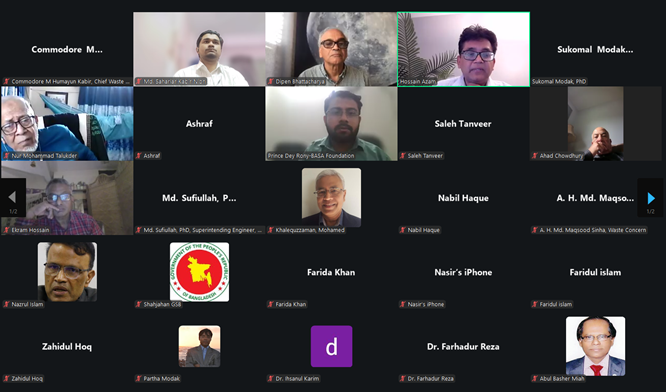
The call to action was made during the 18th bi-monthly webinar titled “Waste Management in Bangladesh: Technical-Policy Challenges, and Way Forward,” recently organized by the Bangladesh Environment Network (BEN).
Delivering the keynote presentation, Dr. Hossain M. Azam, Associate Professor at the University of the District of Columbia, USA, and his research assistant Md. Sahariar Kabir Nion painted a grim picture of the current landscape. While Bangladesh generates roughly 24,000 tons of waste daily, collection efficiency hovers only around 45% to 55% nationally.
“The uncollected waste inevitably ends up polluting our environment, clogging drainage systems, and exacerbating urban flooding,” Dr. Azam noted. He highlighted that about 70% of Bangladesh’s waste is organic, yet the formal recycling rate remains dismally low at around 3%.
The keynote emphasized severe infrastructural deficits, including a lack of sanitary landfills, the absence of material recovery facilities (MRFs), and limited integration of the informal recycling sector.
Officials from Dhaka’s city corporations acknowledged the hurdles but shared ongoing initiatives aimed at mitigating the crisis. Commodore SM Humayun Kabir, Chief Waste Management Officer of Dhaka North City Corporation (DNCC), discussed the technical and policy challenges of managing a mega-city’s waste. He stressed the importance of public compliance and shared that DNCC is looking into integrating modern technologies, including orbital satellite monitoring for real-time waste tracking and Waste-to-Energy (WtE) WtE projects, though WtE faces policy and environmental compliance hurdles.
Representing Dhaka South City Corporation (DSCC), Superintending Engineer Dr. Md. Shafiullah Siddique Bhuiyan admitted that the current “semi-sanitary” landfills are stretched to their limits. “We cannot rely solely on landfill technologies due to land scarcity in Bangladesh,” Dr. Bhuiyan said. To reduce the landfill burden, DSCC is initiating pilot projects for at-source segregation—separating wet and dry waste—and converting Secondary Transfer Stations (STS) into Material Recovery Facilities.
A major consensus among the panelists was the need to view waste not as a burden, but as a resource. Abu Hasnat Md. Maqsood Sinha, Co-founder of Waste Concern, criticized the lack of inter-ministerial coordination which often stalls promising waste management projects. He pointed out that while Bangladesh has excellent policies on paper—such as the Solid Waste Management Rules 2021 and Extended Producer Responsibility (EPR) guidelines—implementation remains painfully slow.
“Waste is a raw material,” Sinha argued, showcasing successful integrated resource recovery facilities in cities like Jashore and Khulna. He urged the government to provide financial incentives, tax holidays, and soft loans to private investors to boost the recycling and composting industries.
Adding to this, Prince Dey Rony from the BASA Foundation shared field-level successes in fecal sludge and solid waste management using nature-based solutions, such as co-composting and black soldier fly innovations, emphasizing the need for robust Public-Private Partnerships (PPP).
Beyond technology and policy, experts highlighted the critical need for a shift in public mindset. Session Chair Dr. Dipen Bhattacharya, retired astrophysics professor and BEN coordinating committee member, called for a “behavioral revolution.” He lamented the lack of social commitment regarding waste disposal in the national curriculum. “Until we instill a sense of civic responsibility in our education system from childhood, merely setting up bins will not solve the problem,” he remarked.
Echoing this sentiment, BAPA leaders, including Global Coordinator Dr. Md. Khalequzzaman and Mohidul Hoque Khan, warned that rural areas and water bodies are rapidly turning into dumping grounds. They urged the formulation of a specific 100-day roadmap to present to the government, demanding immediate, decentralized technological solutions and nationwide enforcement to save the country’s rivers and canals from catastrophic pollution.
The webinar concluded with a unified plea which is protecting Bangladesh’s environment requires not just new technologies, but immediate enforcement of existing laws, cross-sector coordination, and the active participation of every citizen.
