
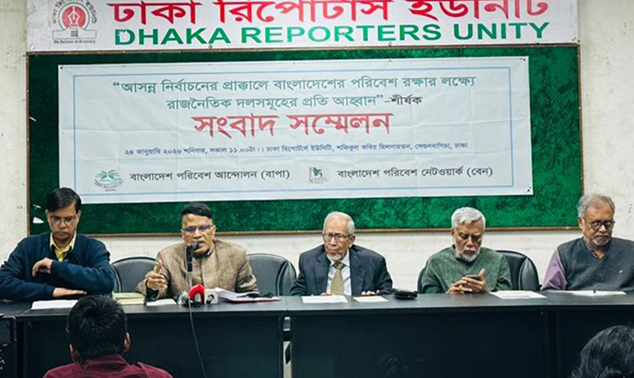
BAPA and BEN held a joint press conference at Dhaka Reporters Unity on January 24, 2026, titled “Call to Political Parties to Protect Bangladesh’s Environment on the Eve of the Upcoming Election.” They directly indicted political involvement in environmental destruction and demanded all parties incorporate concrete environmental commitments into their election manifestos. The conference asserted that, without systematic institutional reform and electoral accountability, environmental protection will remain perpetually subordinated to political and corporate interests.
Presiding over the conference, BAPA President Professor Nur Mohammad Talukder sharply criticized the interim government’s environmental record. While acknowledging reforms in other sectors, he stressed that environmental protection has received neither substantive policy change nor adequate budget. “There is no visible reform or adequate budget allocation in important sectors like environment, education, and health. No clear plan has been adopted considering future generations,” he stated, framing environmental neglect as part of a broader governance crisis. Talukder characterized most political parties and candidates as “representatives of capitalists,” reflecting BAPA’s view that environmental destruction stems from economic elites profiting from natural resources while imposing the costs on vulnerable populations.
Dr. Talukder expressed explicit skepticism about political parties’ environmental commitments, stating he was “not very optimistic about these initiatives” despite BAPA’s detailed policy outreach. This reflects BAPA’s experience that electoral promises on the environment historically vanish after elections, as governments prioritize short-term growth and vested interests over ecological sustainability. Consequently, he urged the public to demand binding, transparent environmental pledges from parties and candidates. This call for civic mobilization recognizes that genuine protection requires sustained grassroots pressure to hold elected officials accountable, not elite consensus alone.
In his keynote address, BAPA Vice President Professor Nazrul Islam highlighted a fundamental paradox: despite rising per capita income, average life expectancy in Bangladesh is declining. He argued that income growth is failing to improve public welfare, identifying air pollution and broader environmental degradation as primary causes, warning: “If we cannot stand up against pollution right now, we will face a major crisis.” This causal link underscores BAPA’s central argument that environmental protection is a fundamental human development imperative, not a sectoral luxury. Dr. Islam’s analysis stressed that institutional reform is a prerequisite for environmental protection, arguing that technical and legislative solutions are inadequate without honest, capable, and efficient government agencies. He cautioned that the historical patterns of casual corruption, bureaucratic incompetence, and misaligned incentives must be fundamentally restructured. This extends BAPA’s broader view that environmental destruction stems not from a lack of laws, but from institutional dysfunction that prevents enforcement, combined with political patronage that shields violators.
Moderating the press conference, General Secretary Md. Alamgir Kabir synthesized recommendations from the January National Conference into concrete demands. He called for urgent action on air pollution, solid waste, river encroachment, waterlogging, coastal and forest protection, and planned urbanization. Crucially, Kabir stressed, “Whichever political party forms the government… we must know their clear plan for environmental protection. People must play a vocal role in this regard.” This positions environmental governance as an electoral litmus test and demands transparency from parties before the election. Md. Kabir articulated a fundamental analytical framework later expanded by Vice President Zakir Hossain: “Wherever the environment has been destroyed, there is evidence of political involvement.” This claim, that environmental destruction is systematically linked to political actors and patronage networks, represents BAPA’s strongest indictment of Bangladesh’s political economy. Documented cases include river encroachment for real estate, industrial pollution by connected entrepreneurs, forest destruction for elite timber networks, and coastal degradation from politically backed shrimp farming. The message is clear: perpetrators operate under political protection, and accountability requires the will to prosecute environmental criminals irrespective of their power or affiliation.
BAPA Vice President Zakir Hossain expanded this critique, identifying corruption and administrative failure as root causes. He stated, “Environment is destroyed due to administration and corruption. Parties should not give important responsibilities to those within their own parties who are involved in environmental destruction. One of the main reasons for environmental pollution is the lack of coordination and boundless corruption of the relevant agencies.” This critique moves beyond individual violations to indict institutional dysfunction, where a lack of coordination between multiple government agencies enables contradictory interventions and prevents coherent governance. Corruption within these agencies allows violators to evade enforcement through bribery and political connections.
BAPA Vice President Mohidul Haque Khan addressed the need for systemic reform: “We need to think about our environment holistically and find specific paths to solutions. Resistance must be built against air and environmental pollution. A qualitative change is needed to protect the environment.” His call for a “qualitative change” recognizes that incremental policy adjustments are insufficient; fundamental restructuring of governance institutions, electoral accountability, and development paradigms is necessary. It emphasizes that short-term profit extraction cannot be allowed to destroy long-term ecosystem integrity and livelihood sustainability.
The press conference presented BAPA-BEN’s 12-point recommendation for political parties: controlling air pollution; managing solid waste; disposing of liquid waste to protect water bodies; stopping river degradation and encroachment; resolving waterlogging; protecting coastal areas; securing fair water-sharing with India; developing domestic Teesta protection plans; transitioning to renewable energy; protecting forests; pursuing planned urbanization; and mitigating traffic congestion. These demands synthesize the January National Conference into specific, voter-evaluable policy commitments.
