
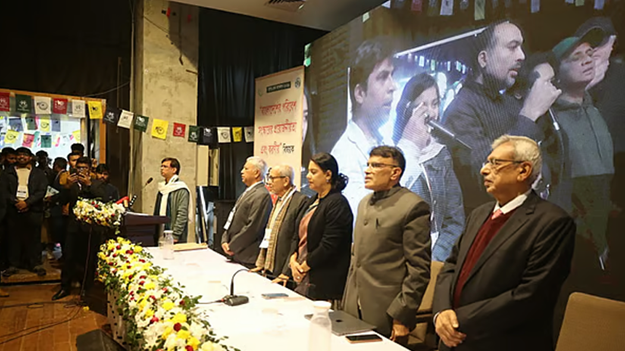
The Bangladesh Poribesh Andolon (BAPA) and Bangladesh Environment Network (BEN) jointly held the National Conference on Environmental Reforms: Necessity and the Way Forward at the KIB auditorium in Dhaka on January 9–10, 2026. The two-day conference brought together environmental scientists, policymakers, economists, activists, and civil society representatives from across Bangladesh to develop a comprehensive, people-led blueprint for institutional and policy reforms to address the country’s escalating environmental degradation.
Inauguration
The inaugural session began with the national anthem. Presided over by BAPA President Professor Nur Mohammad Talukder, the opening set the intellectual framework for the deliberations. Each speaker addressed specific dimensions of the environmental governance challenges facing the nation, reflecting a structured focus on institutional and policy reform.
Professor Feroze Ahmed
Professor Feroze Ahmed, Convener of the Conference Preparation Committee, delivered the welcome address. He emphasized the conference’s mandate to document persistent weaknesses in environmental conservation despite progressive laws. Crucially, Dr. Ahmed outlined the strategic goal of turning deliberations into political commitments, stating: “We will give the proposals from this conference to political parties for inclusion in their manifestos.” This direct link between expert analysis and electoral accountability underscored the conviction that environmental governance must be a non-negotiable part of party platforms before the February 2026 national elections.

Dr. Nazrul Islam
BAPA Vice President and BEN Founder, Professor Dr. Nazrul Islam, presented the keynote paper, with Professor Nur Mohammad Talukder chairing the session. Dr. Islam’s keynote established the conference’s intellectual foundation, arguing that Bangladesh’s environmental degradation is not just a technical issue but a systemic institutional failure. He emphasized the disconnect between policy formulation and implementation, noting that while legislative frameworks exist, such as the Environment Protection Act and regulations on wetlands and biodiversity, enforcement remains chronically weak due to inadequate institutional capacity and misaligned bureaucratic incentives.

Syeda Rizwana Hasan
Syeda Rizwana Hasan, Adviser to the Ministries of Environment, Forest and Climate Change; Water Resources; and Information and Broadcasting, served as chief guest. Her address endorsed the conference’s reform goals and outlined the interim government’s environmental agenda. She stressed the need for “continuity” in environmental protection across political transitions, detailing actions including legal amendments, new policies, and institutional reforms. Her three strategic priorities were: enhancing institutional capacity, developing data and monitoring systems, and tackling industrial and household pollution, salinity, and reduced river flow. Notably, she acknowledged a key regulatory failure, citing the patchy enforcement of the 2002 polythene ban, which validated the conference’s core diagnosis that laws alone are insufficient without enforcement. She announced comprehensive river restoration projects for five rivers in Dhaka and eight others nationwide, focusing on waste removal and navigability, an approach aligned with BAPA-BEN’s ecological “Open Approach.” On pollution control, she highlighted new noise pollution rules empowering police with fines, while also calling for citizen “social responsibility,” framing environmental protection as a shared statutory and civic duty.

Professor Nur Mohammad Talukder
BAPA President Professor Nur Mohammad Talukder, chairing the session, framed the conference as a strategic institutional effort to convert two decades of expertise, analysis, and activism into actionable reform blueprints, aligning with government openness to restructuring. He also highlighted the organization’s involvement in the movement to protect Panthakunja Park from the proposed elevated expressway, illustrating the broader fight to preserve urban green spaces and water bodies from infrastructure encroachment.
Professor Md. Khalequzzaman
Professor Md. Khalequzzaman, Global Coordinator of BEN, delivered the vote of thanks, recognizing the participation of the interim government’s environmental leadership and reaffirming the civil society-state partnership in advancing environmental governance.
Closing
The closing session convened on January 10 in the Chalan Beel room. BAPA President Professor Nur Mohammad Talukder presided, tasked with synthesizing the outputs from the working groups, thematic sessions, and plenary deliberations into a coherent reform agenda.

Dr. Wahiduddin Mahmud
Dr. Wahiduddin Mahmud, Adviser to the Ministry of Planning, attended the closing session as chief guest, signaling the state’s integration of environmental reform into national planning. His participation underscored the government’s recognition that environmental sustainability must be embedded within macroeconomic planning and resource allocation, not treated as a sectoral afterthought.

Md. Alamgir Kabir
Md. Alamgir Kabir, General Secretary of BAPA, delivered the closing vote of thanks, acknowledging the government advisers, delegates, and civil society representatives. He reiterated BAPA-BEN’s commitment to turning conference recommendations into actionable proposals for political parties ahead of the national elections.
A cultural program followed in the Chalan Beel room, offering ceremonial closure and informal dialogue among participants. This program symbolically affirmed the movement’s cultural roots while providing a practical space for networking among scientists, activists, policymakers, and civil society.
