
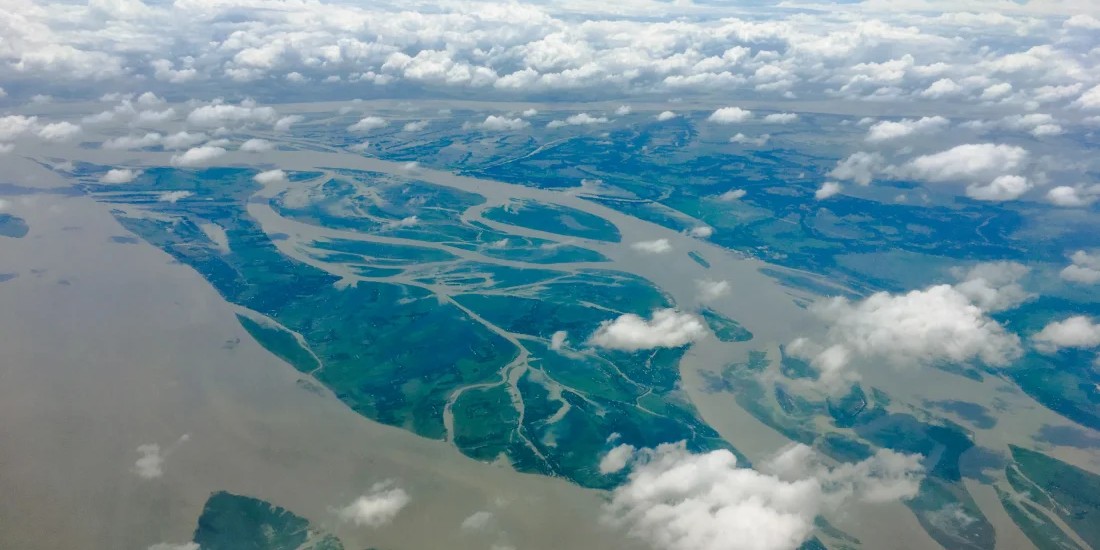
The fourth Sunday of September every year marks the World Rivers Day. People around the world celebrate rivers and recognize their ecological and economic importance (Sayuj, 2026). However, in Bangladesh the day highlights environmental crisis. Rivers are central to this country’s identity, economy and survival yet many of them are dying. A fisherman on the Turag River recently said that his river had been dead for three years. His words revealed the disturbing reality and showed how this destruction has become part of their everyday life (Ahmad, 2026). Funny how the world celebrates rivers while Bangladesh struggles to save its waterways from pollution and illegal encroachment.
At least 79 rivers across Bangladesh have reportedly died or are drying up and Dhaka has lost five major rivers along with 17 connecting canals (Parveen, 2022). The five rivers are the Buriganga, Turag, Balu, Dhaleshwari, and Shitalakkhya. The ready-made garment industry is a major contributor to Bangladesh’s economy but it also creates a significant wastewater problem. The sector reportedly discharges approximately 5.6 crore tons of wastewater every year (Ahmad, 2026). The Buriganga ranks among the world’s most polluted rivers and more than 60,000 cubic meters of toxic waste reportedly enter its waters every day (Rizve & Siam, 2026). This pollution consunes dissolved oxygen and threatens aquatic life as well as places nearby communities at risk. Industrial growth in developing countries like ours always come at the cost of rivers and public health.
The government has spent billions of takas on river restoration over the past two decades including dredging, boundary demarcation and industrial relocation but the results remain same disappointing. Many projects have failed to control pollution at its source. The relocation of the Hazaribagh tannery estate to Hemayetpur in Savar provides a clear example. The project was intended to reduce pollution in the Buriganga but it shifted much of the environmental burden to the Dhaleshwari River. The Savar Tannery Industrial Estate reportedly releases more than 15,000 cubic meters of untreated wastewater into the Dhaleshwari every day (Rizve & Siam, 2026). Its central effluent treatment plant remains only partially operational. Local farmers and fishing communities continue to suffer from industrial pollution.
Illegal encroachment and poor administration have also damaged the country’s waterways. In 2009, the High Court issued a major directive for the eviction of illegal river encroachers. The Bangladesh Inland Water Transport Authority later installed concrete pillars to mark river boundaries. However, investigations found that thousands of these pillars had been placed deep inside riverbeds instead of along the actual banks (Parveen, 2022). This mistake reduced the apparent width of the rivers and helped protect some existing encroachments. The legal framework has also developed over time. In 2019, the High Court recognized rivers as living entities with legal rights. Yet practical enforcement remains weak. Eviction drives often attract public attention but powerful encroachers frequently return within months and reclaim riverbanks for housing and commercial activities.
The Baral once stretched for approximately 220 kilometers and connected the Padma and Jamuna rivers. Its condition deteriorated after the Bangladesh Water Development Board installed restrictive sluice gates at Charghat and Atghori to control flooding (Khandakar & Kar, 2020). These structures disrupted the river’s natural flow. Heavy siltation followed and the river gradually became a series of disconnected stretches of lifeless, polluted waterbody. Local residents with the help of Bangladesh Poribesh Andolon (BAPA) with supports from Bangladesh Environment Network (BEN) formed the Baral Raksha Andolon and campaigned for years to restore their river. In August 2025, authorities opened the sluice gates and allowed water from the Padma to flow back into the Baral (Islam, 2025).
The government has recently taken steps to strengthen its response to river pollution. In August 2026, Prime Minister Tarique Rahman warned that future generations would hold the country accountable if river pollution continued (The Climate Watch, 2026). He ordered the formation of an inter-agency coordination committee and he called for stronger enforcement of environmental regulations. The committee will oversee a time-bound action plan for Dhaka’s dying rivers. A new US$370 million World Bank financing package aims to improve Dhaka’s wastewater management and restore ecological functions (Rizve & Siam, 2026). The initiative focuses on untreated sewage and industrial discharge rather than riverfront beautification alone. These measures could mark a turning point for Bangladesh.
For Bangladesh World Rivers Day is a reminder of the urgent need to protect the country’s waterways. Bangladesh already has laws, restoration plans and public support for river conservation. The country now needs consistent enforcement and a long-term commitment to environmental protection. Industries must stop releasing untreated waste and authorities must prevent illegal encroachment. Communities must also remain involved in conservation efforts. The future of Bangladesh depends on the survival of its rivers.
References
Ahmad, S. (2026). International Day of Action for Rivers: Bangladesh’s rivers are dying, and so is its future. The Daily Star. Retrieved from https://www.thedailystar.net/opinion/views/news/bangladeshs-rivers-are-dying-and-so-its-future-4128131
Islam, N. (2025). বড়াল নদের দৃষ্টান্ত আমাদের যে শিক্ষা দিয়েছে. Prothom Alo. Retrieved from https://www.prothomalo.com/opinion/column/swdmy57pex
Khandakar, R., & Kar, D. K. (2020, January 3). ‘বড়াল’ নামে এক নদী ছিল. Ittefaq. Retrieved from https://www.ittefaq.com.bd/119063/%E2%80%98%E0%A6%AC%E0%A7%9C%E0%A6%BE%E0%A6%B2%E2%80%99-%E0%A6%A8%E0%A6%BE%E0%A6%AE%E0%A7%87-%E0%A6%8F%E0%A6%95-%E0%A6%A8%E0%A6%A6%E0%A7%80-%E0%A6%9B%E0%A6%BF%E0%A6%B2
Parveen, S. (2022). দখল-দূষণে হারিয়ে গেছে ঢাকার ৫ নদী. Sangbad Sarabela. Retrieved from https://sangbadsarabela.com/special/article/5844/%E0%A6%A6%E0%A6%96%E0%A6%B2%E0%A6%A6%E0%A7%81%E0%A6%B7%E0%A6%A3%E0%A7%87-%E0%A6%B9%E0%A6%BE%E0%A6%B0%E0%A6%BF%E0%A7%9F%E0%A7%87-%E0%A6%97%E0%A7%87%E0%A6%9B%E0%A7%87-%E0%A6%A2%E0%A6%BE%E0%A6%95%E0%A6%BE%E0%A6%B0-%E0%A7%AB-%E0%A6%A8%E0%A6%A6%E0%A7%80
Rizve, S., & Siam, F. U. (2026). Billions down the drain, yet Dhaka’s rivers are still dying. The Business Standard. Retrieved from https://www.tbsnews.net/features/panorama/billions-down-drain-yet-dhakas-rivers-are-still-dying-1454166
Sayuj, M. (2026). World Rivers Day 2026: Date, Theme, History and How to Take Part. Banyan Nation. Retrieved from https://www.banyannation.com/blog/world-rivers-day/
The Climate Watch. (2026). Save rivers now or face future generations, PM warns as Bangladesh steps up fight against pollution. The Climate Watch. Retrieved from https://theclimatewatch.com/save-rivers-now-or-face-future-generations-pm-warns-as-bangladesh-steps-up-fight-against-pollution/