
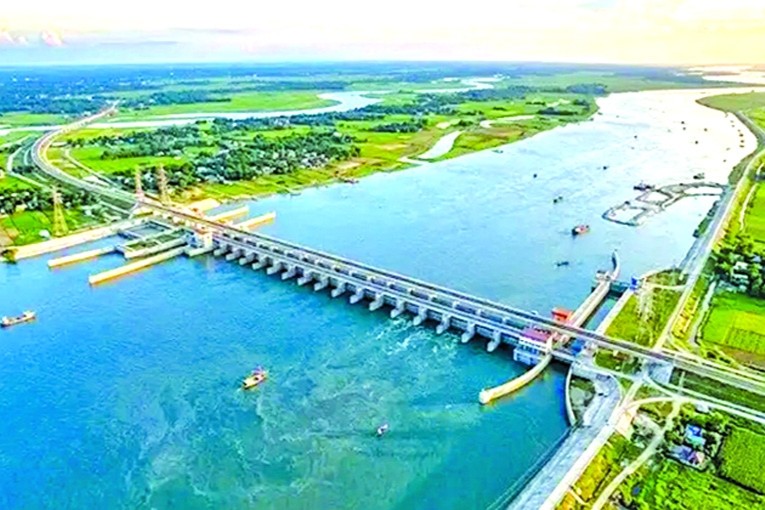
On June 6, Dr. Nazrul Islam delivered a critical speech virtually at the National Press Club in Dhaka during a discussion meeting focused on the proposed Ganges Barrage. Here are the core arguments he made during his speech:
On Transparency and the 65,000 Crore Taka Cost
“Now the government side is saying that they supposedly undertook this project by discussing it with the people. So, who did they discuss it with? The bigger question is how the discussion took place, because the feasibility study of this project… the government has not published that feasibility study. So the people could not know about the study… how will the people express their opinions?”
“Such a massive project, which is 65 thousand crore taka. Because this project was undertaken during the Awami League government’s tenure, and there, it was included in the Delta Plan 2100… its budget was 5.15 billion dollars, and in current terms, that is about 65 thousand crore taka. Now the government, this ministry, to show off, has divided it into two phases to make approval easier… But you cannot finish the project by doing half of it; the second phase has to be done. Therefore, the total budget remains.”
“You start a project now, and then you think, ‘No, this isn’t going well,’ then you can’t come back. There is no opportunity to come back with information here. Therefore, you are going to do such a massive thing, and the burden of which the people will have to bear… Shouldn’t that have been done by discussing it calmly and taking everyone’s opinion?”
On the “Monsoon Water” Myth and Missing Winter Water
“The matter of great concern is that, in this project… there are major technical problems left in it.”
“A false conception has been created among many here that through this project, your monsoon water can be retained and that can be used in winter. This is a completely false conception. Because retaining monsoon water for use in winter is not the main objective of this project. The main objective of this project is that the water that will come in the Ganges during winter, that water will be prevented from going entirely towards Goalanda, it will be obstructed at Pangsha.”
“During the monsoon, the daily flow of the Ganges is about 150 crore cubic meters. So, that means two days of flow will fill up your entire capacity. So then where will the rest go? The rest of the water will have to be released. Therefore, with the monsoon water that you retain there, you won’t be able to do anything with just that.”
“The winter flow is very low… according to your project, you have calculated that out of that, you will send 28,240 cusecs to the Pangsha river. So how much will go towards Goalanda? Towards Goalanda, then, there remains only 4,730… But if we look at the statistics, in the month of April, sometimes the lowest flow drops to only 11,649. And in March, it decreases even more, to 7,483. That means the 28,240 you want to send, that water isn’t even here! So how will you achieve that target there?”
On Siltation and the Failures of Sluice Gates
“Where you will put the dam at Pangsha, upstream of the dam, sedimentation will occur, which happened at Farakka. A dam was built at Farakka; upstream of it, about 330 to 40 crore tons of silt is deposited annually. As a result of which, the riverbed of the Ganges there… has become 20 feet higher. And erosion, about 100 kilometers of land has gone into the water. And about 50 thousand families have become destitute. So will we invite that same consequence to the area from Pangsha to Rajshahi?”
“Now you have said that, ‘no, that much silt won’t come, and our barrage here will be of advanced technology, here underwater there will be submerged sluice gates.’ … But in our country, the experience with sluice gates is very tragic. You travel around the whole country, you will see not a single sluice gate is working; all are closed, blocked by accumulated silt. So this is even more underwater. You can’t even maintain the sluice gates above, and how will you maintain them underwater? They will quickly close, and silt will accumulate. Due to the silt accumulation, the riverbed of the Ganges from Pangsha to Rajshahi will become even higher, and erosion on both banks will increase further.”
On the Threat to the Padma River and Downstream Ecology
“On the other hand, downstream of Goalanda, you are not providing any water. And as a result, that area, I mean, will fall into a terrible crisis. We have the experience of Teesta right in front of our eyes. Same thing… Where the river was a meandering river… you are not letting any water go there… the riverbanks broke and it became wide. And as a result, that river has now turned into an undesirably wide, braided river. Now, by spending 12 thousand, 13 thousand, 15 thousand crore taka, you have undertaken a new project to bring that river back to its previous state. Now, despite having this kind of experience, in the case of Padma, you are wanting to walk down exactly the same path, that you will build a barrage. With that, you think you will solve the problem; actually, you will, I mean, ruin the Padma River.”
“What will be the situation towards Goalanda? Is there no river there? There are branches of the Padma there. The Arial Khan River is there. Water goes from there to the Barisal division. And then water goes to the Meghna estuary. Water will decrease in all these places. As a result, what will be the reaction there? Shouldn’t you bring that into the discussion? In your feasibility study, there is no such discussion… what will happen to further salinity intrusion there? You are not doing any analysis of all this.”
On Existing Blockages Causing the Flow Issues
“You are saying here that you will raise it 12 meters here, and then the water will flow. But right now, during the monsoon, below the Hardinge Bridge, naturally, the height of the Ganges water stays between 12 to 15 meters during the monsoon. Why doesn’t this water flow? You yourselves have said that the water doesn’t flow.”
“The obstruction there is even more complex. You have built a sluice gate there. Where you needed a 300-foot bridge, you built a 20-foot culvert. You have built an entire structure over the river. These all have to be cleared… Why doesn’t water flow in the Baral River? Because you have built a sluice gate at Charghat and kept it closed. Why doesn’t water flow in the Ichamati River? Because you have enclosed the Ichamati River! … You open up all these mouths of all the rivers, do it. Then you come to discuss the Ganges Barrage. Instead of doing that, you keep all those problems alive there and now you are moving forward with a 65 thousand crore taka project.”
On Falling into India’s Trap and the Real Solution
“This dam you are building, by doing this, you are walking into India’s trap. Because India wants you to build this barrage. Because then India will be able to completely reject Bangladesh’s demand, the demand for its share of this dry season water. They will say, ‘You have built a barrage, raise it higher if you need to, we don’t have water to give you.’ … Suvendu Adhikari is even more hardline; he might say it even more clearly, that ‘no, we don’t have water to give.'”
“Take a completely different route… open up all the rivers. Let the monsoon water flow well. Make arrangements to store the monsoon water in all the floodplains. Make arrangements so that groundwater is recharged even more. Then the flow of water will increase here during the winter season. And then you will be able to solve it somewhat here. If you don’t do that, the path you have taken will result in a waste of money and the problems in the future will become even harder.”