
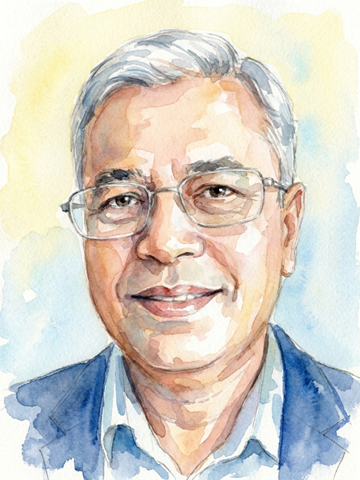
Renowned water resource management, delta geology, and coastal environment expert Dr. Md Khalequzzaman has said that before proceeding with the Padma Barrage, Bangladesh should secure a strong Ganges treaty. The guarantee clause that was in the 1977 treaty must be brought back. A future treaty ideally should be for the whole year and should also include Nepal. The treaty needs to have clear clauses not just on water, but also on sediment flow.
He believes the most important thing is integrated river basin management. All countries in the Ganges-Brahmaputra-Meghna basin must work cohesively. Upstream decisions directly affect the downstream population. Bangladesh must make hydro-diplomacy one of the cornerstones of its foreign policy.
Dr. Md Khalequzzaman said this in an interview with Naya Diganta. He is a distinguished professor and researcher in the Department of Environmental, Geographical, and Geological Sciences at Commonwealth University of Pennsylvania, USA, specializing in geology and oceanography. Known as ‘Dr. K’, this researcher has been working for a long time primarily on water resource management, delta geology, and the coastal environment. In particular, he has conducted significant research on the Meghna River, the Ganges-Brahmaputra-Meghna basin, the sharing of transboundary river waters, and the crisis facing Bangladesh’s rivers and coastal ecosystems due to the impact of climate change.
His position on the free flow of rivers, fair water sharing, and sustainable river management has always been clear. He has emphasized integrated river basin management for Bangladesh’s 54 shared rivers, including the Meghna. Dr. Khalequzzaman believes that if the natural flow of rivers is disrupted by the construction of large dams or barrages upstream, it can create a water crisis, navigability issues, and environmental disasters in the downstream regions.
He recently spoke about the proposed Padma Barrage project, the Ganges treaty, sediment flow, the future of the Meghna basin, and Bangladesh’s long-term water security.
Question: How do you evaluate the proposed Padma Barrage project?
Dr. Md Khalequzzaman: First of all, I want to say the original name of the project was the Ganges Barrage. That is a much more appropriate name. This is because up to Daulatdia, the river is known as the Ganges. The naming ‘Padma Barrage’ might create the perception that the question of Bangladesh’s fair share of the Ganges water is being hidden.
For a delta to survive, the flow of sediment to the coast is extremely important. It is this accumulated sediment that creates new land and makes it possible to combat the risk of rising sea levels. In the 1960s, about 2 billion tons of sediment used to arrive in Bangladesh every year. Currently, it has come down to between 600 million and 1 billion tons. The main reason for this is various infrastructural interventions upstream.
After the construction of the Farakka Barrage, a huge amount of sediment is getting trapped there. Now, if another barrage is built in Pangsha, Rajbari, a large portion of the sediment that enters Bangladesh during the monsoon will also get trapped. This will further reduce the supply of sediment downstream, damaging the river’s natural flow and the coastal ecosystem.
The experience of Farakka in West Bengal, India, is a great lesson for us. Various studies have shown that Farakka has trapped a massive amount of sediment, reducing the river’s capacity to carry water. This has increased waterlogging, flooding, and erosion. Thousands of families in the Malda and Murshidabad regions have been affected. Therefore, before building another barrage in Bangladesh within the same river system, the matter needs to be thought through deeply.
Question: The Ganges water sharing treaty is expiring in 2026. In this situation, how realistic is the Padma Barrage?
Dr. Md Khalequzzaman: In my opinion, this is a very premature and hasty decision. Because of Farakka, Bangladesh does not get enough water during the dry season. We analyzed 20 years of data and saw that despite the treaty, Bangladesh did not get its fair share about 52% of the time. During the most critical period, this rate of deprivation is about 65%.
The biggest weakness of the current treaty is that it doesn’t guarantee a minimum amount of water. If the flow at Farakka drops below 70,000 cusecs, the water is divided into two parts. Consequently, when the water flow decreases, Bangladesh becomes the main victim of the shortfall.
In my opinion, before moving forward with the Padma Barrage, Bangladesh should secure a strong Ganges treaty. The guarantee clause that was in the 1977 treaty must be reinstated. A future treaty ideally should be for the entire year and must include Nepal. There needs to be clear provisions in the treaty not just for water, but for sediment flow as well.
Question: What lessons can be learned from the experience of the Teesta Barrage project?
Dr. Md Khalequzzaman: The Teesta experience has clearly shown that without a guaranteed water flow from upstream, no barrage can be effective. The south-western region is already suffering from salinity, waterlogging, and a water crisis. But the Padma Barrage is not an effective solution to those problems.
The project talks about storing about three billion cubic meters of water. But the Padma carries about 350-525 billion cubic meters of water annually. Compared to that, this storage capacity is extremely insignificant.
Another major claim is that it will be possible to irrigate 1.9 million hectares of land through this barrage. But according to my calculations, irrigating that much land will require 9 to 26 billion cubic meters of water. In this case, the water stored in the barrage cannot realistically protect irrigation, navigation, environmental flow, and fisheries resources all together.
If all the water is held back, a ‘double Farakka’ type situation could emerge in the river section from Pangsha to Goalanda. The risk of a dry riverbed like the Teesta will also arise. A barrage cannot produce water.
Question: Then what kind of strategy should Bangladesh adopt for its long-term water security?
Dr. Md Khalequzzaman: Bangladesh should join the UN Watercourses Convention and ratify it in parliament. This will strengthen Bangladesh’s diplomatic and legal position regarding international rivers.
The most important thing is integrated river basin management. All countries in the Ganges-Brahmaputra-Meghna basin must work cohesively. Decisions made upstream directly affect the downstream population. Bangladesh must make hydro-diplomacy a key pillar of its foreign policy. Water and sediment are Bangladesh’s right—it is not a matter of charity or grants.
There are also many opportunities to work internally. Canals, rivers, and wetlands must be restored. Rivers that have filled up with silt must be dredged. The dredged soil can be used to raise low-lying coastal lands or for construction work.
Emphasis should be placed on restoring small rivers and tributaries in the south-western region. Many polders can be converted into eight-month embankments so that water and sediment can enter during a part of the year.
The river must be seen not as fragmented projects, but as part of the entire basin and ecological system. It is only through integrated river management that Bangladesh’s long-term water and environmental security can be ensured.
The information presented here is an English adaptation on the interview of Dr. Md. Khalequzzaman, Global Coordinator, BEN, for The Daily Naya Diganta.
