
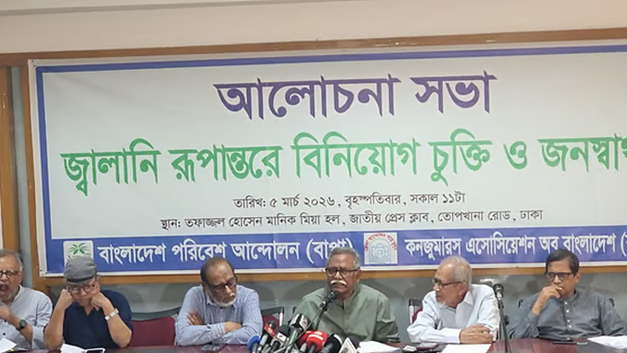
A critical discussion meeting on energy transition, investment contracts, and public interest was held at the Tofazzal Hossain Manik Miah Hall of the National Press Club. The event, jointly organized by the Bangladesh Poribesh Andolon and the Consumers Association of Bangladesh, brought together prominent economists, energy experts, and civil society representatives. They expressed deep concern over the irregularities, corruption, and unequal agreements prevailing in the energy sector. The speakers strongly demanded the public disclosure and immediate cancellation of secret and harmful contracts signed during the tenures of the recently departed interim government and previous administrations. They emphasized that adopting transparent and accountable policies to protect public interest, enhance national capacity, and end structural looting in the energy sector is the most pressing need of the hour.
Eminent economist Professor Anu Muhammad highlighted the uncertainties created in the global energy market due to international geopolitics and wars. He stated that the ongoing attacks by the United States and Israel have plunged the entire world into a state of instability, posing a severe risk to countries with fragile economies like Bangladesh. According to him, this current energy crisis was not entirely inevitable. Rather, it is the direct result of successive past governments formulating policies that favored local and foreign looting while systematically increasing the nation’s dependence on imports. He argued that if the energy sector were not dominated by foreign companies and heavy reliance on imports, the domestic power sector would not have faced such a catastrophe despite the global war situation. He strongly advocated for ensuring absolute public ownership of national mineral resources and building domestic expertise.
Engineer M A Mayeed, former chairman of the Power Development Board, exposed the alarming aspects of various power sector contracts. He pointed out that extreme irregularities exist in many power plant agreements signed without tenders under special rapid enhancement laws. In many instances, initiatives were taken to build power plants in locations that completely lacked the necessary grid or transmission infrastructure. Yet, according to the deeply flawed contracts, the producers had to be paid massive amounts of capacity charges day after day even when their electricity never reached the national grid, which is a practice he deemed suicidal for the economy. Referring to the Adani power plant, he stated that the terms of this specific project are highly detrimental to Bangladesh because the supplier was given the unilateral opportunity to determine both fuel prices and transportation costs.
Professor M Shamsul Alam, energy advisor to the Consumers Association of Bangladesh, fiercely criticized the discrimination and corruption within the energy sector. He pointed out the hypocrisy of the government asking ordinary citizens to minimize private car usage to save fuel while high ranking bureaucrats continue to use multiple vehicles for themselves and their families. He labeled the individuals involved in past energy sector corruption as energy criminals and demanded their swift prosecution. He also expressed frustration over the lack of accountability within regulatory bodies like the Bangladesh Energy Regulatory Commission, urging the government to ensure their transparency and operational independence.
Economist Professor M M Akash focused on three fundamental principles to solve the ongoing energy crisis. These include generating adequate electricity, ensuring affordable prices for consumers, and establishing an appropriate energy mix. He expressed outrage that vast sums from the gas development fund were inappropriately diverted to other sectors instead of being used for crucial gas exploration. If these funds had been utilized properly for exploration at the right time, several new gas fields could have been discovered, effectively eliminating the current excessive dependence on expensive imported liquefied natural gas and coal. He called for dismantling the corrupt triangular power structure comprising dishonest bureaucrats, politicians, and profiteering businessmen to truly serve the public interest.
Representing the youth perspective, student Nazifa Tajnoor from the CAB Youth Parliament presented a comprehensive thirteen point demand aimed at establishing good governance in the energy sector. Key among these demands were the reinstatement of the primary energy and power sectors as public service entities, a significant reduction in fossil fuel imports, an aggressive increase in renewable solar energy production, and the strengthening of gas exploration activities through domestic companies. The proposal also explicitly demanded the cancellation of the controversial Adani power contract and the immediate trial of individuals involved in monumental energy sector corruption.
Politicians Ruhin Hossain Prince and energy expert Rajekuzzaman Ratan called for building a massive mass movement to protect the energy rights of the citizens. They argued that electricity is not a luxury commodity but a fundamental right of modern life, yet it has been turned into a tool for commercial exploitation to hold ordinary people hostage. They advocated for an immediate transition towards renewable energy and the optimal utilization of domestic mineral resources to build a self reliant energy system. Ultimately, all speakers agreed that true development cannot be achieved by sacrificing national interests and that ensuring transparency and accountability in the energy sector is absolutely vital to building a secure future for the next generations.