


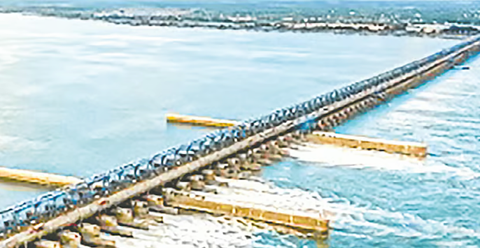
The proponents of the Padma Barrage project claim that it will bring immense development to the Ganges-dependent region. We have been hearing such claims of massive success for all water development projects since the 1950s.
1.
From various sources, what is known so far is that the Padma Barrage will be built at Pangsha in Rajbari district. Its total length will be 2.1 kilometers. It will consist of 78 spillways (water discharge gates, each 18 meters long and 12 meters wide) and 18 under-sluices (each 18 meters long and 14.5 meters wide). Additionally, there will be two fish passes.
It is estimated that due to this barrage, the water level of the Ganges from Pankha (the border point where the Ganges enters Bangladesh from India) to Pangsha will be maintained at approximately 12 meters, and the volume of stored water will be 2.9 billion cubic meters. This water will be used to revitalize the Hisna-Mathabhanga, Gorai-Madhumati, Chandana-Barasia, Baral, and Ichamati rivers. Of this, 7,600 cumecs (cubic meters/second) will flow into the Gorai-Madhumati, and 300 cumecs each into the Chandana and Hisna. For this purpose, ‘offtake’ (intake) structures will be constructed at the mouths of these rivers. The project will take seven years to implement (2026-2033).
2.
The 2016 feasibility study primarily focused on the potential benefits of the barrage. In contrast, its potential negative impacts have been either downplayed or entirely ignored; for example, the problem of upstream siltation caused by the barrage.
The study states that when most of the barrage’s gates are kept closed for 9 months of the year to store water, only 15% of the year’s silt and sand will enter. Consequently, upstream siltation due to the barrage will not be significant, and the riverbed will rise by only 3.28 feet in 60 years.
First, this claim is inconsistent with the Farakka experience. Various studies on Farakka show that over the past 52 years, the riverbed upstream of Farakka has risen by nearly 20 feet in some places.
Second, it might be that the addition of 18 under-sluices to the proposed barrage made the study authors more optimistic about sediment discharge. Notably, since each measure 18 x 14.5 meters, the total width of the under-sluices will be 261 meters, which is only one-eighth of the total length of the barrage (2,100 meters). Furthermore, Bangladesh’s experience shows that calculations on paper often do not hold up in reality. As a result, there is a risk that these discharge points will also quickly become clogged with silt and sand. Because they are underwater, clearing these clogged discharge routes will also be difficult.
Therefore, the optimism expressed in the study regarding low upstream siltation may not prove true. In that case, upstream siltation will exceed estimated amounts; the Ganges riverbed will continuously fill up, and the severity of floods and riverbank erosion will increase. On the other hand, with less sediment in the downstream water, the river will erode its banks at a higher rate to regain its sediment balance. Consequently, there is a risk of increased riverbank erosion both upstream and downstream of the barrage.
Even more crucial is the danger of reduced water flow downstream. Notably, while there might be room for debate regarding sediment reduction downstream, there is no scope for debate regarding water reduction. Because whatever amount of water is diverted upstream for the tributaries of the Ganges, the water in the Ganges tributaries and the Padma downstream will decrease by exactly that same amount. For Bangladesh, this is what is called a ‘zero-sum game’ in English. That is, the distribution of water between upstream and downstream can be altered, but no change in the total volume of water is possible.
In fact, the feasibility study itself makes this quite clear. It shows that due to the barrage, the river’s water level up to Pangsha will be about 12 meters. But right after Pangsha, this level will drop to only 1 to 5 meters, depending on the month of the year. Needless to say, this will have severe negative impacts. Yet, there is not a single sentence in the study about what impact the proposed barrage will have downstream of Pangsha. It is as if the Padma River ends at Pangsha!
3.
Unfortunately, this attitude of the BWDB (Bangladesh Water Development Board) mirrors India’s attitude toward Bangladesh. We have previously seen that the attitude of many in India is that the Ganges ends at Farakka. There might be a rationale behind this Indian attitude—because they are not that concerned about the impact of Farakka on Bangladesh. For India, it is a ‘positive-sum game’—whatever water they can divert is their gain; they have nothing to lose. But the area after Pangsha is also Bangladesh! Shouldn’t the impact of the Padma Barrage on that area be taken into consideration when making decisions about this project?
First, the scarcity of surface and groundwater from Pangsha to Goalanda will further increase, resulting in a decline in crop and fish production in that area.
Second, the total flow of the Padma will decrease after Goalanda. One might say that because the waters of the Jamuna join there, the total flow of the Padma won’t decrease that much. But we know that under the river-linking project, India is also continuously engaged in diverting the waters of the Brahmaputra westward, utilizing the Gazaldoba barrage built over the Teesta for this purpose.
Furthermore, due to the construction of one dam after another over the Brahmaputra in Tibet by China further north, the volume of water received from glacier melt is also decreasing. As a result of all this, problems are already appearing at the sources of rivers originating from the Jamuna, such as the Louhajang, Dhaleshwari, and Kaliganga. Due to the Padma Barrage, the flow of the Ichamati, Arial Khan, other distributaries of the Padma, and various rivers in the Barisal division will decrease after Goalanda.
Third, a decrease in water in the Padma will also lead to a decrease in water in the Meghna estuary, allowing salinity to intrude further inland. Particularly, the land elevation of the northeastern Haor region is so low that salinity from the Meghna estuary can easily reach the Haor areas.
Therefore, it is clear that moving forward with the Padma Barrage project without considering its multifaceted negative impacts downstream of Pangsha would not only indicate a biased evaluation of this project but also increase regional disparity.
Notably, by implementing the Padma Barrage project, Bangladesh would indirectly fulfill India’s desires. India has always wanted Bangladesh to build the Padma Barrage because then India could tell Bangladesh that with whatever water Bangladesh is receiving, it can meet all its demands (through the Padma Barrage). In this way, India would be relieved from Bangladesh’s complaints regarding the sharing of the Ganges. That is why India was so eager to provide financial and technical assistance to Bangladesh for the construction of the Padma Barrage. Thus, it is incomprehensible how building the Padma Barrage reflects an independent foreign policy for Bangladesh.
Therefore, Bangladesh should adopt a different strategy to resolve the problems of the Ganges-dependent region. It has two dimensions: one regional-international, and the other internal.
In the regional-international arena, first, Bangladesh must further intensify its efforts to secure its rightful share of the Ganges from India. To that end, the first task should be to sign the 1997 United Nations Convention on the Law of the Non-Navigational Uses of International Watercourses. Previously, it was said that due to a subservient policy towards India, the Awami League government did not sign this convention. However, even though the subsequent interim government signed many treaties, it did not sign this UN convention. Signing and ratifying this convention would be proof of the current BNP government’s independent foreign policy. This convention provides many protections for the interests of lower riparian countries. Therefore, whether India accepts it or not, signing this convention will help Bangladesh engage in discussions with India from a UN-supported higher moral and legal standpoint.
Second, the 30-year term of the Bangladesh-India treaty signed on December 12, 1996, regarding the sharing of Ganges waters will end soon, and Bangladesh must prepare right now to negotiate with India regarding the renewal of this treaty. Notably, the 1974 Mujib-Indira agreement contained a provision guaranteeing a minimum of 40,500 cusecs of water for Bangladesh during the dry season. The Ganges treaty signed during the era of former President Ziaur Rahman in 1977 guaranteed 27,000 cusecs of water for Bangladesh. The current treaty has no “guarantee of minimum flow” for Bangladesh.
Therefore, the guarantee must be re-established in the renewed treaty, and it must be set at a minimum of 35,000 cusecs. This flow is necessary to save the Sundarbans. Consequently, efforts must be made to gain the support of all relevant international bodies, including UNESCO. Efforts should be made to connect with environmentalist and river-loving forces within India at a non-governmental level and gain their support.
4.
The second dimension of the strategy to resolve the problems of the Ganges-dependent region will be to bring about a 180-degree shift in the internal attitude and behavior toward rivers. Instead of the current cordon/enclosure approach, an open approach to rivers must be adopted. The BWDB must be completely restructured, dismissing the supporters of the enclosure approach and the corrupt.
The task of this new BWDB will be to free all rivers across the country, especially in the southwest, from all kinds of obstacles like sluice gates, flap gates, regulators, narrow bridges, and culverts. All rivers must be freed from encroachment according to the CS maps, and the grabbers must be punished.
All polders must be opened up so that river water can freely flow inside, and the water inside can easily reach the river. Millions of people must be freed from waterlogging and being marooned. All embankments must be converted into eight-month (temporary) embankments. Through this extensive reform program, the unhindered flow of the Ganges water into the Bay of Bengal via the Sundarbans must be ensured. Only then will the Ganges-dependent region be revitalized.
Notably, over time, the utility of surface canal-based irrigation has decreased. In recent times, shallow tube-well-based irrigation has played a main role in increasing agricultural production in Bangladesh. Therefore, it is necessary to recharge groundwater levels. Revitalizing the rivers will help achieve that goal. For this, a project worth 64,000 crore Taka is not needed. The economy of Bangladesh is already heavily burdened by the mega projects of the previous Awami League government. The goal should be to achieve maximum results at low cost.
If Bangladesh moves forward in the aforementioned regional-international and internal streams, the revitalization of the Ganges-dependent region will be ensured; the Padma River will be saved from distortion; regional disparity will not increase; the Meghna estuary will remain healthy; and a positive turning point in protecting Bangladesh’s environment will occur. Therefore, the government should not proceed unilaterally with the Ganges Barrage project; decisions on this matter should be taken with more time and by giving the public an opportunity to express their opinions. It must be remembered that at the end of the day, it is the public who will have to repay the debt of this project.
Dr. Nazrul Islam
Professor, Asian Growth Research Institute
Former Chief of Development Research, United Nations
Founder, Bangladesh Environment Network (BEN)
The information presented here is an English adaptation based on the report published on The Daily Prothom Alo.