


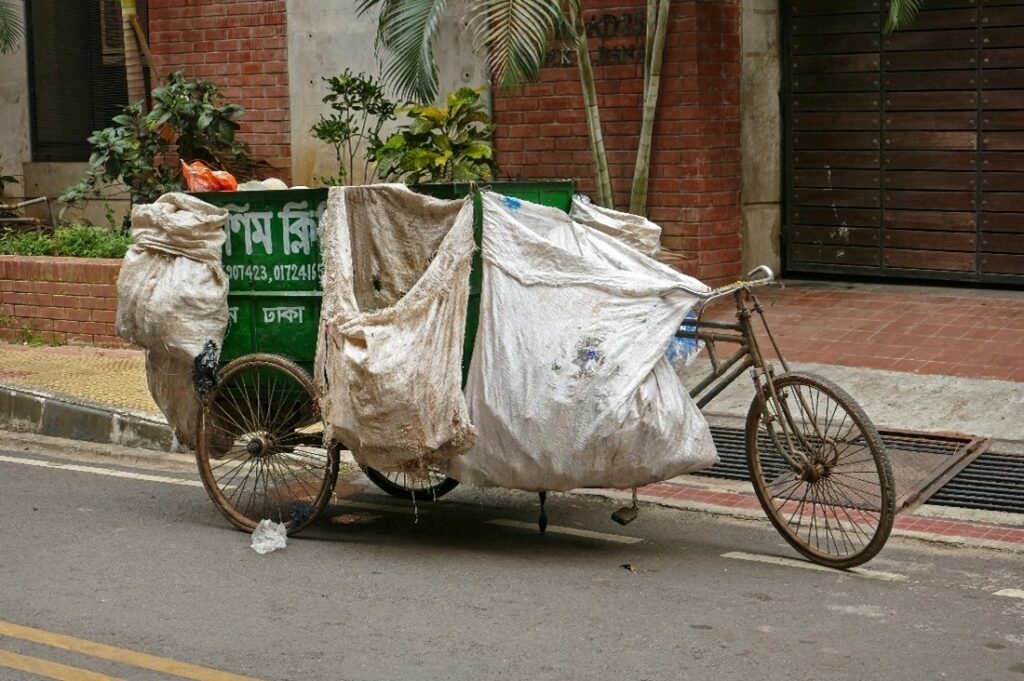
Despite ambitious master plans and staggering budgets, Dhaka’s waste management faces a harsh reality on the ground. For years the Clean Dhaka Master Plan (2005-2015) focused primarily on the basics of waste collection and disposal. Today while over 80 percent of generated waste is successfully collected, the city faces a looming crisis. The primary landfills for both the Dhaka North City Corporation (DNCC) and Dhaka South City Corporation (DSCC) at Amin Bazar and Matuail are rapidly nearing the end of their practical lifespans. To address these capacity overruns, the New Clean Dhaka Master Plan (2018-2032) was introduced to pivot toward waste treatment, reduction, and the “3R” strategies of reduce, reuse, and recycle. In 2019, both city corporations jointly announced a 15-year master plan titled “Towards Zero Waste,” envisioning eco-towns, centralized composting, biogas plants, and recycling hubs. However, implementation of the plan quickly diverged (Prothom Alo, 2022).
Bangladesh’s waste system is not failing due to a lack of international support or knowledge. According to recent analyses, it is failing because of deep fragmentation, weak enforcement, poor coordination, and remarkably low political prioritization. Key challenges include ineffective legislation, overpopulation, community behavior, and financial constraints. Despite implementing various policy measures and spending a massive Tk 3,323 crore on waste management initiatives between 2016 and 2023, the two city corporations have seen mixed results. Today, more than 250 unauthorized dumping sites remain scattered across the capital. Source segregation is incredibly rare, rendering meaningful recycling almost impossible. A half-century after independence, Dhaka is still running on traditional, environmentally hazardous waste management methods (Dhaka Tribune, 2025).
Bypassing the eco-friendly focus of the master plan, the DNCC shifted its focus toward incineration. Local government documents revealed that the DNCC backed away from the original 3R master plan based on what was described as “strange” instructions. Officials were assured that the master plan’s approval would not hamper a new, massive waste-to-energy (WtE) project. Following negotiations with the government and the Power Development Board in 2020, China Machinery Engineering Corporation (CMEC) was chosen to develop Bangladesh’s first WtE facility. Located on the south side of the Amin Bazar landfill, the $467 million project plans to burn 3,000 tons of waste daily to generate electricity. Financed by the Asian Infrastructure Investment Bank and the New Development Bank, the facility includes four incineration lines, two 35 MW turbo-generator systems, and a six-kilometer transmission line (AIIB, 2024).

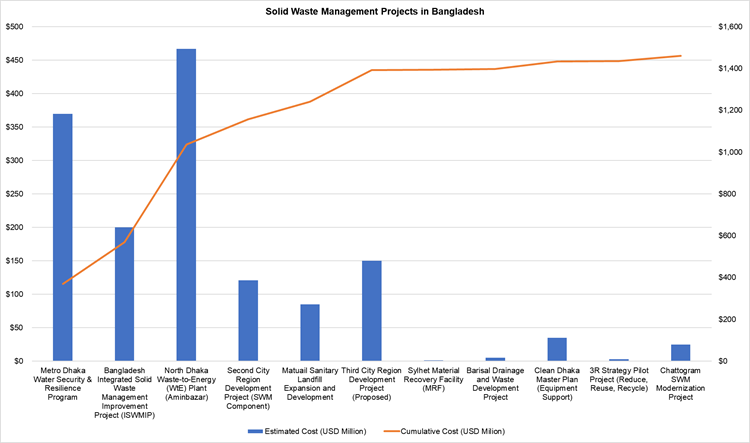
Construction commenced in 2024, with commercial operations slated for July 2026. However, the project’s tenure expires in December 2025. Despite two rounds of cost escalation that have nearly doubled the initial budget, the plant has not been built. Expensive imported machinery is gradually deteriorating on-site because the project is indefinitely stalled, awaiting final environmental clearance. Meanwhile, the DSCC is taking a drastically different path. Building on an Internationally Transferred Mitigation Outcomes agreement signed between Bangladesh and South Korea in June 2024, the DSCC partnered with South Korea-based B&F Company Limited (The Business Standard, 2025).
They are launching a pilot project at the Matuail Landfill to extract landfill gas and establish a resource circulation center. Unlike the DNCC’s incineration model, this pilot project will produce organic fertilizer, biogas, refuse-derived fuel, biofuel, and raw materials for cement. The financial structure places all costs on B&F, with no financial involvement from the DSCC. The initial five-year pilot aims to extract an estimated 15,000 tons of methane annually from nearly 100 acres of landfill to generate electricity. After 15 years of processing all DSCC waste to reach a zero-waste target, ownership transfers entirely to the DSCC, which will also receive 20 percent of the generated revenue (The Daily Star, 2026).
The most critical challenge facing the DNCC incineration project is the actual composition of Dhaka’s garbage. Waste in developing nations like Bangladesh has an exceptionally high proportion of food waste and moisture. Generating power by burning this low-calorific, highly wet waste is widely considered neither applicable nor cost-effective. According to the World Bank, municipal solid waste must have an annual average calorific value of at least 7 MJ/kg to make incineration viable, never dipping below 6 MJ/kg. However, the Lower Heating Value of waste reaching Amin Bazar is a mere 2.753 MJ/kg. The DSCC’s own Chief Waste Management Officer highlighted this issue, noting that their waste has a calorific value of only 600 to 700, while electricity production requires at least 1,500. To reach that, the waste must be burned at very high temperatures, which raises the surrounding temperature and contributes to global warming. This low heating value is largely due to Dhaka’s informal recycling sector. Recyclers recover about 349 tons of waste daily. They extract the exact high-heat-value materials needed for successful incineration, such as plastics, paper, textiles, and metals. The remaining waste ending up at Amin Bazar is 72 percent organic matter with a 62.76 percent moisture content. Authorities routinely overlook this informal resource recovery in their planning. History offers a warning. In 1987, the Timarpur WtE plant in Delhi shut down just 21 days after opening due to the low calorific value of incoming waste. Today, of the 14 WtE plants installed in India since 1990, half have already closed due to high moisture and inert materials. Urban planner Adil Mohammed Khan cautioned that the Aminbazar project failed to present a credible feasibility study, noting that the wet content raises serious doubts about its suitability for power generation. Another expert bluntly stated that there has been no research confirming Bangladesh’s waste is adequately prepared for waste-to-energy production (Dhaka Tribune, 2020; The Daily Star, 2026).
Mass-burn incineration presents severe environmental threats. A WtE plant generates 20 percent bottom ash. With no management plan in place, this toxic byproduct often ends up polluting rivers and agricultural lands. Furthermore, communities face health and safety risks from toxic compound emissions, alongside potential economic displacement. Research shows that WtE projects could actually increase absolute carbon dioxide emissions as they displace natural gas-based electricity due to existing price distortions in the energy market.
Experts are unanimous in their recommendations. They advise making waste segregation at the source mandatory for organic, recyclable, medical, and hazardous waste. They also suggest developing engineered landfills equipped with protective liners, leachate treatment, and methane-capture systems. Furthermore, experts recommend prioritizing decentralized composting and anaerobic digestion plants, which are uniquely suited to Dhaka’s massive organic waste stream, as well as formally integrating the informal waste pickers who already do the heavy lifting of recycling.
Dhaka epitomizes a modern urban crisis of escalating waste generation, a lack of source segregation, overburdened landfills, and a dangerous overreliance on fossil fuels. The DNCC mass-burn incineration project faces fundamental feasibility flaws. The waste is simply too wet and too organic to burn without expensive supplementary fuel, defeating both its economic and environmental purpose. Conversely, the DSCC resource circulation approach is conceptually much more appropriate for Bangladesh’s waste profile. However, it remains unproven at scale, and unsegregated waste will still pose a massive operational hurdle. The recurring pattern of the last two decades is clear. Bangladesh does not lack grand plans or eager foreign investors. It lacks political will, institutional coordination, basic segregation infrastructure, and the enforcement mechanisms to implement plans coherently. Until the fundamentals of waste management are addressed, any imported technology risks becoming just another expensive, stalled monument in Dhaka’s long history of waste mismanagement.
References
Prothom Alo. (2022). What is the future of the waste management master plan? Prothom Alo. Retrieved from https://en.prothomalo.com/bangladesh/city/what-is-the-future-of-the-waste-management-master-plan
Dhaka Tribune. (2025). Dhaka’s growth and the waste that comes with it. Dhaka Tribune. Retrieved from https://www.dhakatribune.com/opinion/specials/392190/dhaka’s-growth-and-the-waste-that-comes-with-it
AIIB. (2024). Bangladesh: North Dhaka waste to energy project. Retrieved from https://www.aiib.org/en/projects/details/2025/approved/bangladesh-north-dhaka-waste-to-energy-project.html
The Business Standard. (2025). DSCC partners with B&F on waste-to-resource pilot at Matuail. The Business Standard. Retrieved from https://www.tbsnews.net/bangladesh/dscc-partners-bf-waste-resource-pilot-matuail-1302016
The Daily Star. (2026). DSCC plans to turn waste into energy at Matuail. The Daily Star. Retrieved from https://www.thedailystar.net/news/bangladesh/news/dscc-plans-turn-waste-energy-matuail-4148796
Dhaka Tribune. (2020). OP-ED: Will waste-to-energy initiatives work in Bangladesh? Dhaka Tribune. Retrieved from https://www.dhakatribune.com/opinion/op-ed/226253/op-ed-will-waste-to-energy-initiatives-work-in