


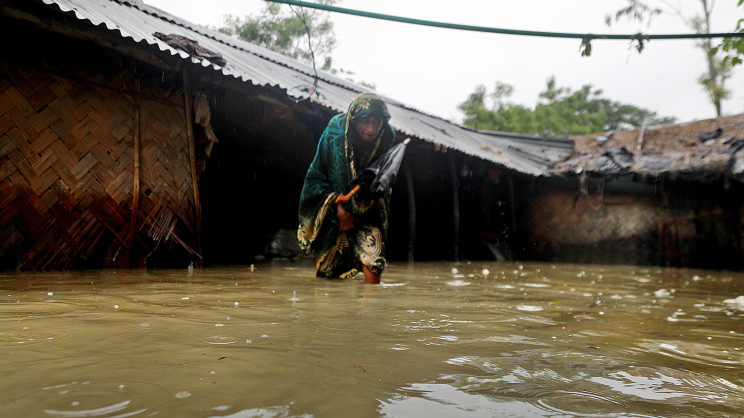
In July 2026, southeastern Bangladesh experienced one of the region’s most devastating humanitarian and environmental disasters in recent years. Relentless monsoon rainfall triggered widespread flooding and landslides. Chattogram was hit particularly hard as on July 7, the city recorded 412 millimeters of rain in just 24 hours, its heaviest 24-hour rainfall in 43 years. More than 1.28 million people were affected and at least 59 people lost their lives (De Rosi, 2026). Decades of unplanned development, environmental degradation, and poorly coordinated infrastructure management had already made the region highly vulnerable. The heavy rainfall was the trigger but the way natural and urban systems had been managed determined how destructive the event became.
By mid July, nearly one million people were stranded across Chattogram and neighboring districts as floodwaters submerged large areas, disrupted electricity supplies, and cut off communication networks. Rural livelihoods suffered heavily as more than 14,200 hectares of cropland, including Aush paddy and summer vegetables were reportedly damaged. Around 112,827 livestock and poultry were killed resulting in losses of more than Tk 300 million while thousands of fishponds were washed away (Dey, 2026). The disruption reached far beyond agricultural losses as daily life effectively stopped and HSC examinations in the district had to be postponed. In Banshkhali, floodwaters destroyed numerous earthen homes leaving families without shelter and basic belongings. In some areas even graveyards were submerged and families had to travel several kilometers to find dry ground where they could bury their loved ones while others were to keep watch over the graves fearing that the rising floodwaters would wash away the remains.
The situation was particularly dangerous in the Rohingya refugee camps of Cox’s Bazar. Many of these camps are built on steep hillsides that have experienced extensive deforestation leaving the slopes highly unstable during periods of intense rainfall. When the rain came landslides tore through several camps destroying bamboo and tarpaulin shelters and killing at least 17 people where most of them were children (De Rosi, 2026). Years of environmental pressure had already created a dangerous setting. Aid cuts had forced the suspension of important slope stabilization and camp maintenance activities leaving many settlements more exposed when the extreme rainfall arrived.

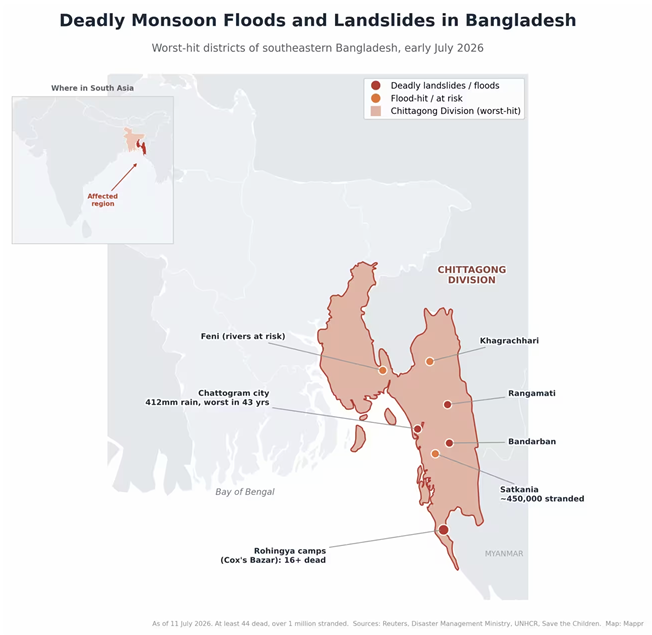
Environmental experts and urban planners have identified decades of ecological mismanagement as a major reason why the flooding became so severe and prolonged. Over the past four decades Chattogram has lost nearly 3,000 ponds, large tanks, and natural wetlands to rapid urbanization and illegal land grabbing (Akter, 2026). These water bodies once served as natural retention basins, holding excess monsoon runoff and releasing it gradually. With many of them gone, enormous volumes of rainwater had nowhere to go. Streets and residential areas flooded quickly, while the loss of vegetation and water bodies also contributed to the city’s urban heat island effect during the dry season.
Indiscriminate hill cutting and the removal of natural vegetation have weakened the slopes and left large areas exposed to erosion. During intense rainfall loose and sandy soil is washed downhill in huge quantities. Much of it ends up in drains, canals, and other waterways, reducing their capacity to carry away stormwater and making urban flooding even worse.
Major waterways such as the Sangu and Matamuhuri rivers have been narrowed and obstructed by illegal structures, sand extraction, and artificial dams built for private fish and salt farming. These interventions disrupt the natural movement of water and prevent floodwaters from draining efficiently toward the Bay of Bengal. The resulting damage to homes and property was initially estimated at around Tk 3 billion (Bonik Barta, 2026).
Despite enormous public investment in Chittagong including a Tk 12,000 crore drainage project, poor coordination between government agencies and conflicting master plans have left major parts of the system ineffective (Jahin, 2026). Uncollected solid waste regularly blocks drains, while insufficient capital dredging of the Karnaphuli River has contributed to a raised riverbed, making it harder for urban water to discharge when high tides push water levels upward.
Contaminated floodwater carrying human waste, agricultural chemicals, and animal remains polluted drinking-water sources across affected areas, creating shortages of safe water and contributing to localized outbreaks of diarrheal disease. Stagnant pools left behind by the flood also provide suitable breeding grounds for mosquitoes and other disease vectors. Families who lose their homes, food supplies, livestock, and livelihoods overnight are left facing not only financial hardship but also deep psychological distress. For many, rebuilding their lives is an overwhelming prospect. Mental health professionals and researchers have stressed the need to include psychosocial support in emergency relief efforts, alongside food, shelter, clean water, and medical care.
Environmental laws must be enforced to stop destructive hill cutting. Occupied wetlands and canals need to be restored. Natural drainage routes must be protected. Urban planning should work with the region’s natural landscape rather than continually replacing it with concrete. Without these structural and environmental changes, Chattogram will remain caught in the same dangerous cycle of extreme rainfall, overwhelmed natural systems, failed drainage, and another preventable human disaster.
References
De Rosi, A. (2026). Deadly monsoon floods and landslides hit Bangladesh: Mapping the 2026 disaster. Mappr. Retrieved from https://www.mappr.co/bangladesh-monsoon-floods-2026
Dey, A. B. (2026b). Nearly a million marooned. The Daily Star. Retrieved from https://www.thedailystar.net/news/environment/climate-crisis/natural-disaster/news/nearly-million-marooned-4221661
Akter, K. (2026). Chattogram loses nearly 3,000 water bodies in 40 years, intensifying heatwaves, water crisis and flood risks. The Climate Watch. Retrieved from https://theclimatewatch.com/chattogram-loses-nearly-3000-water-bodies-in-40-years-intensifying-heatwaves-water-crisis-and-flood-risks
Bonik Barta. (2026). Southern Chattogram submerges amid unplanned infrastructure and occupation of rivers, canals. Bonik Barta. Retrieved from https://en.bonikbarta.com/environment/LwGuVeKhuZpVncSB
Jahin, K. H. (2026). How Chattogram can end its recurring waterlogging crisis. The Daily Star. Retrieved from https://www.thedailystar.net/slow-reads/big-picture/news/how-chattogram-can-end-its-recurring-waterlogging-crisis-4225336