

India’s experience with Farakka shows that this barrage has created such severe problems for the upstream and downstream areas there that it has now become a noose. Dr. Nazrul Islam and Dr. Md. Khalequzzaman write on whether the same could happen in the case of Bangladesh.

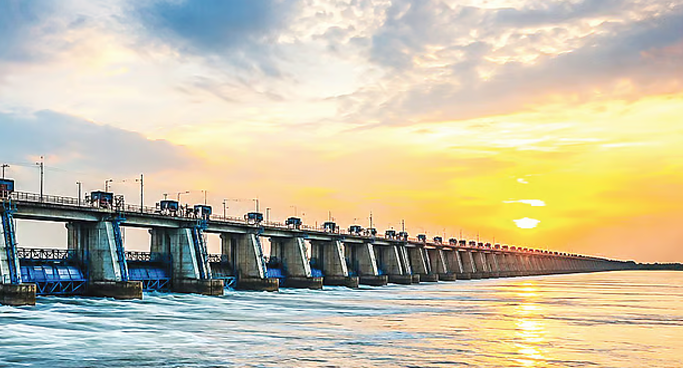
10 questions about the Ganges Barrage
On August 22, the Bangladesh Poribesh Andolon (BAPA) and Bangladesh Environment Network (BEN) organized an exchange of views meeting on the proposed Ganges Barrage at the CIRDAP auditorium in the capital.
There we raised 10 questions about the barrage.
-
Why so much secrecy about this barrage?
-
Will the barrage only use monsoon water in winter?
-
Where is the discussion on the impact of the barrage on the downstream area?
-
Why does the monsoon flow of the Ganges not flow into the distributaries now?
-
Where is the solution to the waterlogging problem in the south-west?
-
How assured can one be about siltation, flooding, and bank erosion upstream of the barrage?
-
How reliable are the estimates of the various benefits of the barrage upstream of Pangsha?
-
Will this barrage not further weaken Bangladesh’s position on the Ganges water sharing issue?
-
Why the planning based on such old data?
-
Is it prudent to undertake such a questionable project with a massive budget in the current fragile economic situation?
Lack of proper answers from water-related agencies
On behalf of the government, the Water Development Board (WDB) and the agencies that played a key role in formulating this barrage project should have answered these questions. However, the WDB is almost never interested in coming out in public to discuss their projects.
BAPA and BEN have so far organized many conferences on the country’s water resources. But despite being invited, WDB representatives have not attended these conferences to explain the government’s position and try to prove its correctness. Apparently, there was no representative of theirs in the exchange of views meeting on August 22 either.
Perhaps the WDB no longer has much internal technical capacity. For these tasks, they completely depend on external research-consulting agencies. The feasibility study and design of the proposed Ganges Barrage project, etc., were also done for the WDB by an agency called DCC, which was partnered by IWM (Institute of Water Modelling), CEGIS (Center for Environmental and Geographic Information Services), and an agency named Data Ex.
It was the WDB’s responsibility to ensure that representatives from these agencies came to the BAPA-BEN view-exchange meeting and answered various questions about the project. These agencies were also invited by BAPA and BEN.
It is difficult to say whether they were motivated by the WDB or responded to the direct invitation of BAPA-BEN. However, two people from these agencies were present at this view-exchange meeting. One of them was once the head of CEGIS and is now retired. Probably when this barrage project was formulated (before 2016) he was working and played a role in formulating this project. The other person came from IWM, where he played an important role in formulating this project and is still working.
The former head of CEGIS stated that the impact of the barrage on the downstream area was discussed in a volume of the appendix to the feasibility report. In response to his statement, almost everyone at the venue requested him to share this volume of the appendix with everyone. Later, he was also contacted for this volume. But he did not reply.
Incidentally, it should be mentioned that an official application was made on behalf of BAPA much earlier to share the feasibility study of the proposed Ganges Barrage and all its appendices. But despite having the Right to Information (RTI) Act regarding information of public importance, the authorities did not respond to this application.
The IWM representative complained that the essay writers; that is, we, did not even read the executive summary of the feasibility report of the Ganges Barrage project carefully. This is a very serious allegation, no doubt. However, it is an interesting point to consider how consistent it is for a representative of those who have kept their report secret and have not shared it despite official requests, to accuse others of not reading that report.
How effective are foreign experts
To explain the high quality of their barrage project, this IWM representative mentioned multiple times that many foreign experts were involved in formulating this project. If he had an adequate understanding of the history of water development efforts in Bangladesh, he might not have shown so much enthusiasm about foreign experts. Nazrul Islam has detailed this history in the 822-page book titled “Water Development in Bangladesh: Past, Present and Future”. There he has shown that these foreign experts are the main architects of the tragedy of water development in Bangladesh. The responsibility of the Bangladeshi engineers who worked as their associates without a word is also not less.
Therefore, the colonial mentality that a project is good just because many foreign experts were involved is something that many of our engineers seem to have not yet been able to come out of. Even more surprising is that the list the IWM engineer boasted about included Pakistan as well. Why this sudden affection for Pakistan is also intriguing.
We saw a recent example of how difficult it is for foreign experts to correctly understand the problems of the rivers in Bangladesh and propose their solutions regarding the Teesta project. Until recently, the WDB and related consulting firms were almost all very enthusiastic about the so-called ‘Teesta Mega Plan’ formulated by Chinese experts.
When we criticized this project, they got angry with us. But ultimately, faced with our logical position, the Chinese withdrew their first feasibility study and presented a revised design for the project. But we show that it is also full of anomalies. (To know more details about these issues, interested persons can see our booklet “Teesta River in Crisis – Which Way to Solution?”)
In the face of our logical criticism, the Chinese mega plan, it can be said, has been abandoned and the government is now largely engaged in finding a solution to the Teesta river problem based on domestic expertise and, in fact, in the lines proposed by us. Against this backdrop, citing foreign experts in support of the claim of correctness of their barrage project by the IWM engineer is at once incongruous and sad.
Almost a month has passed since the exchange of views meeting on August 22. So far, no answer to even one of the 10 questions raised in this meeting has been received from the government or the WDB and related consulting firms. The easiest for them was to respond to the first question (Why so much secrecy?) by opening project-related information, such as the feasibility report and its appendices, to the public. If there is anything there that needs to be kept secret in the national interest, that part can be blacked out with black ink. However, it is hard to imagine what such parts could be.
Will the proposed Ganges Barrage be a second Farakka?
By keeping project-related information secret, the government is rather creating various suspicions. The IWM representative complained that we supposedly did not read the executive summary of the project’s feasibility report properly. The reality is probably the opposite. They probably did not expect that we would read this summary so closely that the fact that the people are being grossly deceived in the name of this barrage would be exposed.
From the very beginning, the proponents of this barrage have been explaining to the countrymen that its main purpose is to retain water during the monsoon and use it in winter. But we have shown on the basis of the statistics provided in the executive summary itself that it will be possible to retain only 1.53 percent of the total monsoon flow of the Ganges with the barrage.
We have further shown that out of the total 698 cumecs of water planned to flow through the five distributaries of the Ganges in Bangladesh (Baral, Ichamati, Hisna-Mathabhanga, Gorai-Madhumati, and Chandana-Barasia) and the Godagari and Bheramara pump stations during the dry season, only 209 cumecs (30 percent) can come from the stored water of the monsoon and the remaining 489 cumecs (70 percent) must come from the current flow of the Ganges, which amounts to 1,295 cumecs.
As a result, due to the barrage, the dry season flow of the Ganges at Pangsha will be divided in a ratio of approximately 60:40; that is, the flow of the Ganges towards Goalanda will decrease by about 40 percent more than it is now.
The proposed barrage will be another Farakka. Because, even now at Farakka, the dry season flow of the Ganges is roughly halved between India and Bangladesh. It is probably to conceal the fact that the flow of the Ganges downstream of Pangsha will decrease by such a massive amount due to the proposed barrage that the executive summary of the feasibility report is so silent about its impact on the downstream area. That is probably why the proponents of the barrage are so displeased. Because we have exposed the matter that they might have wanted to conceal.
The ball is now in the government’s court
The ball is now in the government’s court. The government has to decide whether they will knowingly build another Farakka inside the country, or if they will rethink the matter and proceed along the lines of implementing the five-point proposal we gave in the August 22 view-exchange meeting to tackle the problems created in the south-west of the country due to India’s Farakka.
Briefly, these are:
-
Increasing monsoon flow by removing all obstacles in the distributaries and tributaries of the Ganges;
-
Gradually restoring the connection of the river channels with the polders through the expansion of the TRM (Tidal River Management) program;
-
Gradually converting the coastal embankments into eight-month embankments;
-
Dispersing reservoirs across Bangladesh; and
-
Ensuring the fair share of the Ganges from India.
India’s Farakka experience shows that this barrage has created such severe problems for the upstream and downstream areas there that it has now become a noose. Public opinion in India is increasingly growing strong against this noose. If the government wants to proceed with building a second Farakka in Bangladesh even after having this experience, then it will be extremely regrettable.
However, we hope that the people of Bangladesh will become aware of the matter; they will not be misled by the false assurance that the proposed barrage will only use monsoon water in winter, and they will not allow the tragic consequences brought about by India’s Farakka to be repeated in double magnitude by an internal Farakka in Bangladesh in the name of the proposed barrage.
Dr. Nazrul Islam
Professor, Asian Growth Research Institute
Former Chief of Development Research, United Nations
Founder, Bangladesh Environment Network (BEN)
&
Dr. Md. Khalequzzaman
Professor, Geology and Environmental Science
Commonwealth University of Pennsylvania, USA
Global Coordinator, Bangladesh Environment Network (BEN)
The information presented here is an English adaptation based on the report published on The Prothom Alo.