


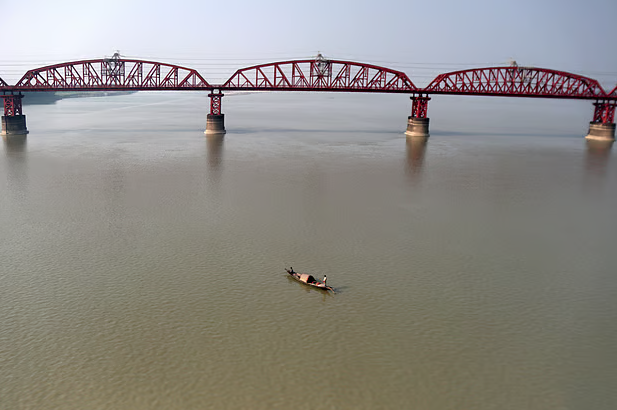
The 30-year Ganges water-sharing treaty between India and Bangladesh is set to expire this year. Reaching a consensus on a crucial and contentious issue like the Ganges treaty requires significant preparation. In a two-part series, Nazrul Islam writes on how Bangladesh can prepare for the treaty renewal. This is the first part:
1. This coming December, the 30-year Ganges water-sharing treaty signed between India and Bangladesh in 1996 is going to expire. This treaty needs to be renewed on time. Reaching a consensus on an important and contentious issue like the Ganges treaty requires a lot of preparation.
The responsible agency for this matter is the Joint Rivers Commission (JRC). This commission is supposed to hold four ‘general meetings’ a year. That has not happened in recent years. A meeting was held in Kolkata from May 21-23, and on the first day, the method of measuring the Ganges flow was observed on-site at Farakka.
However, there is a discrepancy between the statements of Bangladesh and India regarding whether the renewal of the Ganges treaty was discussed in this meeting. Bangladesh’s side has given the impression that this discussion was initiated, but the Indian representative did not state as such.
Needless to say, the urgency in this regard should be from Bangladesh; because, being in an upstream position, India can control how much of the Ganges flow will reach Bangladesh. Therefore, Bangladesh must take the initiative and prepare.
There are three aspects to this preparation:
-
First, determining Bangladesh’s position regarding this treaty.
-
Second, determining and executing what needs to be done to ensure this position is accepted.
-
Third, preparing a suitable team for the negotiations.
There is a mutual relationship among these three tasks. For example, what needs to be done to ensure Bangladesh’s position is accepted largely depends on that position. Similarly, the kind of team that can most effectively present Bangladesh’s position in negotiations with India also depends largely on that position.
2. The discussions held so far between India and Bangladesh regarding common rivers can be characterized as discussions based on a ‘commercial’ approach to rivers. In these discussions, the river is primarily considered a commercial resource, and the flow of river water into the sea is viewed as a waste.
In this view, the natural role of rivers does not hold importance. The opposite of this is the ‘ecological’ approach to rivers. This emphasizes the natural role of rivers. Two aspects of this role are particularly crucial. One is acting as an essential link in the Earth’s water cycle. Ocean water evaporates, is carried by the wind, and is obstructed by mountains; it rises, cools, and falls as rain or snow; then it is carried by rivers and returns to the sea.
Second, every river creates and sustains its own ecosystem in its valley. Overall, both these roles are indispensable for the Earth’s ecological balance. Experience shows that the commercial approach is shortsighted; because if the natural role of the river is damaged, its commercial and economic role is also damaged in the long run. Conversely, the ecological approach is farsighted; because if the river’s natural role is protected, it remains capable of fulfilling its economic role as well.
Before the Industrial Revolution, human society was accustomed to ecological behavior toward rivers; because technologies that could cause major harm to the river’s natural role had not yet emerged. But after the Industrial Revolution, such technologies emerged, and using them, people in industrialized or industrializing countries began building massive structures like dams, barrages, and levees (embankments) on rivers on a massive scale.
3. Initially, although some economic benefits were achieved by these structures, their negative consequences gradually became apparent. For this reason, since the 1970s, a return to the ecological approach toward rivers has begun in developed countries. Following this trend, hundreds of dams and barrages have been removed, and efforts have begun to restore the floodplains of many rivers lost due to embankments.
However, the commercial approach to rivers still dominates in many developing countries, including India and China, and we see examples of this in Bangladesh too. But if Bangladesh engages in discussions with India on sharing river flows based on a commercial approach, it will invite danger upon itself. Because India, citing the need for various commercial uses of river water, can argue that there is no water left to give to Bangladesh.
In reality, we are seeing examples of this. For instance, India did not agree to release any water from the Teesta for Bangladesh during the dry season. Mamata Banerjee made it clear, “There is no water to give to Bangladesh.” Similarly, India is unwilling to give Bangladesh the dry season water of the Ganges; because, according to them, they need that water to maintain the navigability of the Kolkata port.
-
The urgency for the treaty should be from Bangladesh; because, being upstream, India can control how much of the Ganges flow reaches Bangladesh.
-
The discussions held so far between India and Bangladesh regarding common rivers can be called discussions based on a ‘commercial’ approach.
-
India is advancing an inter-river linking project, the main goal of which is to divert water from the Brahmaputra basin towards the west and south of India.
Citing such commercial reasons, India is constructing numerous dams and barrages upstream on these rivers and their tributaries, leaving very little water to flow into Bangladesh, especially during the dry season for the Ganges and Teesta rivers.
Furthermore, India is advancing its inter-river linking project, whose main goal is to divert water from the Brahmaputra basin towards the west and south of India. To the east, India is also planning to build the Tipaimukh Dam on the Barak (the source river of Bangladesh’s third-largest river, the Meghna) and a barrage at Fulertal in the Cachar district. If implemented, water will also decrease in the Meghna basin, causing various undesirable changes and crises in the seasonal cycle of the river flow.
4. To counter India’s commercial approach to rivers, Bangladesh may also try to resort to a commercial approach. In fact, this is what Bangladesh has done so far. For instance, in the context of the construction of the Farakka Barrage, Bangladesh undertook the ‘Ganges-Kobadak (G-K) Project’ across the greater Kushtia, Jashore, and Khulna districts, so that it could claim to India that it also needed Ganges water for irrigation.
Similarly, in the face of India’s construction of the Gajoldoba Barrage, Bangladesh built the Teesta Barrage Project at Dalia in the 1980s, to claim to India that Bangladesh needed Teesta water for irrigation purposes.
But none of these have been successful. The G-K Project could not stop the construction of the Farakka Barrage. Rather, due to Farakka, the G-K project could not advance beyond the first unit of the first phase. The experience of the Teesta Barrage at Dalia is even more tragic. The lack of a stable flow has devastated and distorted the entire Teesta river in Bangladesh.
Therefore, the chances of Bangladesh succeeding in negotiations with India within the framework of a commercial approach are almost non-existent. Instead, the ecological approach would be much more suitable for Bangladesh in this regard.
First, by adopting this approach, the overall protection of Bangladesh’s riverine nature, environment, and ecosystem will be prioritized.
Second, advancing from this position will make it difficult for India to ignore Bangladesh’s arguments; because international recognition of the natural role of rivers is growing stronger day by day.
A major proof of this is the 1997 UN Convention on the Law of the Non-navigational Uses of International Watercourses. This convention is beneficial to Bangladesh for several reasons. First, it places special emphasis on the natural role of rivers. For example, Article 20 of this convention states that watercourse states shall, individually and, where appropriate, jointly, protect and preserve the ecosystems of international watercourses.
Article 23 explains that the ecosystem of rivers must be considered to include the estuaries and marine environment. Consequently, based on this convention, when Bangladesh demands in negotiations with India the re-establishment or preservation of the full natural flow of all rivers flowing from India—to protect Bangladesh’s aquatic ecosystems, increase the gradual height of floodplains and tidal lands, continue the delta formation process at the estuary, and protect the coastal Sundarbans—it will not just be Bangladesh’s demand; it will be the demand of the international community expressed through the UN Convention.
Second, even regarding the economic (commercial) use of rivers, the 1997 UN Convention imposes obligations that are favorable to Bangladesh. For instance, Article 7 of the convention states that when a country uses an international watercourse, it must ensure that no significant harm is caused to other watercourse states. If such harm is caused, the responsible state shall, in consultation with the affected state, take measures to mitigate such harm and, where appropriate, discuss compensation.
It should be noted that this convention recognizes the ‘existing uses’ of rivers, and Article 6 states that in evaluating damage, whether the existing uses of rivers by the partner country have been affected must be taken into account.
5. It is clear that from the perspective of the 1997 UN Convention, India’s Farakka or Gajoldoba Barrages are not justifiable at all; because these barrages have largely obstructed the traditional use of the Ganges and Teesta rivers within Bangladesh; degraded the ecosystems of floodplains and tidal lands; threatened the coastal Sundarbans; and overall caused immense damage to Bangladesh.
Therefore, Bangladesh has two primary tasks aimed at renewing the Ganges Treaty. First, bringing a change in the approach or philosophy towards rivers. The current commercial approach to rivers must be abandoned in favor of an ecological approach. Second, the 1997 UN Convention on the Non-navigational Uses of International Watercourses must be quickly signed and ratified by parliament.
These two steps will help Bangladesh prepare for negotiations with India for the renewal of the Ganges treaty. However, even after executing these two tasks, many more steps will remain. We will discuss those in the second part.
Dr. Nazrul Islam
Professor, Asian Growth Research Institute
Former Chief of Development Research, United Nations
Founder, Bangladesh Environment Network (BEN)
The information presented here is an English adaptation based on the report published on The Daily Prothom Alo.