


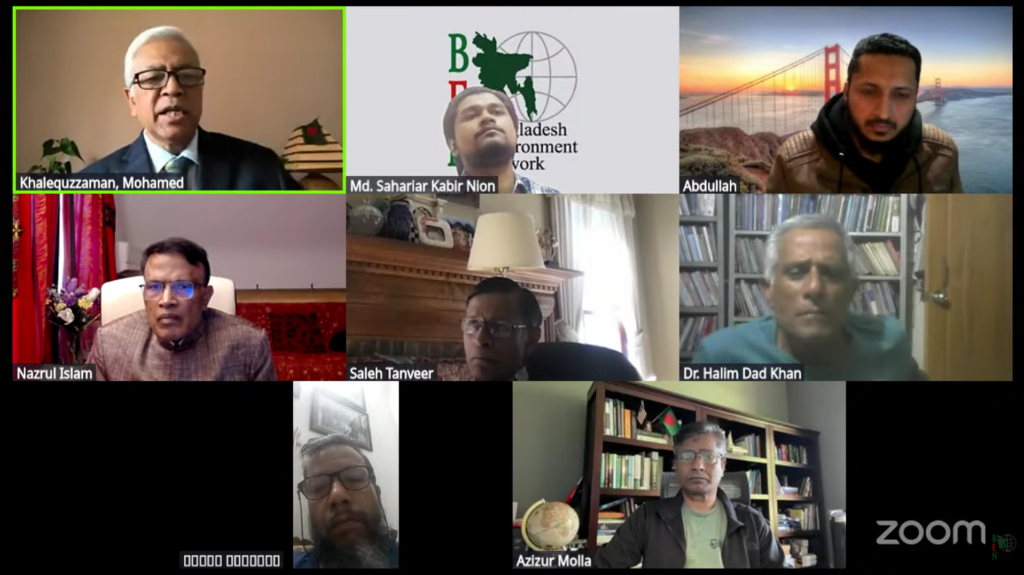
The proposed Ganga (Padma) Barrage has come under sharp criticism from international river experts, geologists, and environmentalists at the 21st bi-monthly webinar of the Bangladesh Environment Network (BEN) held on September 26, 2026. Experts warned that the project could create serious ecological and economic problems for Bangladesh. The webinar titled “Ganga (Padma) Barrage: Questions and Proposals” was chaired by Dr. Nazrul Islam, founder of BEN and moderated by BEN fellow Md. Sahariar Kabir Nion. The discussion raised fundamental questions about the project’s feasibility and long-term consequences. The panelists warned of severe downstream erosion, declining fish populations and sediment loss that could threaten the Bengal Delta.
The proposed barrage is intended to counter the effects of India’s upstream Farakka Barrage. Its proponents expect it to store 2.9 billion cubic meters (BCM) of water and irrigate 1.9 million hectares of land. They also expect it to restore freshwater flows to the Gorai river system, reduce salinity in the Sundarbans and improve fisheries. But can the project deliver on these promises?
Dr. Md. Khalequzzaman, Global Coordinator for BEN and Professor at Commonwealth University of Pennsylvania, challenged the assumptions behind the project during his keynote presentation. He noted that the feasibility study uses outdated river-flow data ending in 2010. The proposed diversion of 28,000 cusecs during the dry season also raises serious concerns. Historical records show that lean-season flows can fall to just 7,000 to 11,000 cusecs. The numbers do not add up. Dr. Khalequzzaman estimated that irrigating 1.9 million hectares would require approximately 19 BCM of water, far more than the barrage’s planned storage capacity of 2.9 BCM.
Sedimentation emerged as one of the most pressing concerns. The Padma is not simply a channel for transporting water. It carries enormous quantities of sediment that sustain the Bengal Delta. A barrage could disrupt this natural process. During the monsoon, large volumes of sediment would accumulate upstream as the structure reduces water velocity. Drawing comparisons with the Farakka Barrage located about 165 kilometers upstream, experts warned that sediment accumulation could reach 23 centimeters annually.
Parineeta Dandekar, Associate Coordinator at the South Asia Network on Dams, Rivers and People (SANDRP) in Delhi, described the damage caused by Farakka. She explained that riverbed aggradation and shifting channels have displaced more than 250,000 people upstream while intense scouring has accelerated erosion downstream. Dandekar recalled witnessing approximately 100 feet of riverbank disappear in a single night in Murshidabad.
She also questioned whether fish ladders could protect aquatic life at the proposed Padma Barrage. Experience with tropical river systems suggests that such structures often fail to provide effective fish passage. Dandekar cited government data indicating a 95 to 98 percent decline in Hilsa fisheries in the middle Ganga following the construction of Farakka. Bangladesh could face a similar crisis. The barrage might disrupt fish migration and threaten one of the country’s most important fisheries.
The risks extend beyond individual rivers. They could affect the survival of the delta itself.
Md. Zakir Hossain, a geologist with the Bangladesh Water Development Board and researcher at MIT, raised another fundamental concern. The project aims to distribute water that may simply not be available. He challenged its proponents with a basic question: “Where does the actual water come from?” A barrage can store and redistribute water but it cannot create new supplies.
Hossain also highlighted the worsening salinity of surface water and groundwater in southwestern Bangladesh. Salinity levels frequently exceed safe limits for drinking and irrigation, placing additional pressure on local communities and agriculture. The Padma is a major sediment transport system and any intervention must account for the movement of sediment along with water.
Hossain criticized the project’s 2013 feasibility study for relying on outdated river-flow data ending in 2010 and failing to adequately consider sediment dynamics. He called for a more comprehensive scientific approach. Future transboundary water-sharing negotiations, he argued, must address sediment management alongside water allocation to protect the long-term health of the river system and the Bengal Delta.
Dr. Ahad Chowdhury, a geologist and faculty member at Jefferson Community and Technical College in Kentucky, drew comparisons between the Bengal Delta and Louisiana’s declining Mississippi Delta. For decades, levees and channelization have restricted the Mississippi River’s natural sediment flow to coastal wetlands. The result has been the loss of thousands of square miles of land to the sea. Attempts to restore these wetlands through costly sediment-diversion projects have faced significant challenges because rigid engineering structures limit the river’s natural processes.
Dr. Chowdhury warned that the Padma Barrage could accelerate similar changes in southwestern Bangladesh. The delta depends on sediment to replenish its land and counter subsidence. Block that supply, and the land becomes more vulnerable. Sea-level rise makes the threat even greater.
Soumya Dutta, a former member of the UN Climate Technology Centre advisory board from India, questioned the plan to create a 628-square-kilometer open-water reservoir under increasingly warm conditions. Large reservoirs can experience substantial evaporation and rising water temperatures. These changes can reduce dissolved oxygen and damage aquatic ecosystems. Higher temperatures could also increase evaporative losses, reducing the water available for irrigation during the dry season.
Dutta also highlighted the cumulative impact of upstream infrastructure. Several dams under development in the Brahmaputra basin could reduce the sediment reaching Bangladesh. The Padma Barrage would add another major intervention to an already stressed river system. The delta cannot afford to lose more of its natural sediment supply.
The panelists proposed alternatives that work with natural river processes rather than attempting to control them through a single massive structure. Md. Abdullah Al Baky, a geospatial scientist based in Melbourne, advocated a flexible network of smaller infrastructure and natural water-storage systems. He drew lessons from Australia’s Murray River system where different water-management measures can support regional needs.
Baky proposed using low-head gated regulators alongside disconnected oxbow lakes and wetlands. During the monsoon, excess water could be directed into these natural basins and stored for later use. The stored water could then help sustain flows in the Gorai river system during the dry season. This approach could support freshwater availability and reduce salinity without causing the same level of disruption to sediment transport and river channels.
Dr. Khalequzzaman also supported a decentralized approach. He proposed dredging approximately 13,000 kilometers of existing rivers and creeks across the Ganges Dependent Area. According to his estimates this could create more than 3.25 BCM of distributed water-storage capacity exceeding the proposed barrage’s 2.9 BCM capacity. The dredged sediment could also be used to raise waterlogged coastal land. One intervention could therefore address several problems at once, including drainage congestion, freshwater storage, and land elevation.
Dr. Chowdhury emphasized the potential of Tidal River Management (TRM), a community-based approach already practiced in Bangladesh. Under this method, embankments are temporarily opened to allow sediment-rich tidal water to enter selected areas. The sediment gradually raises the land before the embankments are closed again. TRM can help restore natural drainage and reduce waterlogging while addressing the problem of delta subsidence. It offers a locally grounded alternative to large engineering projects.
Dr. Nazrul Islam described them as the “commercial approach” and the “ecological approach.” The commercial approach treats rivers primarily as channels for storing and diverting water, often prioritizing large infrastructure contracts over long-term environmental consequences. The ecological approach recognizes that rivers are living systems. Water, sediment, fish, wetlands, and surrounding communities depend on one another.
Dr. Islam called for a shift away from the proposed barrage and urged stronger hydro-diplomacy with upstream countries. Bangladesh needs cooperation with India and Nepal to secure fair water-sharing arrangements and protect the ecological flows that sustain its rivers. International watercourse conventions could provide an important framework for such cooperation.
The message from the webinar was clear that Bangladesh needs solutions to dry-season water scarcity and salinity but a mega-project is not necessarily the answer. Any intervention must account for river flows, sediment transport, fisheries, climate change, and the long-term stability of the delta. The panelists called for greater cross-border collaboration and nature-based water management. The priority must be the survival of the river system, not the construction of another structure that could place it at risk. The webinar can be rewatched from here: https://www.youtube.com/live/kXsgnVksxaw