


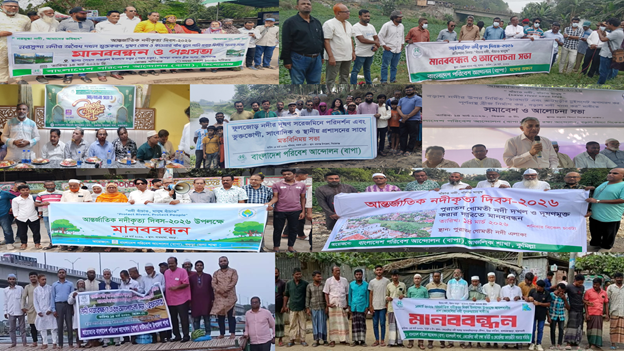
Bangladesh Poribesh Andolon (BAPA) marked the International Day of Action for Rivers on March 14 by organizing extensive nationwide campaigns to raise awareness about the critical state of the water bodies in the country. The organization led numerous rallies and human chains across multiple districts to demand immediate action against river encroachment and severe pollution. Environmental activists gathered with local communities to press for the restoration of natural water flows and the implementation of sustainable ecological policies.
A central delegation from Bangladesh Poribesh Andolon conducted an extensive field inspection of the severely polluted Fuljor Karatoya and Bangal rivers in Sirajganj. Following the inspection the team held interactive sessions with affected locals journalists and regional administrative officials to devise pragmatic solutions. The delegation was led by the general secretary of the organization Md Alamgir Kabir and included organizing secretary Mihir Biswas along with joint secretaries Dr Halim Dad Khan and Humayun Kabir Sumon. Executive members Advocate Parvin Akter and Hafizul Islam were also present alongside the Sirajganj unit convener Dipak Kumar Kar and other dedicated regional environmentalists.
In a parallel initiative the organization partnered with the Baral Rokkha Andolon to host a massive assembly at the Baral Vidya Niketan premises. Activists there vehemently demanded the removal of the Charghat and Atghori sluice gates and called for the construction of a full width bridge alongside extensive river dredging. Further south the Chakaria upazila branch combined their advocacy with an Iftar gathering at a local restaurant near the army camp to demand the rescue of the Matamuhuri river from relentless illegal occupation. The event was chaired by Professor Hamidul Islam Morshed and hosted by Alauddin Alo while Coxs Bazar district president HM Ershad attended as the chief guest. District general secretary Karim Ullah Kolim and Moheshkhali branch leaders Aminul Haque and Abu Bakkar Siddique joined the event with local journalists to amplify their environmental demands.
Coastal environmental concerns took center stage in Moheshkhali where a robust human chain was organized near the Afzalia Para CNG station to advocate for the preservation of the Kohelia river. This collaborative effort brought together the regional branch of the organization the Kohelia Nodi Rokkha Committee and the local fishermen cooperative. Participants spanning various professions including fishermen salt farmers and betel leaf cultivators stood in solidarity with leaders like Nurul Quader Sapur Alam Md Sarwar Abu Ahmed and Musa Ali. Meanwhile in Jashore another significant human chain stretched along the banks of the Bhairab river. Chaired by Dr Ahsan Habib and directed by Sheikh Rakibul Islam Nayan the event featured an impactful address by central leader and Jashore convener Khandaker Azizul Haque Moni. The gathering drew strong support from academics and activists including Principal Pavel Chowdhury Professor Abu Sayeed Md Atiqur Rahman Professor Gopikanta Sarkar Shahjahan Nannu Professor Abdul Gafur Professor Muktar Ali Professor Jahangir Alam Ujjal Kumar Bala Rubaidul Haque Sumon and Rashed Khan.
The momentum of the day resonated across several other districts through targeted demonstrations and discussion forums. In Cumilla activists formed a human chain specifically demanding an immediate end to the pollution and encroachment suffocating the Old Gomti river. Similarly the Kishoreganj unit mobilized citizens for a human chain and street rally to campaign against the illegal occupation of the Narasunda river while pressing authorities to open the Kaona dam to restore natural water flow. Observance of the day was further reinforced by a river inspection and dialogue session in Daudkandi and a well attended human chain orchestrated by the Bogra district committee. Through these unified grassroots movements Bangladesh Poribesh Andolon demonstrated an unwavering national resolve to reclaim and protect the vital river networks that sustain the ecological and economic lifeblood of the country.

