


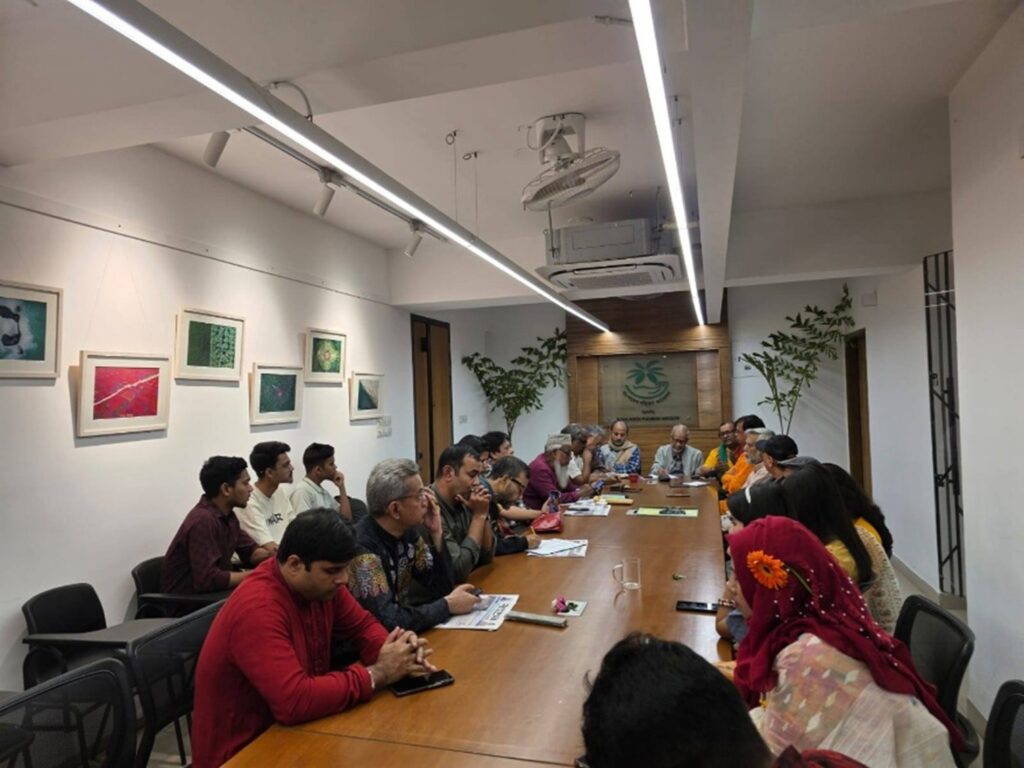
Calling for an integrated approach to protect the world’s largest mangrove forest, Bangladesh Paribesh Andolon (BAPA) organized a discussion meeting on Saturday, February 14, 2026 to mark “Sundarbans Day.”
The event, held at 4:00 PM at BAPA’s central office conference room, brought together environmental experts, journalists, and activists who urged the newly formed government to take urgent, coordinated measures to ensure the forest’s survival.
The meeting was chaired by BAPA President Prof. Nur Mohammad Talukder and moderated by the organization’s General Secretary, Alamgir Kabir. Vice-President Zakir Hossain delivered the welcome address.
Speaking at the event, journalist Nikhil Chandra Bhadra, Coordinator of the Sundarbans and Coastal Protection Movement, expressed grave concern over the current state of tourism in the region. He stated that the existing tourism industry centered around the Sundarbans is not eco-friendly and is severely damaging the forest’s delicate ecosystem. He called for the establishment of a sustainable tourism framework through the formulation of specific, environment-friendly policies.
Disaster management expert and journalist Gawher Nayeem Wahra emphasized the absolute necessity of a holistic approach to saving the Sundarbans. Highlighting the crucial role of local communities in maintaining biodiversity and natural balance, he noted that the local population is facing immense hardship due to rising salinity and various environmental risks. He strongly advocated for finding research-based solutions to address these escalating challenges.
In his presidential address, Prof. Nur Mohammad Talukder urged the new government to adopt rapid, coordinated measures to protect the forest. He stressed the importance of undertaking effective initiatives by actively involving relevant academic institutions, experts, environmental activists, and the local populace.
The meeting was also attended by BAPA Vice-President Mohidul Hoque Khan, Joint General Secretaries Mihir Biswas and Humayun Kabir Sumon, and Executive Committee members Architect Iqbal Habib, Hafizul Islam, Monsefa Tripti, and Fahmida Nazneen. National Committee members Shakhawat Hossain Swapan and Abdur Rahim, environment enthusiast Md. Abu Selim, alongside leaders of various environmental organizations and students, were also present.
At the conclusion of the meeting, an eight-point charter of demands was presented to safeguard the Sundarbans:
- Declare February 14 as “National Sundarbans Day” through official state recognition. This will create opportunities to raise national awareness, strengthen research and conservation efforts, and increase government initiatives regarding the forest’s importance.
- The new government must take visible initiatives within a specific timeframe to protect the forest. This should include effective steps such as policy decisions, project implementation, enhanced monitoring, and the restriction of high-risk activities.
- Maintain upstream water flow to ensure the natural flow of rivers. Effective coordination among relevant countries must be strengthened to control salinity and restore overall river health.
- Adopt a long-term and integrated river restoration plan, taking into account the severe damage caused to human life, biodiversity, and freshwater sources due to rising salinity levels.
- Include accurate and scientific information about the Sundarbans in primary and secondary education curricula to foster environmental awareness and a conservation mindset among the younger generation.
- Launch awareness campaigns to ensure tourists know and strictly follow the rules before visiting the Sundarbans, guaranteeing that tourism activities do not harm the environment.
- Declare the areas adjacent to the Sundarbans as “Plastic-Free Impact Zones” and enforce strict waste management. Plastic usage must be controlled and recycling initiatives boosted through the coordination of local administration, educational institutions, and civil society.
- Create sustainable alternative livelihoods for forest-dependent communities to reduce pressure on the forest. Ensuring their financial security through skills development, microcredit support, and eco-friendly initiatives will significantly decrease their reliance on forest resources.

