


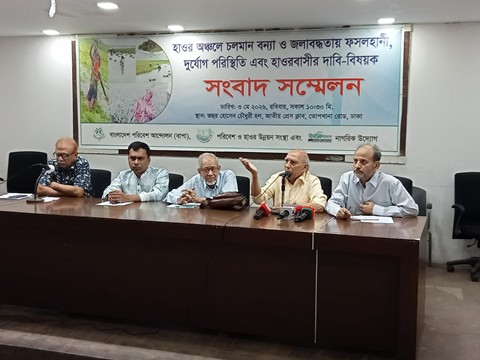
The ongoing devastation in the country’s haor regions, which has seen over 75,000 hectares of vital Boro paddy submerged, is not merely a natural calamity but a glaring manifestation of policy failure, unplanned infrastructure, and unchecked corruption. Environmentalists, disaster management experts, and rights activists raised this unified alarm at a press conference organized jointly by Bangladesh Poribesh Andolon (BAPA), Poribesh O Haor Unnayan Sangstha, and Nagorik Uddyog at the National Press Club on Sunday. Warning of a looming threat to national food security, speakers highlighted that the haor region contributes nearly 20 percent of the country’s total rice production. Yet, farmers are currently watching their year’s only livelihood drown due to delayed and structurally compromised crop-protection dams, exacerbated by three consecutive spells of heavy rainfall and flash floods since mid-March.
Presenting the keynote address, Prof Kasmir Reza, President of Poribesh O Haor Unnayan Sangstha, stated that the current crisis is unprecedented due to severe waterlogging caused by diminishing river navigability and the reckless construction of roads and sluice gates. He emphasized that the anomalies and widespread corruption in the construction of crop-protection dams—many of which remained incomplete well past their February deadlines—have left the region entirely vulnerable. Echoing this sentiment, BAPA President Prof Nur Mohammad Talukder, who chaired the event, heavily criticized the apathy of government agencies. He noted that despite billions of taka being spent annually, the lack of sustainable planning and institutional greed continues to cost farmers their livelihoods, sometimes even driving them to fatal distress.
Eminent experts at the event sharply criticized the tendency to dismiss the haor crisis as an unpreventable natural disaster. Shamsul Huda, Executive Director of ALRD, argued that the crisis is entirely man-made, driven by infrastructures that obstruct the natural flow of water and the exploitative lease-trading of water bodies. Furthermore, disaster management expert Gawher Nayeem Wahra shed light on the severe socio-economic fallout of the floods. He explained that the modern land-lease system leaves sharecroppers bearing the entirety of the financial loss, triggering a vicious cycle of poverty that leads to increased school dropout rates and child marriages in the region. Adding to the misery, farmers are being forced into distress sales of their cattle due to a severe shortage of fodder and safe shelter, a point stressed by BAPA Treasurer Aminur Rasul.
To ensure a sustainable and permanent resolution, the coalition put forward a comprehensive 16-point charter of demands urging immediate government intervention. Among the primary recommendations is the formulation of a science-based master plan that includes the extensive, planned dredging of rivers and canals, and a complete halt to the construction of unplanned roads and sluice gates through the haors. The rights advocates demanded strict punitive actions against those involved in dam construction corruption. To alleviate the immediate suffering of the farmers, they urged the government to directly procure at least one million tons of paddy from the region, provide year-round financial assistance including 30 kilograms of rice and Tk 1,000 monthly per affected family, and offer interest-free alternative employment loans.
The speakers also emphasized the need for localized, accessible flood warning systems and critical infrastructural support for agricultural recovery. They called for the establishment of elevated community threshing and drying centers equipped with lightning arresters and modern drying machines at government expense. Additionally, the coalition demanded that haor water bodies be opened for the local population rather than being leased out to influential syndicates. Drawing attention to the broader environmental context, the experts urged the allocation of dedicated funds from climate trusts to finance research and environment-friendly projects, ensuring that the survival and dignity of the haor people are no longer left to the mercy of institutional negligence.