


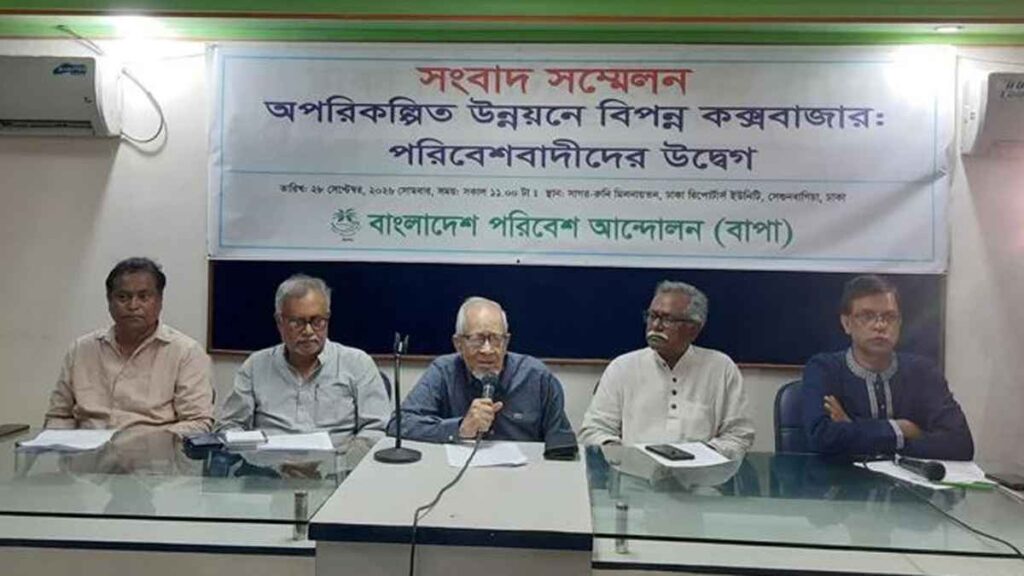
At a press conference titled “Unplanned Development Endangers Cox’s Bazar: Concerns of Environmentalists” held at the Dhaka Reporters Unity on Monday, Bangladesh Poribesh Andolon (BAPA) raised concerns over road construction through reserved hill forests in Moheshkhali, the paving of sand dunes at Sugandha beach and the destruction of mangroves on Sonadia Island for commercial shrimp farming. The speakers warned that unplanned development is weakening the region’s natural defenses and threatening its biodiversity. These ecosystems protect coastal communities from cyclones, tidal surges, and other climate-related hazards. Their destruction could leave the region even more vulnerable.
At Sugandha beach, BAPA raised concerns over a proposed 1.6-kilometer-long and 28-meter-wide road connecting Sugandha Point to Kalatoli Point. The Cox’s Bazar Municipality initiated the project under an urban development scheme funded by the Japan International Cooperation Agency (JICA) with an estimated cost of Tk 63.50 crore. Environmentalists argued that construction in this Ecologically Critical Area threatens the beach’s natural features and violates environmental protections. Filling sand dunes can disrupt coastal processes and destroy habitats for plants and wildlife including red crabs. They also questioned whether the project had received the necessary environmental clearance. A High Court injunction issued on September 2 was upheld by the Appellate Division on September 14 halting construction and raising questions about restoring the beach’s biodiversity.
The proposed road through Moheshkhali’s reserved forests drew similar criticism. The project, planned from JM Ghat to Kalarmarchhara under the South Chattogram Regional Development Project, would cut through a protected forest area. More than 18,286 acres were handed over to the Forest Department in 1954 and declared a reserved forest in 1957. Environmentalists warned that road construction could require hill cutting and the removal of mature trees. It could also fragment wildlife habitats and open previously protected areas to further encroachment and illegal settlements.
BAPA acknowledged that local communities need better transport links to access education, healthcare and emergency services. The organization urged the government to explore alternative routes that would meet local needs while minimizing environmental damage. Following an initial High Court injunction, the Appellate Division limited the proposed road’s width to a maximum of 5.5 meters.
Sonadia Island faces another serious threat as environmentalists reported that thousands of acres of mangrove forests had been cleared over the past four years to establish at least 82 commercial shrimp enclosures. Media reports estimate the loss at between 7,000 and 10,000 acres, although the exact extent remains uncertain. BAPA called for an immediate GIS-based survey to establish the scale of the destruction and identify the affected areas.
Mangroves help protect communities from cyclones and tidal surges while providing breeding and feeding grounds for fish, crabs, and coastal birds. Their removal threatens biodiversity and the livelihoods of people who depend on these ecosystems. BAPA demanded the eviction of illegal occupants and the restoration of damaged forests using native mangrove species. It also called for fishermen, salt farmers, and other forest-dependent communities to participate in long-term conservation efforts.
Economist Professor Anu Muhammad warned that destroying coastal ecosystems while sea levels rise and salinity increases could have devastating consequences. He criticized the continuation of development practices that prioritize the financial interests of a few over public welfare and environmental protection. BAPA President Professor Nur Mohammad Talukder and General Secretary Md. Alamgir Kabir highlighted the contradiction between Bangladesh’s international climate commitments and domestic projects that contribute to environmental degradation.
BAPA called for mandatory environmental impact assessments for all coastal infrastructure projects. They also demanded the digital demarcation of no-development zones and better coordination among government agencies and local communities. Development plans must account for ecological limits from the beginning. Otherwise, roads, commercial projects and other infrastructure could permanently damage the natural systems that protect coastal Bangladesh.