


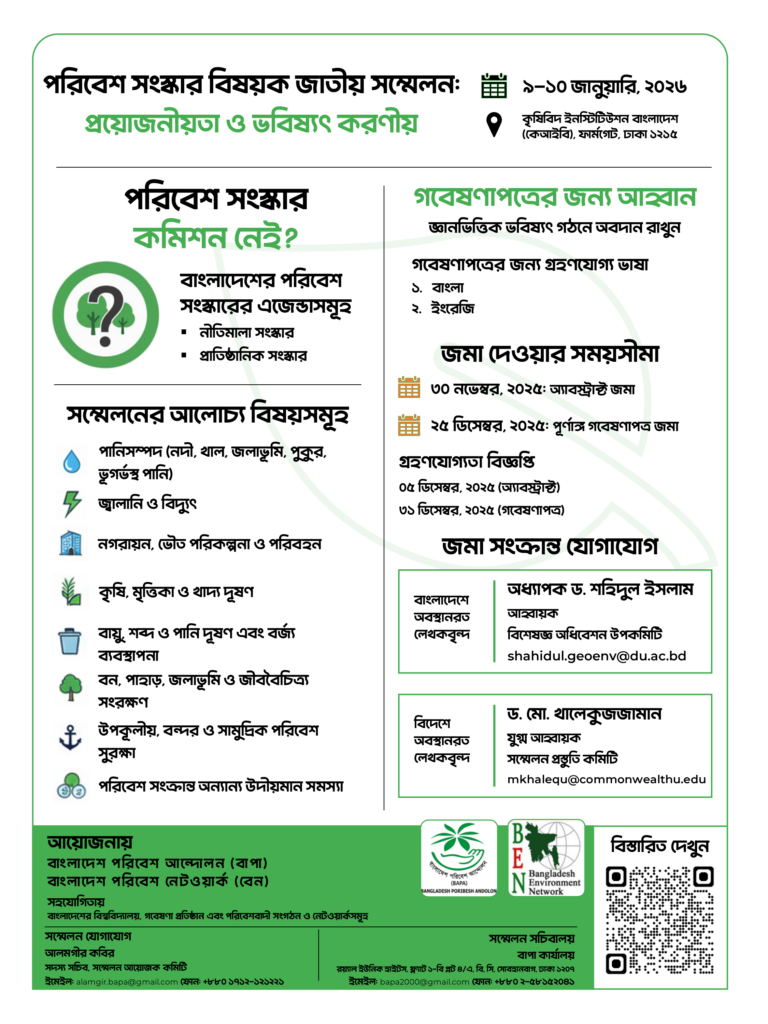
In a decisive move to address the critical gap in national environmental governance, the Bangladesh Poribesh Andolon (BAPA) and the Bangladesh Environment Network (BEN) have announced a comprehensive two-day national conference titled “Environmental Reforms: Necessity and the Way Forward.” Scheduled to take place on January 9–10, 2026, at the Krishibid Institution Bangladesh (KIB) in Dhaka, the conference aims to formulate a people-led, knowledge-based blueprint for reform. The organizers highlighted that while the Interim Government has established various reform commissions for other sectors, the absence of a dedicated Environmental Reform Commission has left the country without a comprehensive assessment or a future roadmap for ecological sustainability. This initiative is rendered even more urgent by the upcoming national election in February, as BAPA and BEN seek to ensure that environmental issues are prioritized in political party manifestos with clear commitments to resolving key crises.
The conference is predicated on the understanding that addressing Bangladesh’s accumulated environmental problems requires a fundamental paradigm shift rather than piecemeal efforts. BAPA and BEN argue that reforms must proceed along two interlinked paths: policy reforms and institutional reforms. This dual necessity is vividly illustrated by the management of water resources, where environmental groups have long advocated replacing the “embankment (cordon) approach” with an “open approach”. A recent success was the removal of the sluice gate at the mouth of the Baral River, a move that rejuvenated the river and restored flow from the Ganges into the Chalan Beel area after four decades of stagnation. However, the persistence of some officials within the Water Development Board to reinstall such gates demonstrates that policy changes are insufficient without reforming the incentive structures of the institutions themselves.
A similar systemic failure plagues the energy and power sectors, where flawed planning has led to economic and ecological liabilities. Despite advocacy for renewable energy, the government’s Power System Master Plan pushed to increase coal’s share in the energy mix to 40% by 2030, resulting in massive overcapacity and reliance on imported electricity while renewable energy achievement remains below 1%. To address these challenges, the conference will cover a broad spectrum of topics, including water resources, energy, urbanization, biodiversity, and pollution. Consistent with their tradition of maintaining independence and integrity, BAPA and BEN have confirmed that this event will be organized without any government or foreign donor funding.

