


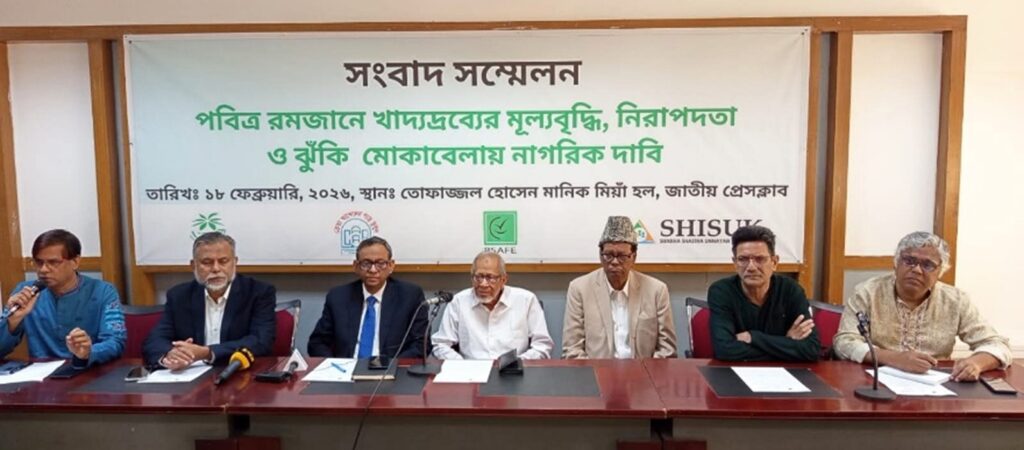
Ahead of the holy month of Ramadan, environmental and consumer rights organizations have put forward a 15-point civic demand to control the unbridled price hike of essential food items, ensure food safety, and mitigate health risks. They stated that ordinary citizens will not find relief unless market syndicates are dismantled and exemplary punishments are ensured for food adulterators.
A press conference was organized on this occasion at the Tofazzal Hossain Manik Miah Hall of the Jatiya Press Club in the capital on Wednesday (February 18) afternoon. Bangladesh Paribesh Andolon (BAPA), BSAFE Foundation, Consumers Association of Bangladesh (CAB), and SHISUK jointly organized the event.
Chaired by BAPA President Prof. Nur Mohammad Talukder and moderated by General Secretary Md. Alamgir Kabir, the event began with an introductory speech by SHISUK Executive Director Shakiul Millat Morshed. The keynote presentation was delivered by Ataur Rahman Miton, Executive Director of Bikoshito Bangladesh Foundation.
In his speech, Shakiul Millat Morshed said, “The new government’s first responsibility should be controlling commodity prices during Ramadan and ensuring the supply of adulteration-free, safe food at affordable prices. A country where street food is safe stays ahead in terms of development.” He cited market syndicates and bureaucratic complications as the primary challenges.
In the keynote presentation, Ataur Rahman Miton stated, “Declaring food security is meaningless without ensuring food safety and nutritional value. According to the Safe Food Act 2013, effective coordination must be strengthened among the 22 ministries and divisions involved in food management.” He called for strengthening the activities of the Bangladesh Food Safety Authority to ensure food safety from production to the consumer level.
CAB President A.H.M. Shafiquzzaman referred to the challenge of market monitoring and dismantling syndicates as an ‘acid test’ for the government, stating, “Ethical accountability and action must be ensured against those involved in food adulteration and unreasonable price hikes.”
BSAFE Foundation General Secretary Rezaul Karim Siddique urged the initiation of good practices by supplying safe food starting from Ramadan. Additionally, CAB General Secretary Humayun Kabir demanded ensuring the proper supply of imported food items and taking action against dishonest businessmen and corrupt officials.
Among others present at the press conference were BAPA Vice President Mahidul Haq Khan, Treasurer Md. Aminur Rasul, and Organizing Secretary Mihir Biswas.
The 15 Demands Raised at the Press Conference:
- Creating a supportive environment for safe and nutritious food from producers to consumers, and establishing a “Safe Farmer’s Market” in every market.
- Ensuring strict monitoring to control artificial crises, hoarding, and syndicates of food products.
- Providing special incentives for safe food producers and marketers.
- Ensuring accountability and compliance with health guidelines for all in accordance with the Safe Food Act.
- Taking strict legal action against unsafe water, ice, and unauthorized food coloring.
- Completely banning the sale of chemically ripened fruits, artificially colored food, stale/rotten items, and uncovered open food.
- Activating the central safe food management coordination committee and forming market-based civic monitoring committees.
- Introducing a “Safe Food” seal for consumer convenience.
- Strengthening regular market monitoring and mobile courts to ensure evidence-based exemplary punishment.
- Visibly displaying the expiration dates and nutritional values of food products.
- Banning the use of hazardous pesticides in agriculture and transitioning to safe alternatives.
- Establishing a special fund for food safety research.
- Launching a single-window digital food business registration and licensing portal.
- Enforcing strict surveillance to ensure mandatory compliance with health guidelines in preparing and selling Iftar items during Ramadan.
- Raising nationwide public awareness year-round by engaging mass media and social media, rather than relying solely on project-based initiatives.

