


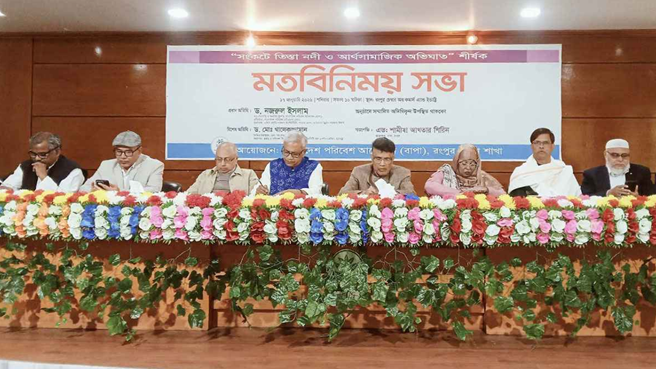
In mid-January 2026, BAPA organized citizens’ exchange meetings in two key river zones, reflecting its integrated approach to river protection. On January 17 in Rangpur, discussions centered on the controversial Teesta River Master Plan, while a January 15 meeting in Charghat focused on Baral River restoration. These parallel deliberations brought environmental activists, scientists, and policymakers into critical engagement with state strategies, Chinese infrastructure investment, and transboundary water politics.
The Rangpur citizens’ meeting, held at the Rangpur Chamber of Commerce Auditorium and presided over by BAPA Rangpur District Convener Shamima Akhter, gathered Dr. Nazrul Islam, Dr. Md. Khalequzzaman, national BAPA leadership, and local business representatives. The discussion centered on the proposed Teesta River Comprehensive Management and Restoration Project, known as the Teesta River Comprehensive Management and Recovery Plan, valued at approximately 12,000 crore Taka (about $1.4 billion USD). About 6,700 crore Taka ($800 million USD) of this comprises high-interest loans from China’s POWERCHINA. The plan envisions dredging 140 million cubic meters of sediment, reclaiming 171 square kilometers of land, repairing and constructing over 230 kilometers of embankments, and building 224 kilometers of roads with 82 jetties.
In his keynote address, Dr. Nazrul Islam outlined a paradoxical position: while recognizing the Teesta basin sustains nearly twenty million lives, he expressed grave reservations about the Master Plan’s technical feasibility. He acknowledged the interim government provides a rare opportunity to address river degradation but warned that a hasty, technically questionable megaproject risks irreversible ecological damage. He directly challenged the plan’s core premise of narrowing the river by a quarter, asking: “If constricted this severely, it might handle winter flow, but how will it contain the massive flow or flash floods during the monsoon?” This critique underscores that constricting a braided, sediment-heavy river into a narrow channel contradicts fluvial dynamics and risks catastrophic monsoon breaches. Dr. Islam further critiqued the plan’s financial structure, opposing high-interest loans for a technically uncertain project. He challenged policymakers: “This money has to be repaid by the people of Bangladesh… Before buying a project worth 12,000 crore taka, shouldn’t you verify if it will truly be useful?” This emphasized that large investments require independent verification and public consultation, not technocratic imposition. While affirming that action on the Teesta crisis is a “demand of the time,” Islam’s stance embodies a paradox of urgency and caution. It reflects BAPA’s position that while the crisis is real and demands intervention, the specific megaproject remains scientifically questionable and politically non-transparent.
In his special guest address, Dr. Md. Khalequzzaman emphasized that river erosion and dry-season scarcity stem fundamentally from India’s unilateral upstream withdrawal at the Gazaldoba barrage, not domestic engineering gaps. He argued that focusing solely on channel modification ignores this root cause of transboundary hydrological control. He advocated for Bangladesh to sign the UN Watercourses Convention and pursue international mediation, positioning transboundary negotiation as the strategic priority over domestic mega-engineering. Dr. Khalequzzaman also criticized the Master Plan’s land reclamation for industrialization, questioning, “How will you build industries on land recovered from the river? … You might hope to get your land back, but it will likely be given to industrialists.” He stated his support for development and investment in Rangpur but saw “no reason to destroy the Teesta for it.” This reflects BAPA’s analysis that such projects often benefit corporate interests over riparian communities, turning infrastructure into a mechanism for wealth extraction at the expense of rural populations.

