


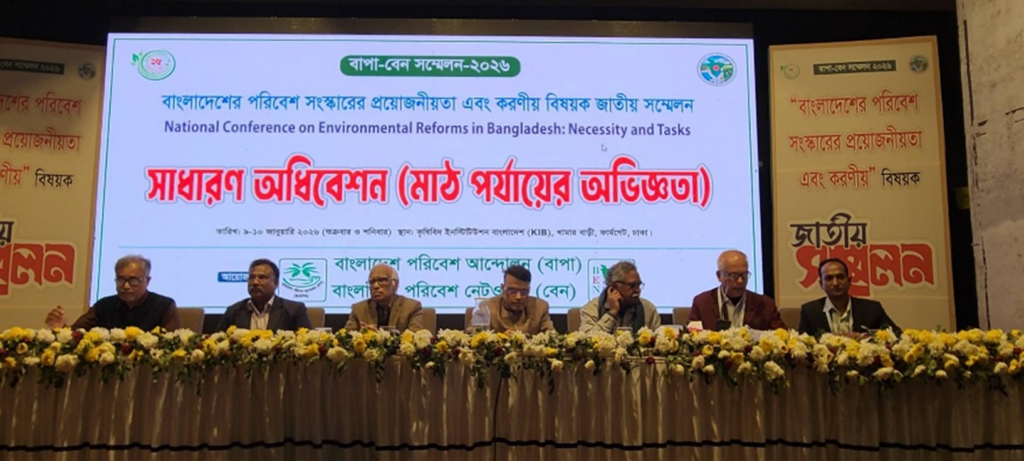
The two-day conference on “National Conference on Environmental Reforms in Bangladesh: Necessity and Tasks” concluded in Dhaka, serving less as a traditional academic gathering and more as an emergency triage for Bangladesh’s fracturing urban ecosystem. Held on January 9–10, the event bridged the gap between rigorous peer-reviewed research and the visceral realities of grassroots activism. From the chaotic “mixed traffic” on the streets to the criminalization of citizens fighting for playgrounds, the discussions revealed a system in collapse. While technical sessions dissected failures in water management, transport, and energy policy, the overarching sentiment was that these are not merely engineering failures but symptoms of a deep “political deficit.”
Following the opening ceremony, the conference proceeded through a structured dual-format program designed to reflect BAPA-BEN’s core commitment: integrating scientific expertise with community-based activism to acknowledge that effective environmental governance is inseparable from the experiences of the most ecologically vulnerable populations.
Day 1: Joint session 1 (A)
January 9 | 11:00 AM – 12:45 PM
The proceedings began with a somber opening plenary chaired by Mohammad Ejaz, Administrator (DNCC); Co-chaired by Professor Mahbubur Rahman (NSU); Coordinated by session organizer Samad Pradhan (BAPA), the session dispensed with celebratory pleasantries and immediately framed the conference as a critical intervention into the country’s “Physical Planning” disconnect.
Four keynotes laid the technical and policy foundation:
- Professor Md. Khalequzzaman presented ” Water Resources in Bangladesh: Needs for Reforms in Policy and Management.” He systematically examined the implementation gap in water legislation, highlighting how institutional fragmentation between agencies like the Water Development Board and the Ministry of Water Resources leads to contradictory and often damaging interventions. He argued that without a unified command structure, piecemeal legislative tweaks would remain ineffective.
- Professor M. Feroze Ahmed presented a chilling analysis in ” Water Pollution and Waste Management.” He described a “toxicity transfer” mechanism where pollution is simply moved from one medium to another—specifically, contaminated water being thrown directly into nature without filtration, allowing toxicity to enter the food chain. He emphasized that current frameworks are hindered by inadequate monitoring and that effective management requires upstream prevention and circular economy models rather than just end-of-pipe treatment.
- Professor Ahmad Kamruzzaman Majumder presented ” Towards Cleaner Cities: A Reform Framework for Air, Noise and Visual Pollution Governance.” Identifying Dhaka’s air pollution as a public health emergency, he attributed the crisis to a lack of integrated zoning, vehicular emissions, and brick kilns. His framework advocated for participatory citizen monitoring and strict industrial zoning.
- Professor M. Shahidul Islam presented ” Sustainable Management of Coastal and Marine Environment of Bangladesh: From Policy to Action.” He warned of irreversible thresholds in coastal mangrove loss due to illegal aquaculture and climate-driven sea-level rise, stressing that coastal governance requires frameworks that acknowledge competing livelihood pressures.
- Professor Mohammad Zashim Uddin presented ” Plant Diversity Management in Bangladesh: A Lesson from University of Dhaka Campus ” using the University of Dhaka as a case study to demonstrate that systematic biodiversity conservation is possible even within urban institutional spaces.
The session was further enriched by insights from designated discussants, including Malik Fida A Khan, Abdus Salam, Hossain Azam, and Haseeb Irfanullah.
Day 1: Joint Session 1 (B) | Expert Session 1
January 9 | 2:00 PM – 3:30 PM
- Water Resources (Rivers, Canals, Wetlands, Ponds, Groundwater) Chaired by Nasim Akhtar (DUET); Co-chaired by Nazmul Islam (PUST); Coordinated by Humayun Kabir Sumon (BAPA), During this session, the impact of urban development on riverbank changes of the Balu River was assessed and predicted using remote sensing and CA–Markov modeling. It was discussed how water can be protected and fish populations revived through an integrated approach to Haor conservation. The socio-economic impacts of riverbank erosion among char dwellers at Sariakandi in Bogura District were also examined. Additionally, the management of Bangladesh-India trans-boundary rivers was discussed, specifically regarding existing barriers and the way forward. The session included an assessment of river encroachment and its environmental impacts within the Chiknai River Basin. Post-flood settlement, built-up regeneration, and surface water dynamics in Tanguar Haor, Sunamganj, were also analyzed based on MNDBI and MNDWI data from 2016 to 2024. The discussion further explored the “Heterogeneous Traffic Mix” beyond simple traffic volume. It was discussed that the sharing of lanes by private cars, buses, and rickshaws forces the network to default to the speed of the slowest vehicle, leading to a loss of operational discipline. The social cost of this planning failure was addressed, characterized as a “terrifying transformation” where the city consumes its own livability. The criminalization of civic activism was also discussed, highlighting cases where mothers face jail time for demanding playgrounds, suggesting that urban planning has become a tool of oppression against the youth.
- Air, Sound, And Water Pollution; Waste Management Chaired by Mohammad Zainal Abedin (B-Safe); Co-chaired by Sheikh Rokon (Riverine People); Coordinated by Mohammad Jahangir Alam (BARCIK), During this session, an assessment of the efficiency of an Effluent Treatment Plant was discussed through a case study, while lead in paint was identified as a hidden threat in Bangladesh. Panelists reached a consensus that Effluent Treatment Plants (ETP) in industrial zones are largely non-functional, with industries treating local water bodies as open dumping grounds. Beyond the leather industry, environmental degradation in Bangladesh’s tannery zone was evaluated, specifically focusing on a case study of Hemayetpur, Savar. The session connected technical pollution science with occupational health, emphasizing that environmental protection is inseparable from worker safety, particularly regarding lead exposure in paints and chemical exposure in tanneries. Industrial pollution and governance failures in the Turag River were assessed to find pathways for regulatory reform and sustainable management. A waste-to-value approach was discussed to reduce petroleum-based plastic pollution in Bangladesh by converting lignocellulosic corn fiber into compostable PLA. Additionally, e-waste management in Bangladesh was analyzed by evaluating environmental-economic impacts and identifying policy gaps. Finally, the environmental distribution of biofilm-forming Escherichia Coli associated with plastic surface materials was discussed.
- Forests, Hills, Wetlands, and Biodiversity Conservation Chaired by Md. Atiar Rahman (RUET); Co-chaired by Mohammad Rezwanul Haque (NSTU); Coordinated by Shah Israt Ajmeri (Children Watch Foundation), Focusing on the degradation of critical biomes like Chalan Beel and the Sundarbans, this session framed ecosystem-based adaptation as essential for the million’s dependent on forest resources. During the session, a community-based assessment was discussed regarding the perceived biodiversity loss in the Chalanbeel wetland ecosystem. The practice of fishing through poisoning in the Sundarbans was analyzed as a significant threat to the diversity and sustainability of aquatic ecosystems. A nature-based solution to eutrophication and invasive water hyacinth was discussed, specifically through the implementation of integrated floating vegetable gardens combined with fish culture. Ecosystem-based adaptation strategies were explored for enhancing resilience in the Sundarbans. Additionally, the session included an assessment of community-based conservation needs and management measures for the Khailshagari Fish Sanctuary in the Chalan Beel region.
- Coastal, Port, And Marine Environment Protection Chaired by Mustafizur Rahman (CPD); Co-chaired by Mst. Marjina Begum (RU); Coordinated by Kalim Ullah (Cox’s Bazar, BAPA), This session examined livelihood threats in Chandpur, dune stabilization, and the impacts of mangrove crab farming and port activities in Chittagong. During the session, a comprehensive analysis of the state of the environment in Chandpur District (Town) was discussed. The dune systems of coastal Bangladesh were investigated using Unmanned Aerial Vehicles (UAV), specifically through a case study conducted at Sonadia Island. Crab farming was discussed as a climate change adaptation approach in Shyamnagar, coastal Bangladesh. From a geoarchaeological perspective, climate change and human response during the last thousand years in the Bengal Basin were analyzed. The session also addressed the government decision to lease out three container terminals at the Chittagong Seaport and the probable consequences of that action. Finally, pathways for sustainable marine environments in Bangladesh were discussed, focusing on port-centric pollution mitigation.
Day 1: Parallel Expert Session 2 | Expert Session 2
January 9 | 4:00 PM – 5:30 PM
- Urbanization, Physical Planning, and Transportation Chaired by Mosud Mannan (Ex-Ambassador); Co-chaired by Mohidul Haque Khan (BAPA); Coordinated by Shamima Mahbub Doly (BAPA), During this session, presenters synthesized scholarly analysis with grassroots data to cover several critical aspects of urban and rural development. The need for EIA-driven planning reforms in Bangladesh was discussed, specifically focusing on Dhaka-centric urbanization and its associated policy gaps. Trends and drivers behind the decline of urban biodiversity in Bangladesh were analyzed, alongside an evaluation of conservation needs. The session explored urbanization, transport dynamics, and mobility planning within the country. Additionally, eco-friendly local building materials were analyzed for their potential to mitigate heat stress in Northern Bangladesh. Finally, the prioritization of environmental issues in industrial management was discussed, citing evidence from Green Textile Limited.
- Agriculture, Soil, and Food Contamination Chaired by Md. Azizur Rahman (BAU); Co-chaired by Faridul Islam (BAPA); Coordinated by Matin Saikat (BAPA), During this session, experts highlighted how heavy metal contamination from industrial sources is threatening food safety and market access, placing agriculture within broader sustainability frameworks. The discussion addressed the environmental, health, and institutional challenges facing modern agriculture at a crossroads. The influence of irrigation pump types on heavy metal contamination in rice and the resulting health risks in Southwestern Bangladesh were analyzed. Furthermore, sustainable environmental governance was discussed as a means of tackling emerging contaminants in the agroecosystem of Bangladesh. The session also explored scoping strategies for enhancing food safety within the horticultural value chain of the country.
- Energy and Power Chaired by Badrul Imam (DU); Co-chaired by Aminur Rasul (BAPA); Coordinated by Ahsan Roni (BAPA), Discussions advocated for a just transition from thermal power to renewables, focusing on solar irrigation and policy reforms to protect workers during the transition. During this session, the opportunities and challenges of solar pump-based irrigation were discussed through a case study of Chithulia Union, Kushtia. The impact of sustainable energy on international trade from a Bangladesh perspective was analyzed. To ensure efficient energy management, time series-based electricity demand forecasting was discussed. Furthermore, the session addressed the reform of Bangladesh’s energy governance, specifically focusing on a gender-responsive, decentralized renewable pathway for environmental transformation.
- Forests, Hills, Wetlands, and Biodiversity Conservation Chaired by M.M. Akash (DU); Co-chaired by Kazi Md. Fazlul Haque (DU); Coordinated by Hasan Yousuf Khan (BAPA), This session addressed the rising threat of environmental carcinogenesis and ecotoxicity, linking biological protection directly to human health. During the discussion, the relationship between environmental xenobiotics and carcinogenesis in a changing world was analyzed. A spatio-temporal assessment of above-ground biomass changes in relation to vegetation cover in Sharsha Upazila, Jashore, was presented. The session also examined the ecotoxicity of Alpha-cypermethrin, Chlorpyrifos, and Imidacloprid to non-target freshwater crustaceans and the resulting implications for rice-field biodiversity. Finally, a spatial and biophysical assessment was discussed regarding the decline of water quality in the rapidly urbanizing watersheds of Dhaka.
Day 2: Joint session 1
January 10 | 9:30 AM – 11:00 AM
The second day opened with a critique of national master plans, chaired by Nazrul Islam (CUS); Co-chaired by Zakir Hossain (BAPA); Coordinated by Javed Jahan (BAPA).
- Md. Shahriar Ahmed Chowdhury presented “Bangladesh Power and Energy Sector Reform: Necessity and Way Forward” which provided a critical assessment of the coal-focused Master Plan, documenting massive economic losses from thermal overcapacity.
- Architect Iqbal Habib presented “Urban Transformation Through Reforms: Rethinking Urbanism, Countrywide Physical Planning and Public Transportation” which analyzed Dhaka’s excessive centralization, arguing for decentralized urbanization and integrated regional planning to reduce environmental stress.
- Md. Shah Kamal Khan presented ” Policy and Institutional Reformation in Agriculture for Reducing Contamination in Crop Production, Soil, and Food in Bangladesh” which advocated for integrated pest management and soil restoration to combat pesticide contamination.
- AKM Shakil Newaz presented “Earthquake Threats in Bangladesh: Vulnerability Assessment and Strategic Pathways to Resilience” which assessed earthquake vulnerability, reinforcing the sentiment that the Bangladesh National Building Code (BNBC) is systematically violated by powerful developers.
The session was further enriched by insights from designated discussants, including Ahmed Badruzzaman, Adil Mohammad Khan, Zainul Abedin, and Md. Zillur Rahman.
Day 2: Parallel Session 3 | Expert Session 3
January 9 | 11:30 PM – 1:00 PM
- Mix Session (Virtual) Chaired by Md. Khalequzzaman (BEN); Co-chaired by Humayun Kabir Sumon (BAPA); Coordinated by Sahariar Kabir Nion (BEN), During this session, discussing energy independence and transboundary water conflicts, pathways for renewable integration and lessons from global leaders were analyzed to advance energy independence in Bangladesh. The politics of precarity in India–Bangladesh transboundary water conflicts were discussed, moving from themes of hydro-hegemony to hydro-coercion. A framework for environmental action in rapidly developing nations was proposed, shifting the focus from simple compliance to restoration. The session also examined coastal sedimentation and accretion trends along the Bangladesh coast from 2013 to 2025. Institutional and policy pathways toward sustainability were analyzed through the lens of reforming environmental governance. Additionally, gaps and deficiencies in the national solid waste management system were assessed, alongside carbon emission inventory and mitigation pathways specifically for Dhaka. Finally, hydro-chemical stress in coastal canals was discussed within the context of accelerated industrial development.
- Air, Sound, and Water Pollution and Waste Management Chaired by Md. Samsuddoha (CPRD); Co-chaired by Shahriar Hossain (ESDO); Coordinated by Titli Naznin (BAPA), During this session, discussions advanced the analysis of pollution to include emerging threats like microplastics and the effectiveness of noise policy. A comparative analysis was discussed regarding air pollution control policies in Bangladesh relative to those in the USA, Japan, China, and South Korea. The impact of land use on particulate matter ($PM_{2.5}$ and $PM_{10}$), humidity, and human health within a Metro-Rail environment was analyzed. Additionally, the session included an assessment of noise pollution levels in the recreational areas of Dhaka City. The discussion also addressed the Greenhouse Gas (GHG) emission inventory in Bangladesh’s agricultural sector, specifically assessing carbon dioxide emissions from urea fertilization and proposing sustainable reforms. Physicochemical and microbial risks associated with Public Water Points (PWPS) in Kushtia Municipality were analyzed for their implications on public health and community practices. Finally, the variability of microplastics due to tidal influences was discussed.
- Disasters, Climate Change, and Others Chaired by Md. Niamul Naser (DU); Co-chaired by Gaus Piary (WBB); Coordinated by Shakil Kabir (BAPA), During this session, the discussion focused on exploring nanoparticle health impacts and e-waste regulation. The scopes and potentialities of nanoparticles in plant disease management in Bangladesh were analyzed. The importance and necessity of environmental education at the secondary level for sustainable development were discussed from a Bangladesh perspective. The session addressed the integration of trade, logistics, and environmental sustainability in Bangladesh and beyond. Visual representations of environmental vulnerability among young Bangladeshi children were also analyzed to understand how the earth is seen through their eyes. Additionally, a comprehensive assessment of public water points in Kushtia Municipality was discussed, specifically focusing on water quality, health risks, and community perceptions. Finally, sustainable e-waste regulation was explored, drawing lessons for Bangladesh from Japan.
- Water Resources (Rivers, Canals, Wetlands, Ponds, Groundwater) Chaired by Md. Tofazzal Islam (GAU); Co-chaired by Shahnaz Husne Jahan (ULAB); Coordinated by Monsefa Tripti (BAPA), Providing a rigorous analysis of the Teesta River crisis and Arial Beel restoration, this session linked hydrology directly to policy failure. Lithological and geotechnical controls on meander stability were discussed, specifically providing evidence from the Madhumati and Brahmaputra Rivers. A geo-environmental analysis was analyzed regarding the anthropogenic impact and ecological challenges facing the Arial Beel. The environmental crisis and restoration of the Teesta River were also discussed. Additionally, the session included an assessment of the condition of local small water bodies in Bangladesh, with evidence drawn from Katakhali Khal and Bil Surjo Nodi in Sirajganj. Finally, the management of water resources at the Bhitargarh Ancient City was analyzed.
Day 2: Parallel Session 4 | Expert Session 4
January 10 | 2:00 PM – 3:30 PM
- Urbanization, Physical Planning, and Transportation Chaired by Adil Mohammad Khan (JU); Co-chaired by Halim Dad Khan (BAPA); Coordinated by Ziaur Rahman (BAPA), During this session, several critical urban challenges were discussed through technical and social lenses. The pollutant influx in urban environments was analyzed using a proxy-based approach to better understand contamination sources. The relationship between urban heat and human health was explored, emphasizing the need for designing and reforming climate-resilient cities in an increasingly warming world. Strategies for water urbanism, described as “weaving the blue network,” were discussed as a pathway toward urban resilience. Additionally, the session included an evaluation of the sanitation service chain in Dhaka City’s slums, specifically focusing on gender issues. Finally, agricultural yield trends in Bangladesh were analyzed as evidence of the environmental pressures caused by a changing climate.
- Climate Change and Others Chaired by Mahmadul Islam Selim (Teesta Forum); Co-chaired by Mahmuda Parvin (Stamford University Bangladesh); Coordinated by Saiful Islam Jewel (BAPA), During this session, climate mobility and marginal lives in Tahirpur were analyzed within the context of transnational distress and environmental disasters. The effects of climatic variability shifts on tea cultivation were assessed, specifically through a case study on Tetulia Upazila of Panchagarh District in Northern Bangladesh. Loss and damage in the Bangladesh aquaculture sector due to extreme temperatures and erratic rainfall were discussed, alongside policy and institutional pathways for strengthening climate change education as a core component of environmental reform. The capacity and limits of civil society in Bangladesh were evaluated regarding their role in environmental reform in the absence of a formal commission. Additionally, vulnerability and risk associated with lightning disasters in Bangladesh were assessed through the application of the Pressure and Release (PAR) model. Finally, the session included a water quality assessment of the Buriganga River based on autumn season analysis.
- Water Resources (Rivers, Canals, Wetlands, Ponds, Groundwater) Chaired by Kazi Matin Uddin Ahmed (DU); Co-chaired by Hasan Yousuf Khan (BAPA); Coordinated by Abu Bakar Siddik (Maheshkhali, BAPA), During this session, several critical water resource challenges were discussed through technical assessments and environmental modeling. Rainfall trends in Eastern Bangladesh from 1991 to 2020 were analyzed using non-parametric methods to understand changing precipitation patterns. The impacts of tourism in Tanguar Haor were discussed, leading to specific recommendations for its sustainable management. A comprehensive review of water quality status across Bangladesh was analyzed alongside existing regulatory gaps to identify areas for policy reform. The session also included a detailed assessment of the physicochemical and biological parameters of Gulshan Lake in Dhaka City. The spatiotemporal dynamics of Jamuna River migration were discussed, specifically regarding its impact on flood risk and land use, with projections provided through 2034. Finally, the session analyzed how Rohingya refugee-induced land use changes have impacted surface runoff dynamics in Cox’s Bazar using an integrated machine learning and remote sensing approach.
- Agriculture, Soil, and Food Contamination Chaired by Lutfur Rahman (BA); Co-chaired by Mihir Biswas (BAPA); Coordinated by Khondokar Azizul Haque Moni (BAPA), During this session, critical intersections between agro-chemical usage and public health were analyzed to identify pathways for systemic reform. Discussions addressed food safety in Bangladesh, specifically focusing on agro-chemical contamination, regulatory gaps, and the necessity for environmental reform. Challenges in environment-friendly agricultural practices were identified, alongside recommendations for realistic and followable solutions to overcome these barriers. The session highlighted the reforming of food safety as a “silent emergency” within the country. Technical assessments included an analysis of the in vitro antibacterial activity of different nanoparticles on bacteria associated with rice plants. Additionally, the effects of various weed management practices at different growth stages of Boro Rice (Oryza sativa L.) were discussed.
Day 2: General Session 4
January 10 | 4:00 PM – 5:30 PM
The heart of the conference was the General Session on grassroots movements, chaired by Professor Anu Muhammad (JU) and facilitated by Dr. Nazrul Islam (BEN). This session featured nine specific movements that crystallized the struggle for environmental justice:
- Baral River Protection: S. M. Mizanur Rahman documented a two-decade struggle against sluice gates (constructed in 1985) that killed the river. Despite a 2019 High Court ruling, institutional reluctance persists.
- Karatoya River Restoration: Ziaur Rahman focused on the fight against upstream Indian withdrawal and downstream embankments, calling for dike removal and natural flood management.
- Arial Beel Protection: M. Shahidul Islam described the fight against illegal aquaculture, restrictive polders, and industrial encroachment in southern wetlands.
- Old Dhaka Environment: Javed Jahan advocated for the just relocation of polluting chemical industries to save the Buriganga River and protect public health.
- Harina Beel (Mymensingh): Rakibul Hasan Nayan detailed resistance against drainage for aquaculture and rice farming, promoting wetland protection legislation.
- Bhabadaha Waterlogging: Azizul Haque Moni addressed the crisis of waterlogging caused by restrictive polders and inadequate drainage, calling for agricultural adaptation.
- Buri Teesta Protection: Faridul Islam Farid highlighted the drying of this crucial river due to channel constriction and upstream withdrawal.
- Rajshahi Air Pollution: Jamat Khan documented pollution sources from brick kilns and vehicles, advocating for cleaner technologies.
- Cox’s Bazar Environment: Kalim Ullah addressed severe ecological stress from tourism, refugee settlements, and industry.
Day 2: Conference Adoption Proposal Session
January 10 | 5:30 PM – 6:15 PM
The conference concluded with a synthesis session chaired by Dr. Nazrul Islam and moderated by Alamgir Kabir. Consolidated findings were presented by Md. Khalequzzaman, Md. Shahidul Islam, and Zakir Hossain.
The final verdict was that technical solutions for all discussed problems exist, but their implementation is stalled by the political economy. Speakers argued that urbanization is fundamentally a “political question,” asserting that without political ownership of the planning process, no amount of engineering will fix Dhaka.
The conference adopted a unified set of resolutions to be presented to political parties ahead of the February 2026 national elections:
- Establishment of an Environmental Reform Commission.
- Comprehensive water resource management, including transboundary negotiations.
- A decisive energy transition to renewables.
- Mitigation of agricultural contamination through integrated pest management.
- Segregation of traffic to break the urban deadlock.
- Implementation of just transition mechanisms to protect workers while enforcing pollution control.
The event ended with a clear message: the environmental crisis is a governance crisis, and reform is the only path forward. Read the full report here.

