


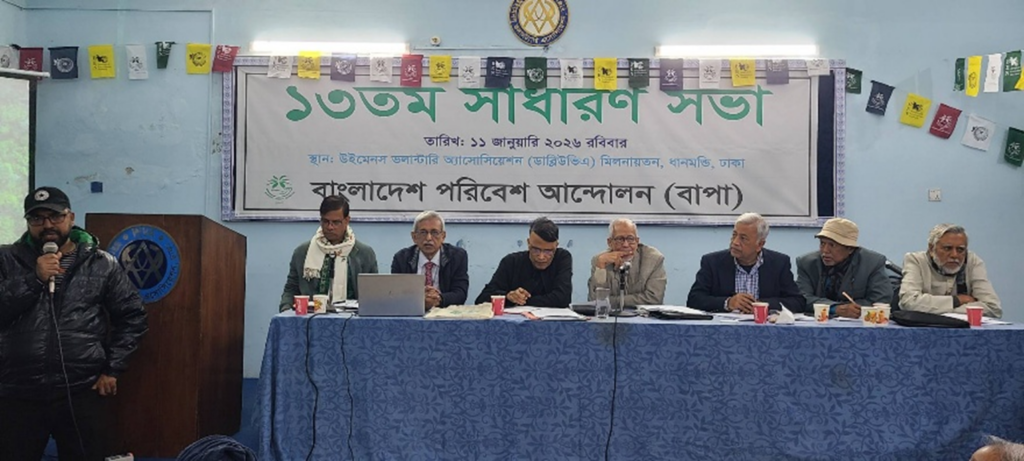
The Bangladesh Poribesh Andolon (BAPA) convened its 13th General Meeting on January 11, 2026, at the WVA Auditorium in Dhaka, bringing together activists, scientists, and policymakers to address the severe coastal crisis. Presided over by President Professor Nur Mohammad Talukder, the meeting articulated an 11-point demand directed at all political parties ahead of the February 2026 national election. This intervention positions coastal protection as a central, non-negotiable electoral and governance priority, insisting that environmental protection must be a core component of party manifestos and constitutional responsibilities.
Nikhil Chandra Bhadra, Coordinator of the Sundarbans and Coastal Protection Movement, presented the formal proposal. He established the meeting’s premise: Bangladesh’s southwestern coast faces an unprecedented crisis driven by climate disasters, salinity intrusion, embankment failures, and livelihood collapse, causing mass displacement. Although responsible for only 0.4 percent of global emissions, highlighting the injustice, the region bears disproportionate costs. Over the past two decades, climate change has increased coastal disasters tenfold, creating crises in livelihoods, food, water, and shelter. The meeting emphasized that without urgent political commitment and national action, the crisis will become irreversible, posing an existential threat to millions and undermining the country’s ecological sustainability.
Speeches by BAPA and BEN leadership synthesized scientific evidence, policy analysis, and grassroots testimony, diagnosing the coastal crisis as a result of institutional failure and political neglect, not inevitable natural forces. This could be reversed through determined intervention. The meeting crystallized an 11-point agenda demanding the declaration of coastal regions as legally protected climate-vulnerable special areas, the allocation of a dedicated national budget for coastal protection and livelihood resilience, the establishment of permanent mechanisms for salinity control and safe drinking water, the conversion of every coastal household into a disaster-resistant shelter, and the representation of affected coastal populations in all decision-making. Further demands include implementing effective protective measures for the Sundarbans as a critical ecological bulwark, protecting rivers and water bodies from encroachment, pollution, and siltation, creating extensive green belts through large-scale coastal afforestation, constructing durable, sustainable embankments and repairing existing infrastructure, promoting agricultural development and alternative livelihoods, and establishing a statutory Coastal Development Board for comprehensive, cross-sectoral governance.

