


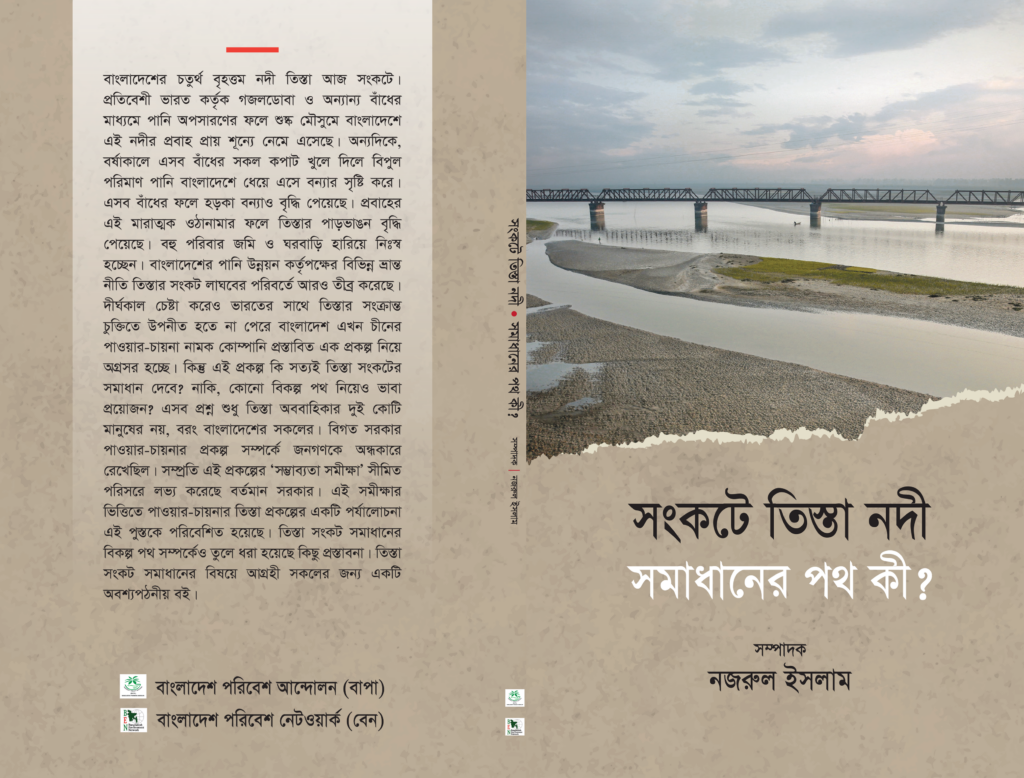
The complex hydro-political crisis engulfing the Teesta River has received a comprehensive analytical treatment in the newly released volume, “Teesta River in Crisis: What is the Path to Solution?” (Songkote Teesta Nodi: Somadhaner Poth Ki?). Edited by Dr. Nazrul Islam in association with Dr. M. Khalequzzaman and Faridul Islam Farid, the publication emerges as a critical intervention against the backdrop of the controversial “Teesta River Comprehensive Management and Restoration Project.” Published by the Bangladesh Poribesh Andolon (BAPA) and the Bangladesh Environment Network (BEN), the anthology challenges the prevailing “commercial approach” to river management, advocating instead for a paradigm shift toward transparency and nature-based solutions.
Tracing the trajectory of Bangladesh’s river protection movements—from the seminal “Save Buriganga Movement” of 1999 to the historic 2019 High Court verdict recognizing rivers as living entities—the book contextualizes the current Teesta standoff within a broader struggle for ecological justice. It articulates the philosophical evolution spearheaded by BAPA and BEN: a decisive rejection of the “Cordon Approach,” characterized by restrictive embankments, in favor of an “Open Approach” that respects the country’s unique deltaic landscape. This theoretical foundation serves as the lens through which the contributors critique the Power China project, a 1,200 crore Taka engineering endeavor that had previously been shrouded in bureaucratic secrecy under the former administration.
The volume systematically dissects what the editors term the “Triple Problem” of the Teesta: acute dry-season water scarcity, devastating monsoon floods, and the severe distortion of the river channel through erosion, widening, and sedimentation. The authors argue that these hydrological pathologies are inextricably linked to “Triple Causes,” identifying them as the unilateral diversion of flow by India, the implementation of flawed domestic policies, and the accelerating impacts of climate change. The collection warns that the proposed infrastructure-heavy interventions, now under consideration by the interim government following the limited release of a feasibility study, may fail to address these root causes, potentially rendering the massive financial investment a futile exercise in fighting geological forces.
Beyond a technical review of the Preliminary Development Project Proposal (PDPP), the book compiles rigorous research articles exploring the requisite framework for a functional water-sharing treaty, the applicability of Chinese river management experiences to the Bengal Delta, and the historical narratives of the local riverbank communities. By bringing these diverse perspectives into the public domain, the editors aim to disrupt the opacity that has historically plagued the project. The publication serves as both a critique and a roadmap, urging policymakers to subject the Power China proposal to rigorous, independent scrutiny before committing to a path that risks irreversible ecological consequences and economic waste.

